A hardware startup can carry its future in a box. Hamed Hanafi did, hauling a respiratory-device prototype between laboratories on Halifax’s hills. His company, NovaResp, needed equipment, engineering colleagues and somewhere to turn research into a business. At Dalhousie University’s Emera ideaHUB, those needs had an address. The attraction was wonderfully tangible: people who could help build the thing, with tools close enough to use.
That is the proposition behind this university-operated incubator on the downtown Sexton Campus. It serves founders developing physical products, where a convincing presentation still leaves plenty of work for the soldering iron. Its territory stretches across medical devices, ocean technology, clean technology and robotics. The common denominator is an engineering problem standing between an idea and a product somebody can try.
The HUB combines workspace, prototyping facilities, venture coaching and access to university expertise. For an early-stage company, that combination can shorten the distance between a question and an experiment. Its most useful output is evidence: a working prototype, feedback from a potential customer, or a better reason to change the design before committing to production.
A $10 million vote for the workbench
The project’s origins are institutional. In November 2016, Dalhousie announced a $10 million contribution from energy company Emera to create the ideaHUB. The ambition was to keep more of the region’s inventions moving toward commercial use, with students, researchers and businesses sharing engineering infrastructure. Dalhousie supplied the university setting; corporate and private philanthropy helped make the incubator possible.
The dates need a little care. Dalhousie describes the HUB as established in 2018, the year the larger campus redevelopment was completed. Its official opening celebration took place in April 2019. The original Bridge residency welcomed seven companies, including Graphite Innovation and Technologies, which was developing protective ship coatings, and Aurea, which was working on a small wind turbine for charging USB devices.
The HUB sat within a $64 million redevelopment of Sexton Campus. That figure covered the wider IDEA Project, including two new buildings and renovations. It was never a startup financing round. Private donors Mickey MacDonald and John Risley also contributed a combined $2.5 million to the HUB. Those distinctions matter: a building budget, an incubator donation and a founder’s materials allowance pay for different things.
Separate commitments, separate purposes. These are support for the institution and its programs, not equity rounds.
Three doors, depending on what you have built
The entry point can be modest. The current ideaDESIGN page describes three sessions devoted to testing assumptions and defining product features. It welcomes Dalhousie students and the wider Halifax community. Graduates can apply for up to six months of access to coworking space, labs and 3D printers. Its June 2026 offering even included dinner and a $150 gift certificate for completing all three sessions. Entrepreneurship occasionally comes with supper.
For teams ready to build, ideaBUILD packages a 10-month program around an operational prototype. It offers a $10,000 materials grant, a 12-week bootcamp, engineering support and two Prototype Days for feedback. The ideal applicant has already done some customer discovery and has a reasonably defined product idea. A Dalhousie affiliation is unnecessary; the program invites founders from Nova Scotia and Atlantic Canada.
ideaBRIDGE is further along the road. Its residency lasts up to two years and targets incorporated ventures with a working prototype, prospective customer pilots and six to 12 months of financial runway. Residents receive workstations, benches, laboratory access and a venture coach. The intended next steps include pilots, fundraising, manufacturing and launch. An alumni affiliate option allows graduates to return for occasional support.
Different entry points, not an automatic promotion ladder.
There is also a separate student doorway. The IDEA MakerSpace offers Dalhousie students free access to its space, equipment and a range of materials. Its tools include a laser cutter, 3D printers, woodworking equipment and soldering facilities. Student staff and volunteers help visitors learn. The space excludes curricular projects, giving personal experiments and extracurricular making some room of their own.
The expensive part is learning what to change
Look at the facilities and the practical logic emerges. The mechanical assembly lab has hand tools, measuring equipment and small fabrication machinery. The electronics lab lists oscilloscopes, soldering stations and a circuit-board printer. Additive manufacturing equipment lets teams test plastic components before committing to production. These resources support repeated adjustments to a product whose first version is unlikely to settle every question.
Access has boundaries. The facilities page distinguishes the HUB’s prototyping rooms from first-floor engineering shops, where students and startups can commission work on a fee-for-service basis, subject to availability. A founder should therefore identify the actual process needed for the next prototype. “Access to engineering facilities” is a useful starting point, but it does not mean every machine is available for unrestricted use.
The expertise is deliberately mixed. The current team page lists Talis Apud-Martinez as director, Clif Johnston as academic director and Lauren Ramey as engineering lead. Its advisers span venture development, industrial design and engineering. Ben Bschaden, a Bridge alumnus and GiBLI Tech co-founder, now coaches founders. Industrial designer Glen Hougan brings attention to users and product form. A technically successful object still has to make sense in somebody’s hands.
That blend also explains the culture the HUB is trying to create. A 2022 leadership profile described plans to complement founders’ technical abilities with mentor training and interpersonal skills through MindFrame Connect. The underlying recognition was sensible: assembling a company requires more than assembling its device. A shared workshop becomes more useful when founders can ask each other difficult questions and make good use of advice.
A box, a breathing problem and a bigger team
NovaResp makes the model concrete. Hanafi’s research in respiratory mechanics developed into work on predictive technology for respiratory assistance. The company’s account links his motivation to his father’s difficulty using a prescribed CPAP device. The first obstacle in that story was adoption: a treatment could exist and still be something a person resisted using.
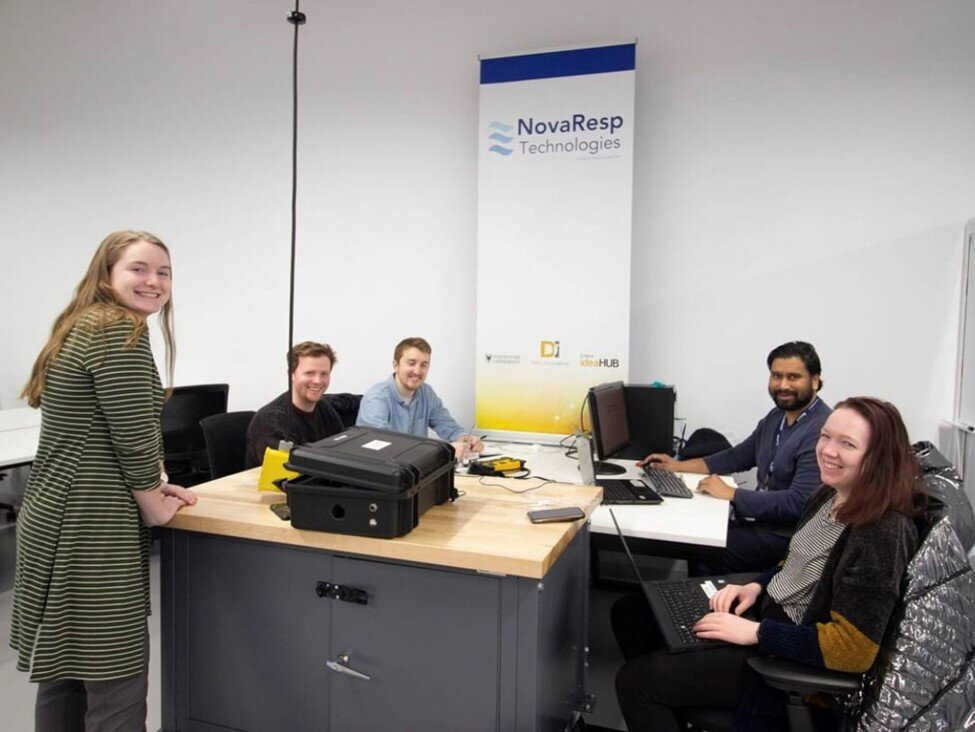
By May 2021, the HUB reported that NovaResp had graduated, employed more than eight people and moved into office and laboratory space at Innovacorp. Access to equipment and nearby research facilities helped it validate a prototype and obtain data for financing. The account also features Ramey, then an engineering co-op student working on mechanical development. Her appearance on today’s HUB staff page is a pleasing return visit.
“It’s a team, and together we all come up with better and better ideas.”
Hamed Hanafi · NovaResp founder · 2021
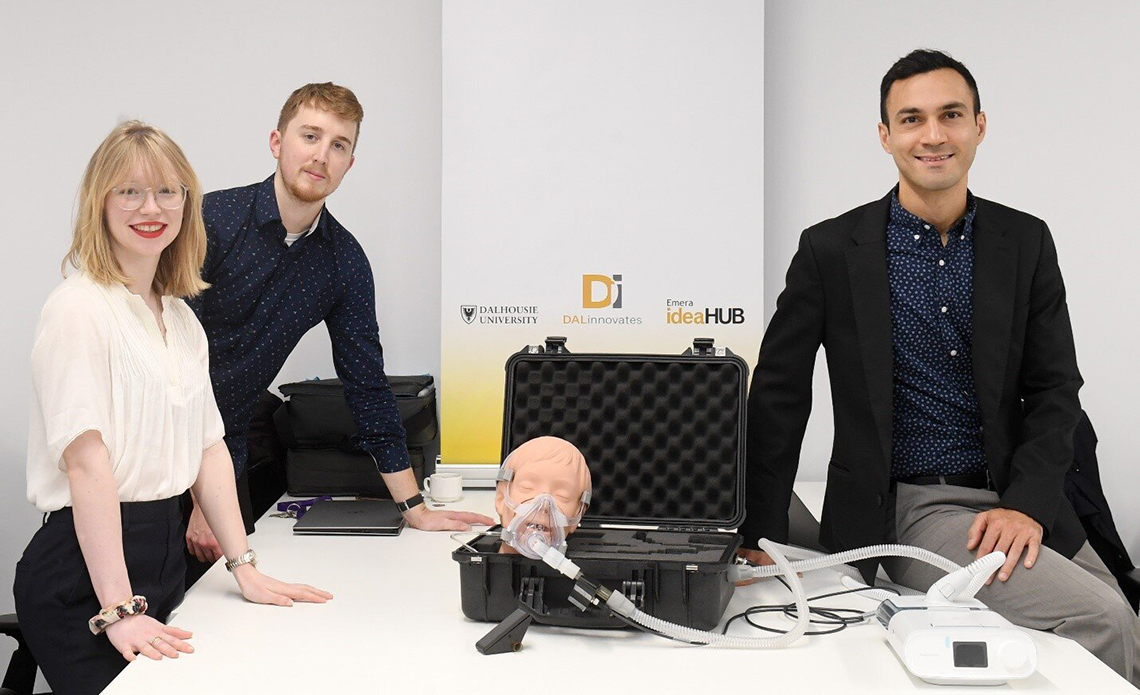
The distinction between a prototype and a business runs through the example. Equipment enabled testing; colleagues enabled more work; the resulting evidence supported the next move. For founders elsewhere, the repeatable lesson is to organize support around the next question that needs answering. A workspace earns its keep when it helps a team complete that experiment.
The bicycle was carrying another business
Zen offers a different lesson: sometimes the product changes the company’s mind. Ravi Kempaiah developed an e-bike prototype during a residency at the ideaHUB. He also participated in Dal Innovates’ Lab2Market Launch program. Mentors in that wider network encouraged him to examine whether the battery technology had a larger opportunity than the bicycle surrounding it.
A January 2025 Dal Innovates account describes the resulting shift toward supplying batteries for two- and three-wheel electric vehicles. It also records $100,000 in Sustainable Development Technology Canada funding and production space supplied by Invest Nova Scotia. Those were supports for Zen, distinct from the HUB’s own funding. The story belongs to several organizations working with one founder.
What changed was the commercial frame. A component developed for one finished product could potentially serve other manufacturers. For another founder, that suggests a useful exercise: list which parts of the prototype a customer values, then ask whether any of those parts could have customers of their own. Building can reveal an opportunity that the original business plan hid.
Public money buys another cohort
In May 2024, Nova Scotia announced $650,000 to expand ideaBUILD over three years, adding a spring intake and supporting up to 20 startups annually. Biomedical technology was a particular priority. The expansion connected product development to a regional policy objective: helping health and life-science ventures make progress inside Nova Scotia.
Dalhousie’s report that month counted 148 startups supported, 571 jobs reported by those companies and $7.7 million in research-and-development partnerships. It also reported that 85 percent of participants remained operating more than a year after their program or residency. These are dated institutional results, not a forecast for an applicant. Staying open is a useful milestone; it is different from proving profitability.
The program continues to recruit. The published fall 2026 ideaBUILD schedule ran applications through August 31, with the program scheduled for October 2026 through August 2027. Its pitch remains specific: help founders produce an operational prototype. The expansion adds capacity to that task rather than changing the basic reason the HUB exists.
A good fit has something left to prove
Within Atlantic Canada’s startup network, the HUB occupies the physical-product development stage. Its partners include Volta, Enginuity and Dal Innovates. Founders may also encounter programs such as Lab2Market for commercialization training or Creative Destruction Lab for seed-stage venture development. These relationships can be sequential or overlapping; the hardware bench is the HUB’s particular contribution.
The model fits founders who need repeated engineering work, can engage with advisers and have enough time and resources to use the support. A software-only business would have less use for its fabrication equipment. A venture seeking immediate volume production would need to plan beyond a prototyping lab. The published Bridge requirements make financial runway a condition of the ideal applicant, even with facilities available.
For a prospective participant, the useful preparation is concrete: bring a defined product problem, evidence from prospective users and a clear account of what the next prototype must demonstrate. The HUB’s promise is credible at that scale. A founder arrives with something unresolved. The workshop gives that question a place to meet the real world.
Visit the workshop, follow the work
WATCH · FROM THE 2019 OPENING REPORT