An investor can learn something by stepping onto a buoy. In May 2025, Oneka Technologies shared photographs of Mario Venditti and fellow Innovobot co-founders Danny Grant and Marc Schmidt visiting its demonstration site in Fort Pierce, Florida. The visitors got aboard an Iceberg-class buoy. Their portfolio company was turning the motion of ocean waves into freshwater. A business proposition had acquired a deck you could stand on.
The visit offers a useful opening to Venditti’s working life. He is the Montreal-based CEO and founding partner of Innovobot, where venture investment sits alongside an engineering studio. His career has repeatedly taken him into the space between a promising technology and the organisation required to sell and deliver it. That space contains fewer lightning bolts than the usual innovation imagery suggests. It contains suppliers, customers, technical decisions and people who need to agree on what happens next.
It is tempting to describe an investor by the companies in a portfolio. Venditti’s earlier jobs offer another way in. Before he helped finance young businesses, he worked inside businesses that had to operate. The distinction gives his current role its texture. An idea can attract attention in an afternoon. The company around it may demand years.
The forty-country apprenticeship
Venditti’s education crosses three disciplines: engineering, physics and management. He studied engineering at McGill, completed a master’s in physics at Concordia and returned to McGill for an MBA. On a résumé, these appear as credentials. In the context of his career, they also mark three different questions: how something works, why it works and how to organise a business around it.
His early professional record includes consulting at KOM International and services leadership at TradeMerit. He subsequently became chief operating officer of Above Security. That job put business development, service delivery and technology development within his responsibilities. It required attention to what customers received, as well as what the company intended to build.
During his tenure, Above Security expanded internationally, including acquisitions in Switzerland and Winnipeg. By 2015, the business served customers in more than 40 countries, with security operations centres in Canada, Mexico and Switzerland. Hitachi Systems announced its acquisition that August, with completion planned for October. The purchaser wanted to combine Above Security’s capabilities with its own international business.
Above Security’s customer footprint in 2015, during Venditti’s time as COO.
A footprint that large gives the word “growth” some practical weight. Each additional customer has to receive a service. Acquisitions have to become working relationships. A global sales strategy has to connect with the capacity to deliver. Venditti’s experience was in that connective tissue, where the organisation’s ambitions encounter the organisation’s calendar.
The acquisition supplied a visible result. His responsibilities supply the more revealing detail. They help explain why his later investment platform would place so much emphasis on engineering and commercial execution. He had already worked where those functions met.
Concrete makes the question heavier
CarbiCrete brought a different kind of technology into Venditti’s orbit. Its origins were in McGill research by Mehrdad Mahoutian under professor Yixin Shao. Mahoutian investigated materials that could react with carbon dioxide to make construction products. Steel slag, an industrial by-product, became the replacement for cement in the process.
Mahoutian and cleantech entrepreneur Chris Stern teamed up with marketing professional Yuri Mytko and Venditti to form the company. Venditti became its COO. Innovobot also provided funding. Here, the connection between operating and investing was particularly close: a company in which he had worked became part of the platform’s investment story.
The technology uses carbon dioxide in curing and retains it in the resulting concrete products. Its route to market included an industrial pilot with Quebec manufacturer Patio Drummond, followed by commercial product availability in September 2023. A laboratory result had to become something a manufacturer could produce.
Concrete is an accommodating subject for grand metaphors, but the business question is unusually literal. Can the process become a product? Can that product enter an established industry? Can a company organise the transition? Venditti’s place in the founding team puts him close to those questions, rather than safely above them in an investment presentation.
A workshop beside the fund
At Innovobot, the organisational answer has two connected parts. Innovobot Resonance Ventures, or IRV, backs early-stage deep-tech companies. Innovobot Labs works on designing, developing and commercialising technologies with clients ranging from startups to large corporations. Capital and technical help sit within the same platform, giving founders more than one way to engage.
The areas of work include robotics, artificial intelligence, embedded systems, human-machine interfaces and advanced materials. That range makes the engineering studio relevant to quite different businesses. It also makes the people around Venditti part of the story. His founding partner Danny Grant brings technology leadership; the platform combines operators, engineers and investment professionals.
One earlier investment, Heyday, developed conversational AI for customer messaging. Hootsuite bought the Montreal company for CA$60 million in August 2021. Innovobot had been an investor, and Venditti publicly congratulated the Heyday team. The acquisition gives the investment record a specific outcome, without turning a company’s purchase price into a claim about any individual investor’s return.
The Labs offer a different view of the work. In January 2023, Innovobot Labs and tactile-sensing company Peratech announced FusionPad for presentation at CES. The trackpad combined force sensing with applied haptics, allowing interactions beyond a single click. Its announced design also considered integration with existing engineering tools and supply chains.
That last detail is easily overshadowed by the clever part of the product. Yet integration is where a new component acquires a chance of being used. A notebook maker needs something that fits its engineering process. A supplier needs something it can produce. A satisfying click has a surprisingly extensive supporting cast.
Venditti had already explored the question of financing and resources in a 2020 podcast conversation with Fadi Albatal. The episode considered building companies and whether conventional venture capital uses those resources efficiently. The subject predates the platform’s recent expansion. It suggests that the relationship between money and practical assistance has been a recurring business concern.
An investor steps onto a buoy
Innovobot announced its IRV investment in Oneka in December 2024. The Sherbrooke company uses wave energy for seawater desalination, addressing freshwater supply for coastal communities and industries. The investment announcement paired funding with technical expertise and collaboration, particularly around systems and manufacturing.
“We look forward to supporting their growth and contributing to the development of the blue economy,” Venditti said. He also serves on Oneka’s board. The relationship therefore reaches beyond the funding announcement into governance and company development.
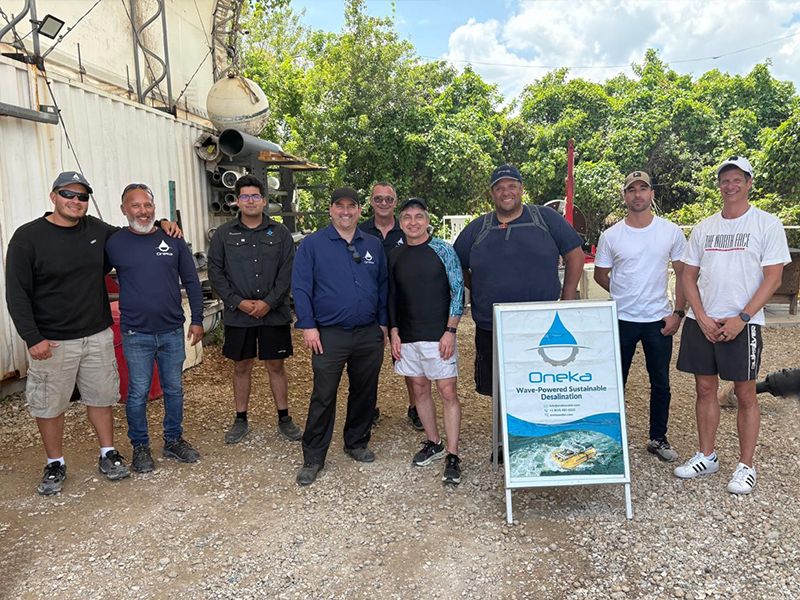
The Florida visit is a modest but telling episode. Investors and engineers were standing in the same place, beside the company’s equipment. It would be easy to embroider the scene with an invented conversation or a revelation at sea. The documented visit is interesting enough: the technology could be encountered in use, beyond a diagram or a financial model.
A buoy also reminds a reader that “deep tech” can mean a physical object with a demanding environment around it. The distance between demonstration and wider deployment includes engineering and commercial work. In Venditti’s career, that distance keeps reappearing in different forms.
When the plan meets the balance sheet
Investors encounter constraints of their own. In 2025, IRV reset its strategy after raising much less than its intended CA$40 million. Neha Khera arrived as managing partner, with Venditti and Grant supporting as general partners. The fund moved toward earlier investments and a structure suited to the capital available.
“Neha’s job is to turn IRV into a platform for early-stage investment in technology in Canada.”
Mario Venditti, April 2025
Venditti’s stated ambition was a continuing investment platform. The episode gives the profile a necessary complication. A business devoted to helping founders execute also has to adjust its own organisation when assumptions change. The arithmetic reaches the investor’s desk, too.
Aviation, California and the next laboratory
By February 2026, Innovobot’s expansion included two acquisitions. Voler Systems brought a Silicon Valley engineering business specialising in embedded systems and connected products into the platform, establishing the Labs’ U.S. division. The geography widened, along with the engineering capacity.
Inflight Canada brought aircraft cabin systems and passenger experience work. Announced on February 16, the acquisition followed several years of collaboration between the companies. It coincided with Inflight Canada’s fiftieth anniversary. This chapter concerns an established business as well as young ventures, extending the platform’s work into products and systems already serving an industry.
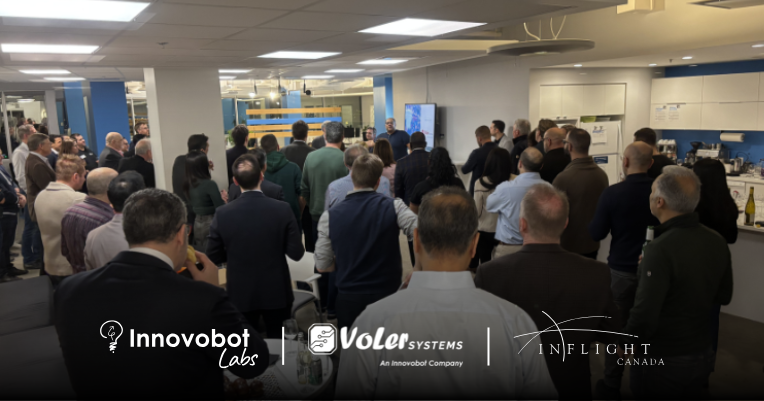
In July, IRV announced agreements with Concordia, TransferTech Sherbrooke, Manitoba, McMaster and Saskatchewan, building on its McGill relationship. These university connections give the investment platform routes toward researchers and founding teams early in company development. They also bring Venditti’s story back toward the laboratory origins that feature in CarbiCrete’s history.
Read together, these episodes suggest a consistent interest in the work surrounding technology. Venditti has moved among services, materials, investment and engineering, while repeatedly confronting the same practical problem: an invention needs a company capable of carrying it forward.
The ocean buoy supplies a pleasingly concrete ending. The idea has left the slide. People can visit it, examine it and climb aboard. Between that moment and a lasting business remains a great deal of work. Across his career, Mario Venditti has kept placing himself near that work.