Troy Stovall has an engineer’s remedy for a founder who cannot stop perfecting an idea: let somebody use it. Years before he led TEDCO, a mentor gave him a lesson about software. “The whole point of version one is to get to version two.” The advice has survived a career involving university budgets, investment decisions and Maryland’s efforts to turn research into companies.
It is a forgiving idea with a demanding sequel. An imperfect beginning gets permission to exist. Then comes the obligation to listen. For Stovall, now the chief executive of the Maryland Technology Development Corporation, the person’s capacity to learn matters because the original plan may need considerable editing. A pitch deck can be revised. Teaching its owner to accept the revision takes more work.
The engineer who kept changing classrooms
His professional name is Troy A. LeMaile-Stovall. His education began with electrical engineering at Southern Methodist University, where he graduated cum laude. He earned a computer science master’s at Stanford as a Bell Labs One Year on Campus Fellow, then an MBA at Harvard Business School, graduating in 1994. Circuits, software, business: three ways of asking whether something will work.
His early employers included Rockwell International, AT&T Bell Labs, Southwestern Bell Telephone and McKinsey. The technical background gives his language about versions a literal history. He has done the work that precedes the metaphor.
Then came investment management and entrepreneurship. He co-founded GulfSouth Capital, the family investment and venture capital office associated with SkyTel founder John N. Palmer, and became its first president and CEO. He also founded management consulting firms. By the time TEDCO hired him, his experience included being responsible for both an organization’s plans and the machinery needed to carry them out.
Universities supplied another classroom. Stovall served as senior vice president and chief financial officer at Jackson State, executive vice president and chief operating officer at Howard, and chief operating officer at the University of the District of Columbia. At Jackson State, he received the Thurgood Marshall HBCU CFO of the Year award. These roles put him inside institutions where resources must serve people with very different responsibilities.
Houston, before the boardroom
He grew up in Houston, including South Park and Sunnyside, and attended Catholic school. In his account, his mother supplied a rule that would outlast every subsequent job title: make a difference for someone. Since he could never know which person would be the one, the responsibility extended to everyone he encountered.
His recollections of St. Thomas High School include becoming its first Black student body president. After the election, he says, the principal reported objections from alumni and asked him to step down. Stovall declined, delivered the customary morning prayer, and remembers that the subject never came up again. It is an early example of the composure he describes bringing to leadership.
He can also tell a less dignified travel story. On the drive to Stanford, his old car broke down near Denver. The repair estimate exceeded its value. An SMU connection at a dealership and confirmation of his Bell Labs fellowship helped him arrange a replacement. Even the journey to a computer science degree required a human introduction.
Houston gave him another set of lessons. He has written about watching the energy industry’s cycles and about the distance between values a company announces and behavior it permits. His reflections on Enron examine that distance. An impressive list of principles provides little protection if the people in charge do something else.
That concern would become part of his work at TEDCO. The question follows naturally from the institutions in his career: what does an organization owe the people who rely on it, especially when making the right decision is inconvenient?
A lighthouse with an operating budget
TEDCO announced his appointment in July 2020, effective September 7. He arrived with a background that crossed the agency’s concerns: technology, capital, institutional management and access to opportunity. He also arrived with an exercise for the leadership team. Before starting, he asked colleagues to write about the organization’s core values.
The writing continued across the staff. Accountability, collaboration, integrity, respect and stewardship became subjects people had to explain in their own terms. In a 2023 reflection, Stovall said their adoption and expression by colleagues were what made him proud of his first years at TEDCO.
He uses a lighthouse to describe what values do. The image allows for an awkward route and difficult conditions. It puts responsibility on the navigator, too. Someone still has to pay attention and decide how to proceed.
That is a useful picture for an organization investing public resources in uncertain businesses. Founders need room to take risks; the institution needs discipline about the risks it supports. Values acquire substance in those decisions, in how colleagues handle disagreement, and in what happens when a promising plan fails to behave as promised.
“I’m a pretty good coach.”
Troy LeMaile-Stovall, on his career triumphs
The art of the handoff
Asked about his career triumphs, Stovall has pointed to watching colleagues become better people and leaders. Coaching is a thread that connects the changing titles. It is also something he has done outside the office: his biography records coaching a youth robotics team and serving as a certified swimming official.
His sporting vocabulary reaches the workplace. A former track athlete, he has compared TEDCO’s role to a relay exchange, where runners have to coordinate the handoff. Individual speed does not settle the outcome if the baton goes astray. The comparison directs attention to the space between institutions, where an entrepreneur can otherwise lose time finding the next person who can help.
TEDCO’s support includes routes for founders who need help improving a pitch or business model, even when an investment application is declined. In that approach, feedback has a practical destination. Someone can leave a difficult conversation with a next step.
Stovall also has an eye for the overlooked participant. In describing economic empowerment, he has discussed the second employee, the person who joins a founder and helps build the enterprise. The founder may get the photograph. The company still needs someone to do the next job.
Four S’s, one Maryland
For a wider view of his thinking, follow his fondness for alliteration. Stitching means connecting the people and institutions already present. Scaling concerns their ability to grow. Storytelling makes the results visible. Stickiness gives companies reasons to stay where they began.
That last word is unusually tactile for economic policy. It places the emphasis on what a founder can actually use: employees, customers, capital and relationships. A company has reasons to remain in a state when those things are available and continue to improve as the business grows.
Stovall has made the point that Maryland should build around its own assets. He has also argued for leaders to follow one another when a shared effort needs coordination. Everyone leading simultaneously can become a rather crowded procession.
HIS FOUR S’S
- 01StitchConnect people and institutions
- 02ScaleHelp companies grow
- 03StoryShow what the work produces
- 04StickGive companies reasons to stay
A framework for action, rather than a forecast of returns.
Harvard’s 2025 account of his work describes TEDCO as preparing entrepreneurs for institutional capital. Stovall jokes that they may encounter their most agreeable venture investor there. The humor has a serious job: preparation includes helping a founder become ready for the scrutiny that follows.
The activity has a measurable scale. TEDCO’s fiscal 2025 report records 37 direct investments and $14.4 million deployed, following review of 301 applications. Those are organizational figures. They also show why connecting the right person with the right support needs a process, rather than depending on the chief executive remembering every conversation.
TEDCO investment activity · Fiscal year 2025
A wider door, a longer reach
His interest in access has a concrete expression in BRIDGE, TEDCO’s Business Resource Information, Development, and Guidance Ecosystem program. Supported by a three-year, $10 million federal grant, it extends assistance to businesses beyond the organization’s traditional technology focus, including retail, hospitality and professional services.
The practical offerings include advising, legal assistance and help with back-office functions. For a small business, those tasks can consume the hours supposedly reserved for running it. An idea may be ready for a customer while the owner is still trying to untangle a contract or organize the accounts.
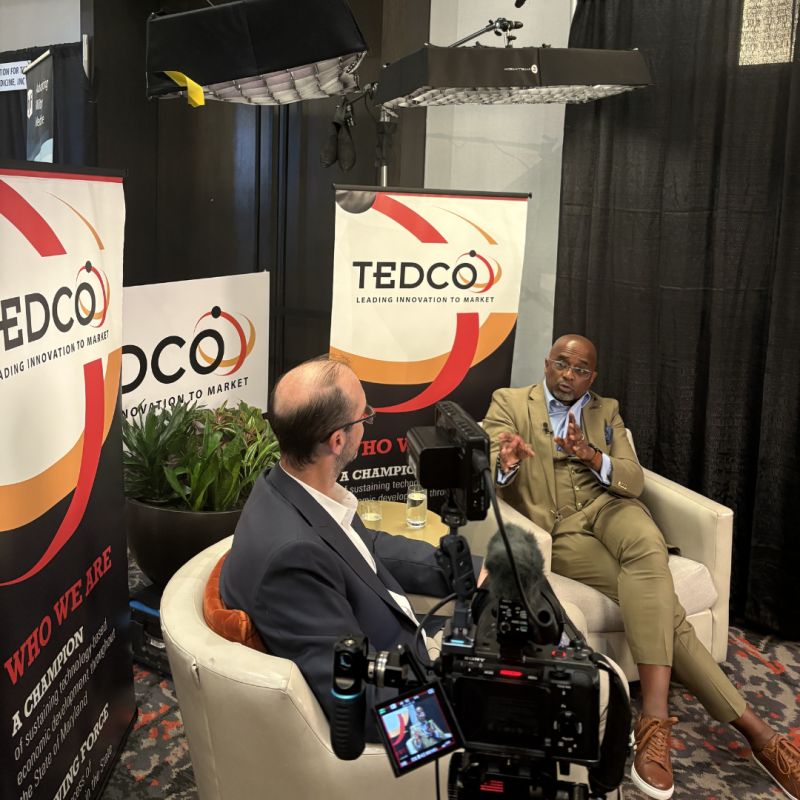
The same concern with useful access appears in TEDCO’s international work. Its 2025 Expo brought agreements involving Taiwan, South Korea and Jordan. The Taiwan arrangement enabled up to $50 million in investment capital through TAIIDA and SFIC Group. The stated purpose included talent connections and continuing collaboration across borders.
In the Expo conversation published in March 2026, Stovall described support that includes customers, talent and a game plan. He treats a company’s development as a journey with detours. An overseas connection can be part of that journey; so can a local adviser who helps a founder reconsider the route.
His questions about measurement extend the argument. He has asked whether economic development should pay more attention to capital that would otherwise never arrive and talent that would otherwise leave. Counting activity is relatively straightforward. Judging what changed because people worked together asks more of the people doing the counting.
The next version is a team effort
Stovall’s February 2026 message returns to teams, their obstacles and their endings. He discusses how a group resets after a challenge and how a completed task leads to a transition. Success creates another organizational question: who carries the work forward?
That is consistent with the career that brought him here. Engineering supplies the habit of testing. Investment asks which people and plans deserve backing. University operations add the obligation to make systems useful to others. Coaching connects the three.
In September 2026, The Daily Record named him among Maryland’s Most Admired CEOs for a second time, following his 2022 recognition. The honor adds a dated milestone to the biography. The more revealing measure in his own accounts remains the progress of other people.
His mother’s instruction survives in that attention to the next person. A founder needs an introduction. A colleague needs room to lead. An early product needs a customer willing to try it. For Troy Stovall, the second attempt begins when someone has enough support, and enough honesty, to learn from the first.
More of the conversation
Read, watch and follow.
Troy’s website ↗Troy on LinkedIn ↗TEDCO biography ↗Watch the 2025 Expo interview ▶TEDCO Talks on YouTube ▶Harvard: Doing Well and Doing Good ↗A conversation with Adam Bryant and Rhonda Morris ↗Troy’s writing on organizational values ↗Listen: Maryland’s connections to the world ↗September 2026 recognition ↗