Nikhil Sinha's favorite memory of graduate school happened below ground. In the basement of Penn's Annenberg School, he and his fellow students spent evenings talking. The conversations had range and depth, he recalled decades later, and they helped form him as both a scholar and a professional. It is a modest scene to place at the beginning of an executive story: no ringing bell, no term sheet, no product launch. Just people in a room, taking ideas seriously.
Yet the basement contains a useful key. Sinha's career has crossed more institutional borders than most: communication research, university teaching, payments and outsourcing, venture capital, online education, university building and startup support. His résumé can read like a stack of passports. Look closer and the stamps resolve into one itinerary. Again and again, he has worked on systems that move knowledge, opportunity and people toward one another.
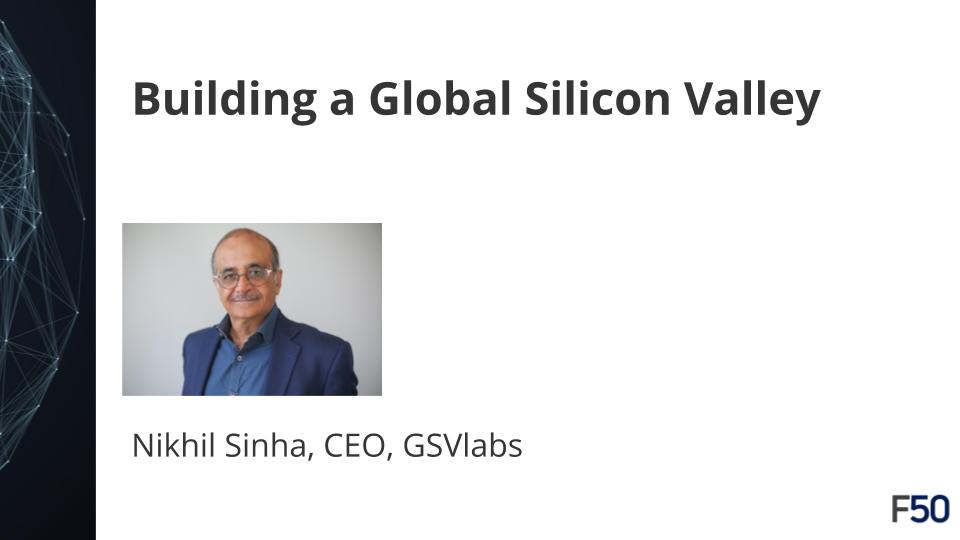
Today he is chief executive of OneValley, the San Mateo company formerly known as GSVlabs. The company describes itself as a global entrepreneurship platform, with programs, tools, funding access and networks for founders. It reports that it has supported more than 10,000 startups and that those founders have raised more than $2 billion. The figures are corporate measures, but the animating question behind them is older than the company: why does promising talent so often begin life far from the resources that would make it productive?
The scholar studies the pipes
Sinha began with English literature at St. Stephen's College in Delhi, graduating in 1982. He later earned master's and doctoral degrees at Annenberg. His 1991 dissertation, “Choices and Consequences,” examined telecommunications policy in developing countries. That subject now sounds like a preview. Communication networks are never merely wires and switches. They decide who speaks, who receives, who pays and who waits.
After the Ph.D., he joined the Department of Radio-Television-Film at the University of Texas at Austin as an assistant professor. The department brought cultural studies, media industries, international communication and other traditions into the same intellectual neighborhood. Sinha's own interests centered on political economy and communication policy, but he later said Annenberg's breadth let him work across approaches and serve on doctoral committees outside his specialty. He eventually became associate dean for academic affairs.
“The intellectual rigor of the Annenberg program also served me well once I left academia and began a career in the private sector.”Nikhil Sinha
Leaving academia did not mean leaving the underlying questions. His corporate chapters included senior roles at eFunds, a payment-management company; iDLX Technology Partners; and Silverskills, where he served as president and co-CEO. He later worked as a venture partner at Adams Capital Management. The objects changed from curricula and policy to operations, transactions and investments. The habit of looking at the system survived.
One career, four institutional forms
Building the institution, not merely entering it
In 2011, Sinha took on a different sort of blank page as founding vice-chancellor of Shiv Nadar University in India. A new university asks its early leaders to turn principles into plumbing: academic structures, faculty culture, governance, degrees and the thousands of ordinary decisions that eventually harden into tradition. Sinha led the institution through its first years, remaining until 2015.
The role made literal what his earlier work had studied. A university is an access machine with a soul, or it ought to be. It gathers disciplines, concentrates attention and gives young people permission to attempt difficult things. In Sinha's later account, research universities mattered to innovation because they attract ambitious people, tolerate experiment and place previously unconnected bodies of knowledge within conversational distance.
He has also kept a long tie to Penn. “I never disconnected from Annenberg!” he said, describing visits, alumni panels and nearly two decades on its alumni advisory board. That exclamation point is informative. For an operator concerned with networks, loyalty itself can be infrastructure. The institution keeps changing, the student body turns over, and the relationship remains available for another exchange.
The course escapes the campus
At Coursera, where Sinha held chief content and business roles before continuing as a senior adviser, the access question moved onto a screen. The platform offered courses from universities to learners who did not share their geography. Sinha emphasized mobile use in India, noting in 2017 that 96 percent of courses could be completed entirely on a phone. Offline access, audio and transcripts were not decorative features. They acknowledged the conditions under which a global learner actually learns: an unstable connection, a limited battery, perhaps no laptop at all.
This is the less glamorous side of democratization. Grand promises are easy; data-fetching frameworks are work. Access becomes real only when the product survives the user's circumstances. Coursera also moved into workplace learning, partnering with companies to make training available at scale. Sinha's view was that learning and development had become a competitive necessity, not an ornamental benefit.
When a valuable experience is trapped in a place, identify its essential ingredients. Then rebuild them around the constraints of the person who cannot get there.
Silicon Valley, without the postcode
Sinha joined GSVlabs as chief executive in 2018 and became a partner at Global Silicon Valley. His argument at the time was crisp: “Silicon Valley is more of a mindset than a geographic location.” The line avoids provincial worship, but it does not pretend a mindset is sufficient. Founders need resources, methods, customers, mentors, investors and each other. Talent may be universal; enabling ecosystems are not.
Under Sinha, GSVlabs expanded its Passport platform and later became OneValley. Physical innovation centers in Silicon Valley and Boston had helped local companies. A digital platform could extend parts of that experience to founders in places such as Addis Ababa, Nairobi, Santiago, Lima, Kuala Lumpur and Manila. The aim was not to photocopy Palo Alto. It was to make useful components of an innovation ecosystem travel.
“Being an entrepreneur is a lonely job.”Nikhil Sinha
His prescription for that loneliness is practical. First, connect founders to a dynamic community of peers, including people at a similar stage or in a related market. Second, connect them to customers and market context early. Sinha contrasted day one with day 100, even day 1,000. The timing matters because advice received after a costly detour is philosophy; received before it, the same advice becomes leverage.
OneValley's business has broadened around that logic. Its current offering spans accelerator and incubator programs, startup software discounts, hiring, infrastructure, networks and funding. The company launched a venture fund in 2021. More recently, it has leaned into artificial intelligence: Haystack, built with Seekr, was designed to help startups and smaller businesses navigate business-tool vendors with tailored recommendations. In 2026 the company was publishing field research on the architecture, evaluation and enterprise demands facing early-stage AI companies.
The technology is new; the institutional instinct is familiar. A small company selling into a large enterprise inherits grown-up requirements before it inherits grown-up resources. Explainability, vendor risk, documentation and audit expectations do not shrink to match headcount. Sinha's recent comments on explainable AI return to the same old imbalance: capability is distributed unevenly because the tools of credibility are expensive.
Reinvention with memory
There is a temptation to describe Sinha's career as a sequence of pivots. The word is too neat. A pivot suggests one direction discarded for another. His path looks more cumulative. The communication scholar learned to see networks. The professor learned how disciplines collide. The corporate executive learned operations. The vice-chancellor built an institution. The Coursera leader worked on distribution at digital scale. The investor and ecosystem CEO met founders where theory encounters a payroll.
Each chapter furnished the next with a tool. That is a more generous model of reinvention than the ritual bonfire of one's former identity. You can leave a profession without evicting its questions. You can carry a basement conversation into a boardroom, a dissertation into a platform strategy, a university's multidisciplinary ideal into a founder network.
In 2026, Sinha announced two OneValley leadership appointments: longtime executive Alec Wright as president and chief operating officer, and Seth Hauben as chief growth officer. Both had spent years inside the company. The move placed daily operations and growth with colleagues who knew the institution's culture. For a leader whose work has repeatedly involved building structures that outlast a single moment, continuity is not a dull virtue. It is the point.
The long game, then, is not access as a slogan. It is access built into the pipes: the course that works on a phone, the founder introduced before the wrong hire, the research idea placed near a commercial path, the smaller company given tools to meet a larger customer's standards. Infrastructure is rarely charming. Neither is a basement. Put the right people and possibilities inside, however, and both can become places where distance loses some of its authority.