In March 2015, Jay Krishnan was preparing to return to the United States. He had been working in Bengaluru when a recruitment call interrupted the itinerary. By May, he was presenting a vision to the board of a proposed startup hub in Hyderabad. In July, he moved there. Before the November launch, the incoming chief executive found himself doing a less ceremonial job: helping get the building ready.
A startup hub sounds rather grand until someone has to make it habitable. Krishnan’s early turn as a construction manager gives his career a useful opening scene. The assignment required both a theory of entrepreneurship and somewhere for entrepreneurs to sit. One could make an elegant presentation about the first. The second demanded execution.
The project was T-Hub. Working alongside founder and chief operating officer Srinivas Kollipara, Krishnan became its founding CEO. His intended journey west had become a detour into the practical business of bringing an institution into being.
An engineer learns what survives the lab
Krishnan’s preparation had begun in engineering. He studied at RV College of Engineering, earned a master’s in electrical engineering at the University of Hartford, and later undertook executive management education at IIM Bangalore. The combination matters: a product has to function, and the organization selling it has to function too. Each can fail independently, which is an inconvenient arrangement for anyone fond of tidy plans.
His working life crossed hardware, networking and the Internet of Things. Brooktrout-Cantata, Juniper Networks and Cisco Systems appear along the route. So do startups. His ventures DDI and Radifinity eventually produced exits through intellectual-property and asset sales. A separate startup failed. His present professional biography includes that failure alongside the exits, rather than quietly sweeping it behind the more photogenic outcomes.
That is a useful distinction in a field where the acquisition announcement often becomes the entire autobiography. An exit says something worked well enough for a buyer. A failure leaves a different inventory: assumptions that did not hold, decisions that could not be rescued, and experience that travels to the next job.
- 2015HyderabadFounding CEO, T-Hub
- 2021WaterlooCEO, Accelerator Centre
- 2024India + JapanBeyond Next Ventures
The room needed more than desks
T-Hub was incorporated in 2015 as a nonprofit bringing government, business and academia together. Its institutional design made collaboration part of the operating model. A founder could be close to people with research, commercial experience, money or access to a customer. Proximity was the starting condition; useful work still had to follow.
The early model acquired several working parts. Incubation sat alongside corporate innovation programs and international exchanges. By a February 2019 interview, Krishnan was describing how the corporate accelerator had drawn more than 100 startups from India and abroad. He also described exchanges involving Israel, Australia and the United States. Hyderabad was the base for a network whose usefulness depended on reaching beyond Hyderabad.
A rented desk has an obvious price. An introduction is harder to value until it removes a month of fruitless approaches. That is the quieter proposition behind this kind of institution: help a young company reach someone it would otherwise struggle to meet, then give the relationship a chance to produce something concrete.
A spreadsheet with fewer hiding places
For all the language of innovation, Krishnan has also spent time on the unglamorous question of financial projections. In 2017, he explained two ways to build them: start with the size of a market and work down, or start with the mechanics of the business and work up. His preference was the second.
“It forces the entrepreneur to think,” he said of the bottom-up approach. The attraction is easy to understand. A large market can make almost any tiny percentage look enticing. Working from the business itself requires attention to what is being sold, how it differs, and who is already competing for the customer’s money.
His advice included identifying a value proposition and understanding competition. Those are familiar terms, but they become less comfortable when someone asks for specifics. A projection earns its usefulness by making the assumptions visible. There is considerably less room for magic when the arithmetic has to explain itself.
“It forces the entrepreneur to think.”Jay Krishnan, on bottom-up projections · 2017
The invitation to try again
Failure also appears in the way Krishnan has spoken to founders. In January 2017, the Garage Stories event in Hyderabad advertised him speaking about learning from failure, alongside PurpleTalk founder Sridhar Muppidi. The setting was a session built around the experiences behind businesses, including their difficult beginnings.
There is a practical reason to put such a conversation on the calendar. A founder’s failed venture does not automatically become another person’s useful lesson. Someone has to describe what happened. Someone else has to be able to ask an awkward question. An event can create that exchange without pretending it guarantees a better outcome.
Krishnan’s own professional account gives him material for that conversation. He has occupied the founder’s seat, the corporate seat and the investor’s seat. The view changes with each move. A promising invention, a product ready for a customer and a company ready for investment are related things. They do not arrive on the same day.
Waterloo, with the coffee postponed
In March 2021, Krishnan was beginning another operating assignment: CEO of the Accelerator Centre in Waterloo, Canada. He started remotely from India. The early routine was straightforward: talk to the team, stakeholders and partners, and understand the organization’s strengths. The meetings could happen on video. Coffee would have to wait.
He explained Waterloo’s appeal through three characteristics: momentum, diversity and density. He also wanted proximity to academic work rooted in science and engineering. Those preferences fit his background in hardware and networks, where a commercially useful invention may begin well before a recognizable consumer product appears.
At the time, he contrasted the attention paid to fashionable marketplaces with the valuations attached to difficult infrastructure problems. The point was about where effort and capital went. Waterloo offered a place to pursue his interest in technology emerging from research, with a university and a community of companies close at hand. The geography was new; the question of how people meet was familiar.
Conditions he looked for in a startup community. A framework, rather than a ranking.
An operator’s reasons for moving
Krishnan has been unusually direct about why he wanted the Canadian job. He wanted to work with entrepreneurs in an operating role. He also wanted to test whether he could help build startup communities in two different parts of the world. Personal ambition was part of the explanation, openly acknowledged.
His assessment of Canada included the drawbacks: a smaller domestic market and long winters. He weighed those against the quality of technology, proximity to the United States, and a community he found welcoming to immigrants. It was a considered choice with weather attached, as Canadian career decisions so often are.
He also emphasized adaptability. Moving between countries asks a person to learn new habits and institutions; building a company asks much the same. His account makes the relocation feel less like collecting international job titles and more like choosing another place in which to do work he enjoyed. The attraction was a role and a community, together.
A return journey for ten startups
By April 2024, the two institutions in his career were working together. T-Hub and the Accelerator Centre announced a Market Immersion Program intended to help Indian startups enter North America. T-Hub would select ten companies and support implementation. A concluding Demo Day would connect participants with investors, industry specialists and the local community.
The arrangement gave a concrete form to a familiar ambition: international access. The phrase can sound wonderfully frictionless from a conference stage. The actual work includes learning a market, building relationships and finding people prepared to listen. A program offers a sequence for doing that work.
It also made Krishnan’s career route useful to other people. Hyderabad and Waterloo had each been a place where he worked. Now they were endpoints of an institutional partnership. The program was an announced opportunity, with a defined cohort and activities. Its value would depend on what the participating founders could do with the connections.
T-Hub × Accelerator Centre
Market Immersion Program · announced April 2024
The conversation moves to Japan
Krishnan joined Beyond Next Ventures in 2024. He now serves as partner and head of India investment groups at the Japanese venture firm. In June 2025, he discussed plans for a $50 million India fund focused on deep technology, artificial intelligence and semiconductors. A fundraising plan is an intention, rather than money already secured; the distinction belongs in any account of venture capital.
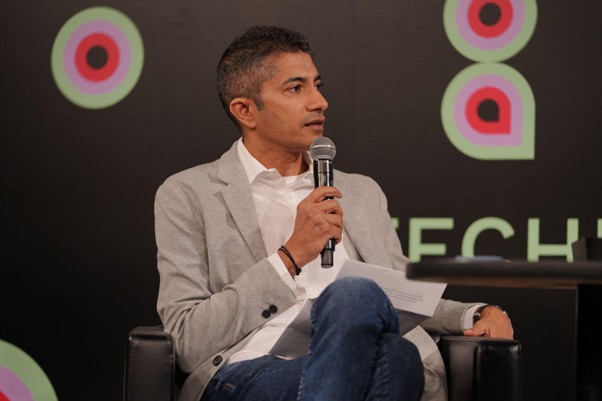
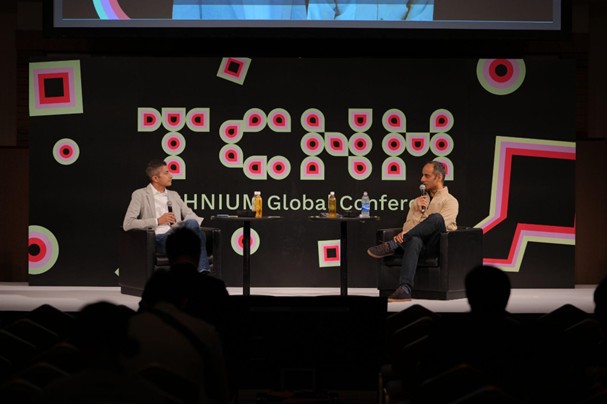
That May, he had moderated a TECHNIUM Global Conference discussion with Shailesh Lakhani, formerly of Peak XV and Sequoia Capital. Their subject was India’s changing startup economy and the possibilities for collaboration with Japan. The conversation explored how research and commercialization could connect across the two countries.
“I don’t think that there has been a better opportunity for India and Japan to collaborate,” Krishnan said. The optimism had an identifiable destination: relationships between researchers, businesses, investors and markets. After T-Hub and Waterloo, another set of introductions was on the agenda.
The students who stay after the talk
In 2026, Beyond Next Ventures India and IILM announced a partnership around the IILM Innovation Lab. Its planned work included a venture-building elective, mentorship for students and researchers, and links with Japanese university partners. The intervention begins before a polished pitch, when an idea may still need a prototype and a plausible business model.
Krishnan has described a memory from his accelerator years: students lingering after talks with scribbles and incomplete ideas, some of whom later became founders. That small scene gives his current interest in universities a human scale. The potential company is still a person waiting to ask a question after everyone else has left.
Another part of his life has followed a longer timetable. His short-story collection, Unfinished Business, appeared in early 2024; he described a writing journey that had begun two decades earlier. The engineer and investor is also a fiction writer and an avid reader. Even a career spent helping ventures move faster has made room for a project that took its time.
The recurring work in Krishnan’s career is making an opening usable. A building must open. A founder must reach a customer. A researcher must find a way beyond the lab. Institutions can help, provided their programs turn into encounters that matter. Back in 2015, that work included getting a building ready. Today, it includes being close enough to hear the student’s unfinished question.
Follow the conversation
Jay’s personal site · LinkedIn · Beyond Next Ventures biography
Watch: India Innovation Hub launch, 2018
Watch: GREEN ROOM interview
Read: His route to Canada
Read: The India-Japan discussion
Explore: Jay’s YourStory writing