The first thing T-Hub sells is proximity. A founder with a prototype is placed within reach of the person who can test it, fund it, regulate it, repair the pitch or introduce it abroad. That sounds like networking, the startup world’s most overworked noun. In Hyderabad, however, the idea has concrete, elevators and 572,000 square feet of floor space. T-Hub is a nonprofit innovation intermediary built to make useful encounters less accidental.
It began in 2015 as a partnership among the Government of Telangana, academic institutions and industry. The early operating team included founding CEO Jay Krishnan and founding COO Srinivas Kollipara; IIIT Hyderabad, the Indian School of Business and NALSAR supplied academic weight. The arrangement borrowed from the “triple helix” model: government clears a path, universities contribute knowledge and companies bring markets. Founders sit in the middle, where the paperwork is supposed to turn into momentum.
The building is the invitation
T-Hub’s original home, CatalysT at IIIT Hyderabad, covered roughly 70,000 square feet. It worked well enough to expose its first constraint: capacity. By 2022, about 250 startups were preparing to move from that campus into T-Hub 2.0 in Raidurg. The reported bill was about ₹400 crore, paid with state funds. Contemporary accounts described a ten-storey structure able to accommodate thousands of startups, with event rooms, corporate innovation areas and the kind of open workspace designed to manufacture chance conversations.
So what failed first? Not the founding thesis. The square footage did. T-Hub’s response was unusually literal: make the network bigger by making the building bigger. It was also a change in posture. The first phase demonstrated that Hyderabad could gather a startup community; the second was built for internationalization, specialist programs and a far larger throughput of founders.

“We are here to serve startup founders in their quest to survive, scale and succeed.”T-Hub’s stated purpose
Not one accelerator, but a stack of them
Calling T-Hub an accelerator now understates the peculiar thing it has become. It runs stage-specific and sector-focused programs, but it also hosts specialist institutions. AIC T-Hub sits within the Atal Innovation Mission network. MATH focuses on AI and machine learning. T-Drive supports the defense innovation ecosystem, and T-Hub anchors a large iDEX incubation effort. Google for Startups opened a dedicated Hyderabad hub inside the campus in late 2025, offering selected founders workspace, technical mentorship, workshops and access to its global founder network.
The sectors range from SaaS and fintech to biotech, clean technology, mobility, media, blockchain, space, quantum and semiconductors. That breadth is not a claim that one team knows everything. It is an admission that a space-tech company and a consumer software startup need different rooms, different experts and very different routes to market. The model has shifted from one generic curriculum toward a federation of focused pathways.
The useful handoff
- 01Validate the product and business model
- 02Match with operators and technical mentors
- 03Pilot with a corporate or public buyer
- 04Meet capital and enter a new market
Its menu is organized around a house framework called 6M + 2P: Money, Methodology, Market Access, Mentorship, Motivation, Manpower, Partnership and Policy. There is some consultant varnish on the acronym, but the checklist is sound. A young company can have capital and still die for lack of a customer. It can find a customer and stumble over hiring, legal work or product readiness. T-Hub tries to own the handoffs between those needs.
Customers on both sides of the table
Founders are the obvious users. They apply to cohorts, rent desks, attend workshops, meet mentors, pitch investors and seek introductions to customers. T-Hub says a startup need not be based in Telangana - or even India - to be associated with it, though individual programs can favor regular attendance in Hyderabad. The organization reports a community of more than 2,300 startups, 290 mentors, over 200 investors and more than 200 corporates.
The less obvious customers are the institutions trying to work with founders. A global company can ask T-Hub to source startups against a technical problem and run an accelerator. A government department can use it to deliver an entrepreneurship initiative. An overseas ecosystem can use T-Bridge to help its companies enter India, or to give Indian startups a route outward. Investors get a filtered pipeline. Universities get a commercialization channel. This two-sided demand is what distinguishes T-Hub from a landlord with a lively events calendar.
A conventional accelerator
A fixed cohort, a short curriculum, mentor office hours, demo day and often an equity stake.
T-Hub’s broader wager
A nonprofit campus plus specialist incubators, corporate pilots, public funds, labs and cross-border market access. T-Hub says it takes no startup equity.
The economics are deliberately indirect
T-Hub Foundation is incorporated as a Section 8 not-for-profit. It says it does not take equity from startups. That removes a familiar accelerator incentive and lowers one barrier for founders, but it also means the institution needs other payers. The resulting model mixes state backing, workspace and venue income, corporate innovation work, CSR-supported cohorts, government programs and partnerships. Public funding schemes including SISFS, T-Spark, T-Fund and SIDBI iDEX can provide capital to eligible companies; angel and venture introductions provide another route.
What the second campus reportedly cost
The number matters because T-Hub is not merely a course business. Hyderabad funded a physical platform whose return is measured through companies, capital, jobs, pilots and the city’s attractiveness to technical talent.
This is where the usual startup scorecard gets slippery. T-Hub’s $2 billion-plus figure refers to money raised by startups in its ecosystem, not revenue or investment raised by the nonprofit. A warm introduction also is not a purchase order, and a demo day is not a durable company. The model is best judged on conversion: prototypes commercialized, pilots purchased, capital closed, foreign markets entered and companies still operating years after a cohort ends.
Partnerships turn the address into a network
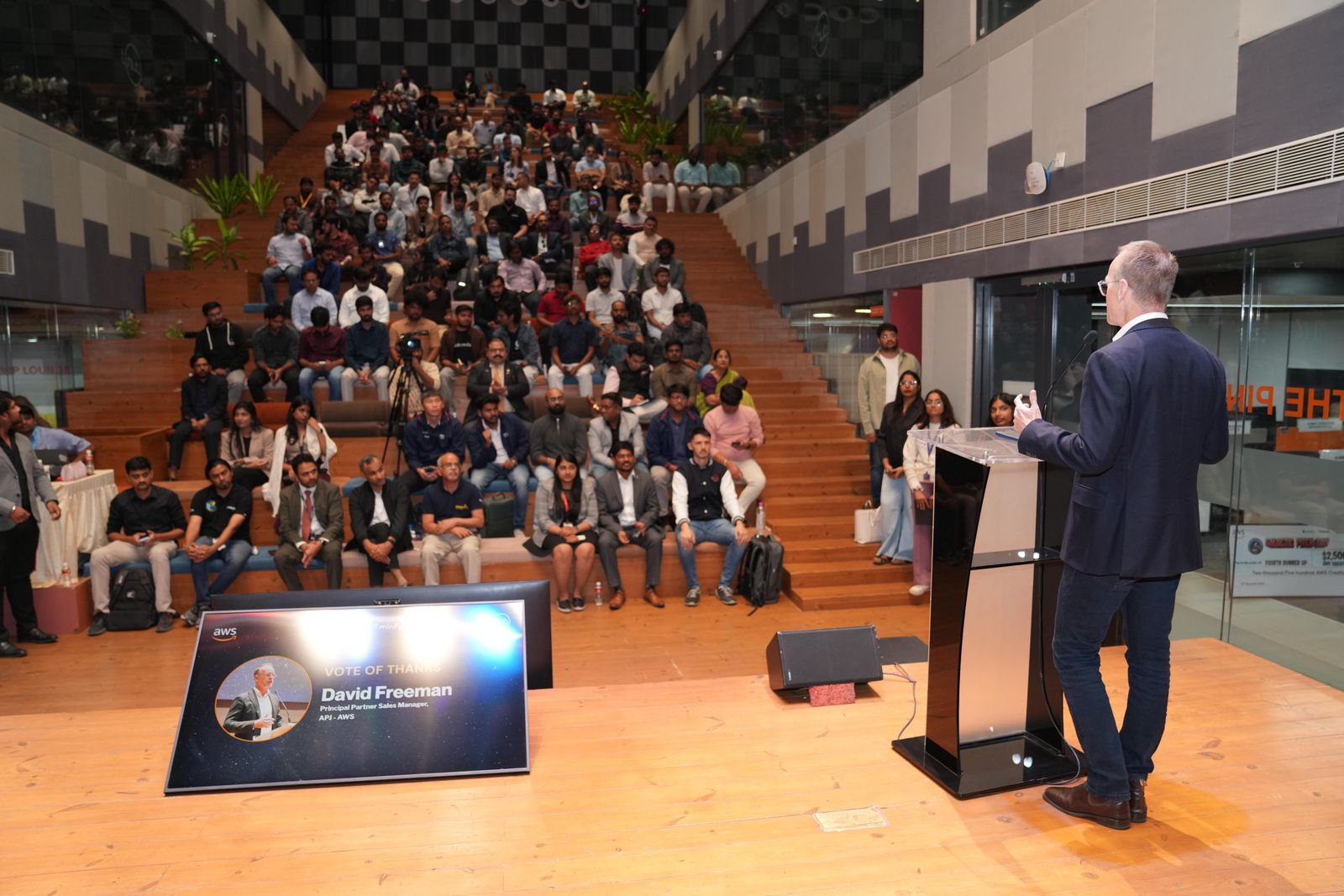
Recent partners show how the machine is meant to work. AWS, T-Hub and Minfy launched a space accelerator in 2024 combining technical, business and mentorship support. DENSO signed an agreement to connect automotive expertise with Telangana’s startups. Global Wales created exchanges around electric vehicles, health technology and digital work. WaveX partnered with T-Hub to expand creative and media entrepreneurship. Google’s in-campus hub added an unusually recognizable technical anchor.
For a founder, the practical benefit is not the partner logo. It is access to a person who can answer a narrow question: Will this architecture survive production? Which compliance step comes before the pilot? Who owns procurement? What must change before this product travels? Programs work when they convert institutional prestige into specific help. They become theater when the logos stay on stage and the founders stay in the audience.
What a founder can actually do here
The sensible way to use T-Hub begins with a bottleneck, not a tour. An idea-stage team may need validation and business-model discipline. A company with a minimum viable product can pursue a cohort such as AIC T-Hub’s sector programs, where commercialization and customer acquisition become the work. A scaling company can ask for corporate or global capability center introductions, investor meetings, hiring support or an international market bridge. There are also desks and cabins, event access, rapid prototyping facilities, AI and machine-learning infrastructure, legal and intellectual-property help through T-Edge, and a network of discounted service providers.
The conditions matter. Applications are curated, benefits vary by program and a badge is not a guarantee of money. Google’s Hyderabad hub, for example, gives selected startups complimentary workspace and technical access, but its published guidance says cloud credits are handled separately. Some opportunities can be joined remotely; others reward founders who can repeatedly show up in Hyderabad. The best candidate arrives with a clear technical or commercial question, enough product evidence to interest a partner and the time to follow an introduction through. A team seeking only cheap real estate will find simpler coworking options. A team needing a regulated pilot, an automotive expert or a route into India has more reason to choose this particular address.
The copyable bit is not concrete
Another city could imitate the coworking floor and still miss the point. The portable lesson is to design the handoffs. Start with a recurring founder bottleneck, name the institution able to remove it, give one operator responsibility for the introduction and measure whether anything happened afterward. Specialize only when the local market supplies credible mentors, customers and technical facilities. T-Hub’s move into space, defense, AI and semiconductors works because Hyderabad has research institutions, state participation and a deep enterprise-technology base nearby.
The approach is harder to reproduce where government support changes with every administration, universities have no incentive to commercialize research, corporate partners cannot buy from startups or founders must travel too far for repeated contact. Scale can also hide weak selection. A large campus increases the number of collisions, but it does not guarantee that any particular collision is useful.
T-Hub’s wager is nonetheless refreshingly concrete. Early-stage companies usually experience an ecosystem as a scavenger hunt: one office for a grant, another for a prototype, a conference for investors, a cold email for a customer. T-Hub tries to compress that geography. Its product is the reduced distance between asking and getting an answer. The building simply makes the metaphor impossible to miss.