The awkward hours between hotel checkout and an evening flight are a small tax on a holiday. You have time to explore and a suitcase that would prefer you didn’t. For DUBZ co-founder Omar Abou Faraj, that inconvenience on a trip to Georgia became a business idea. For Intelak Hub, the startup that followed became an unusually clear demonstration of what an incubator can help set in motion.
DUBZ joined Intelak’s inaugural cohort, offering baggage collection and delivery. In 2018, dnata, the air services business within the Emirates Group, acquired a majority stake. The group’s annual report puts its ownership at 70%. A programme backed by aviation companies had helped develop a business one of those companies wanted to own.
That episode gives Intelak a more interesting identity than the familiar collection of workshops, mentors and demo days. Its proposition is proximity to the travel industry: people who understand the problem, organisations that can help test a solution and, occasionally, a business partner with a chequebook.
Four teams, and a very specific invitation
Intelak began in September 2016 with institutional founders: the Emirates Group, GE and Etisalat Digital. Dubai Silicon Oasis Authority provided the original home at the Dubai Technology Entrepreneurship Centre, or Dtec. The name means “taking off” in Arabic, an aviation metaphor the programme did not have to work very hard to find.
The original selection plan was concrete. Twenty teams would enter a two-week bootcamp; four would win AED 50,000 apiece and move into incubation. Workshops covered design thinking, financial modelling, marketing and investor pitches. Cash would arrive against development milestones, giving the winners a budget tied to progress.
The first four graduates came from more than 125 entries. Their ideas ranged from virtual hotel-room previews to a mechanism for securing overhead luggage compartments. Travel technology, in this formulation, extended well beyond another booking screen. A mundane difficulty experienced by passengers or crew could be a perfectly respectable starting point.
The suitcase had a business model
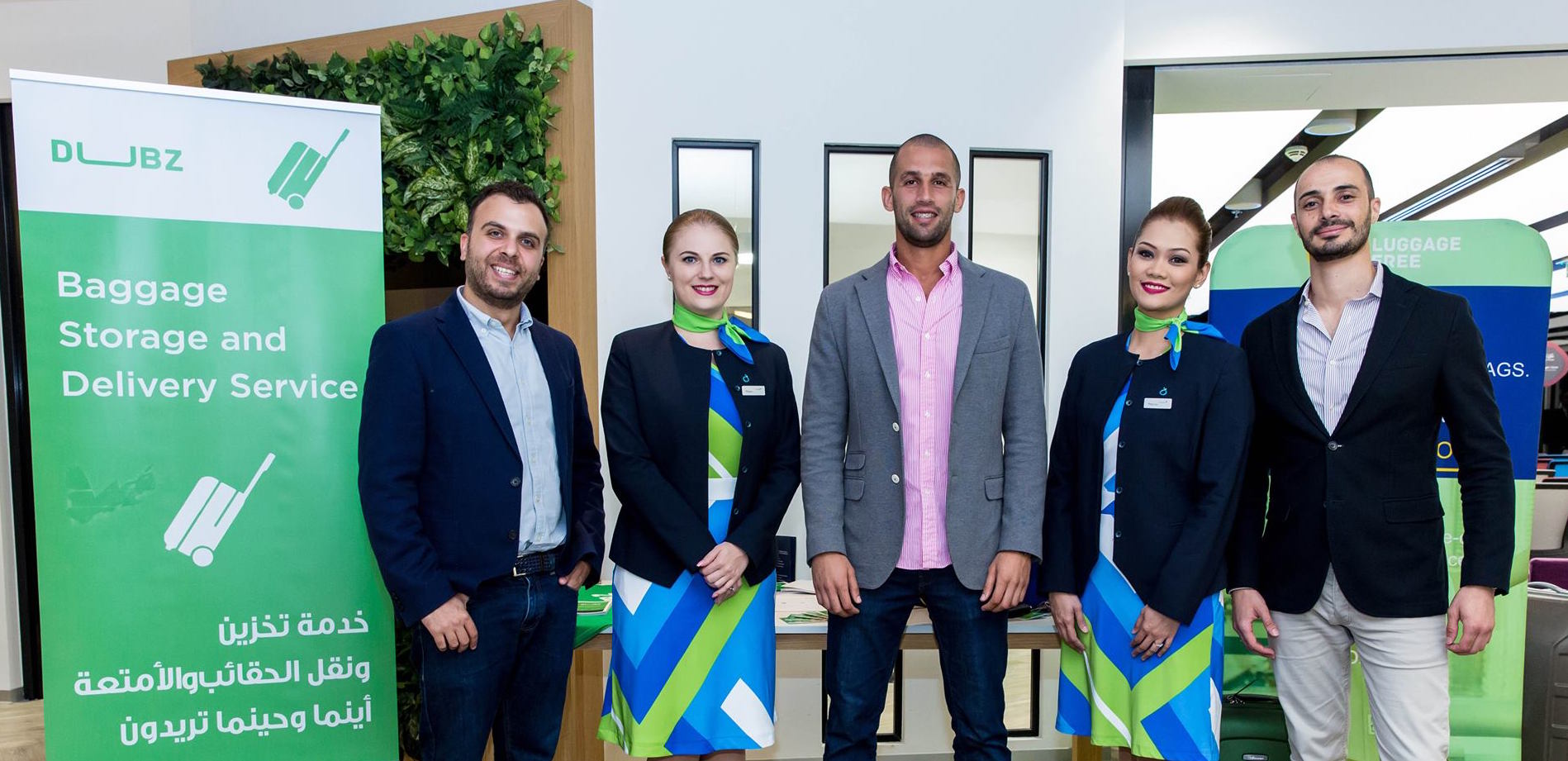
DUBZ charged for handling bags. Intelak’s announcement described home check-in for selected airlines and an arrival service that collected luggage and delivered it to a hotel or home. The technology connected with airport data; the operation also involved GPS-equipped vehicles, monitored facilities and drivers managing paperless transactions.
That detail matters. A traveller sees a convenient collection service. Behind it sit handling procedures, information flows and coordination with the airport. The business has to work at the point where a pleasant website becomes somebody else’s operational responsibility.
“Our vision is to create luggage freedom.”
Omar Abou Faraj
DUBZ co-founder, speaking in 2018
Faraj later told Entrepreneur Middle East that Intelak had attracted investor interest, but dnata offered a combination of financial strength, industry expertise and connections. The choice helps explain the value of a specialist programme. A founder can assess prospective partners by what they enable the business to do, as well as by what they can invest.
The DUBZ deal belongs to DUBZ. It is an example of a possible outcome for an Intelak participant, and a useful one to study; joining a cohort does not confer a similar acquisition path.
A small grant, a larger set of relationships
The original AED 50,000 award was development money. By December 2018, the Emirates Group reported close to AED 1.6 million in combined seed funding and in-kind contributions over Intelak’s first two years. Technology, equipment access and mentoring counted alongside cash. The same announcement recorded 16 graduates, more than 80 bootcamp teams and over 50 workshops.
Those figures describe a partner-supported operation. The institutions contribute resources and get exposure to proposed solutions in their industries. Founders receive help developing businesses and opportunities to work with those institutions. Its public offer is organised around this exchange.
Per winning team, released against development milestones.
Today’s advertised amounts need careful reading. In September 2026, the Accelerator page offers AED 50,000 per selected startup. The Incubator’s purpose statement lists AED 20,000 licensing grants, while the About page still describes AED 50,000 equity-free incubation funding. Treat the specific cohort’s written agreement as the offer to evaluate.
For a founder, the calculation also includes time: preparing a demonstration, attending sessions and adapting a product to an operating partner. An introduction can be valuable. It still has to lead to work that advances the company.
Three doors into the programme
Intelak separates its support into Idea Lab, the Incubator and the Accelerator. That gives a student exploring entrepreneurship a different entry point from a company seeking to expand into Dubai. It also makes choosing the right programme a substantive decision.
Idea Lab
Entrepreneurship and idea development for UAE Nationals.
Incubator
Support for early-stage teams developing their businesses.
Accelerator
Advanced-stage startups pursuing growth and Dubai opportunities.
The 2025 Idea Lab campaign invited UAE National students to apply, with a September deadline. The Incubator advertises mentoring, investor events, legal and licensing clinics, and opportunities to exhibit and pitch. Its current page mixes different location and stage requirements, so a prospective applicant should establish which conditions apply to the intended cohort.
The Accelerator is more explicit about its intended user: an international growth-stage startup or scale-up with at least two full-time team members, an appropriate technology solution and a reason to implement or test it in Dubai. Its page advertises up to five startups per cohort and an investor-focused demo day.
In practical terms, the programmes help founders develop ideas, find industry feedback and prepare for commercial conversations. The hub also maintains a community platform for participants, alumni and partners. Continuing access to that network is part of the offer after the formal sessions end.
The brief changed when travel changed
Intelak’s partner group evolved. Dubai Tourism joined in 2018; Microsoft and Accenture joined in 2020 as the platform expanded its technology scope and international reach. Dubai’s 2024 sustainability report also lists Amadeus among five principal partners. The combination links aviation operations, destination development and technology expertise.
The pandemic gave that network a different assignment. In October 2020, Intelak announced ten accelerator finalists following a call for safer travel solutions. The challenge covered shopping, payments and other visitor touchpoints, alongside engagement, personalisation and accessibility. Applications were reported to have risen 30% over 2019.
Participants included Handiscover, focused on accessible accommodation, and RightHear, which helps blind and visually impaired people orient themselves in public spaces. The selection broadened the meaning of a better travel experience: confidence and independence belonged in the discussion alongside speed and convenience.
By the 2024 report, Intelak’s accumulated activity had reached a different scale. The useful distinction is between the programme’s own support and what participating companies subsequently raised.
Investment raised by Intelak alumni
The alumni fundraising total is an outcome measure reported by Dubai’s tourism department. It should not be read as money Intelak invested, a valuation of the hub or a return earned by its partners. Each would answer a different question.
An airport operator’s to-do list
The current challenge statements show where Intelak wants founders to direct their attention. Crew training involves fragmented knowledge and manual reporting. Lounges need better planning and less excess. An on-demand staffing brief asks for ways to connect service businesses with verified temporary workers.
The Incubator’s list reaches into robotics, finance and cargo. Its cargo brief considers workflow improvements and automated loading; the robotics brief asks how systems could function reliably alongside live airport infrastructure. These are invitations to solve particular operating problems, with implementation embedded in the question.
That specificity is Intelak’s useful market position. Hub71 in Abu Dhabi supports a wider range of technology sectors. Dubai’s in5 offers business setup support and specialist creative and technical facilities. A travel founder might find value in any of them. Intelak’s case rests on the relevance of its industry relationships to the product being built.
Bring a problem small enough to test
The lesson a reader can copy is to begin with a recognisable inconvenience and identify who controls the steps needed to fix it. DUBZ’s service required a relationship with the aviation system. Intelak’s contemporary briefs similarly ask founders to understand an existing workflow before proposing a replacement.
A useful application would connect one such problem to a bounded test: what the product does, who uses it, what must be integrated and how improvement would be measured. For a lounge tool, that might mean a demonstrable change in waste or availability. For a cargo product, it might mean fewer manual steps. These are practical deductions from the briefs, rather than promised programme outcomes.
The fit weakens when Dubai has little relevance to the business, when a team cannot support an operational trial or when it needs immediate, guaranteed sales. Corporate access is most useful to founders prepared to turn a conversation into a credible test.
A suitcase left waiting between checkout and takeoff was specific enough to build around. Intelak’s enduring proposition is to help founders take that sort of observation into a room where someone knows how the industry works - and can decide whether the proposed fix belongs in it.