An incubator has an awkward ambition: it should help its tenants become too successful to stay. In Casablanca, Technopark once made that ambition quite literal. A 2015 report described rents that rose as businesses matured, encouraging established companies to leave room for younger ones. The desirable tenant was, eventually, a departing tenant.
That small property-management decision opens a larger question. What does a startup actually rent when it joins an incubator? Floor space, certainly. But the useful part may be the experienced entrepreneur nearby, the introduction to a buyer, or someone who notices that the founder’s financial model requires a minor miracle.
- Workspace comes with mentoring, training and business introductions.
- Early ideas and growing companies have different program routes.
- The network operates across five Moroccan cities, with a sixth site at the Cité de l’innovation Souss-Massa.
A company with a public assignment
Technopark opened in Casablanca in 2001. Its operator, Moroccan Information Technopark Company, or MITC, grew from a partnership between the Moroccan state, CDG and banking institutions. Historical accounts put the state’s founding stake at 35 percent. The arrangement gave a company a public assignment: help innovative businesses take root.
It also supplied an early management puzzle. In December 2002, Le Matin reported complaints about slow decisions and maintenance, including lifts and electricity. A manager described the difficulty of serving a public mission while operating with private-business expectations. A handsome building could attract entrepreneurs; running it required decisions that did not arrive handsomely enough.
Those complaints matter because they locate the first visible friction in ordinary operations and governance. Later training programs should not be treated as proof that every early problem disappeared. But the subsequent offer became much broader than accommodation: a founder could seek help with a prototype, a pitch, a financing plan or a prospective customer.
The neighbour is part of the product
The physical offer remains practical. Ready-to-use offices start at 17 square metres. Coworking accommodates self-employed people, student entrepreneurs and project holders. Secure access runs around the clock; cleaning, maintenance and shared equipment help remove chores from the founder’s working day. Such services solve small problems that otherwise become surprisingly large distractions.
The social offer is more distinctive. Technopark names one objective Rompre avec la solitude de l’entrepreneur
: break the entrepreneur’s isolation. Mentoring, alumni connections and Technobreakfast give that intention a schedule. A breakfast may sound modest beside an investment committee. For someone working alone, meeting the right person over coffee can be the more immediate improvement.

This is where it sits in the market: between workspace provision and structured business support. A conventional coworking office answers where to work. A specialist accelerator usually answers a narrower growth question for a selected cohort. Technopark combines recurring occupancy with several forms of support, giving founders more than one point of entry.
Six months to make the idea answer questions
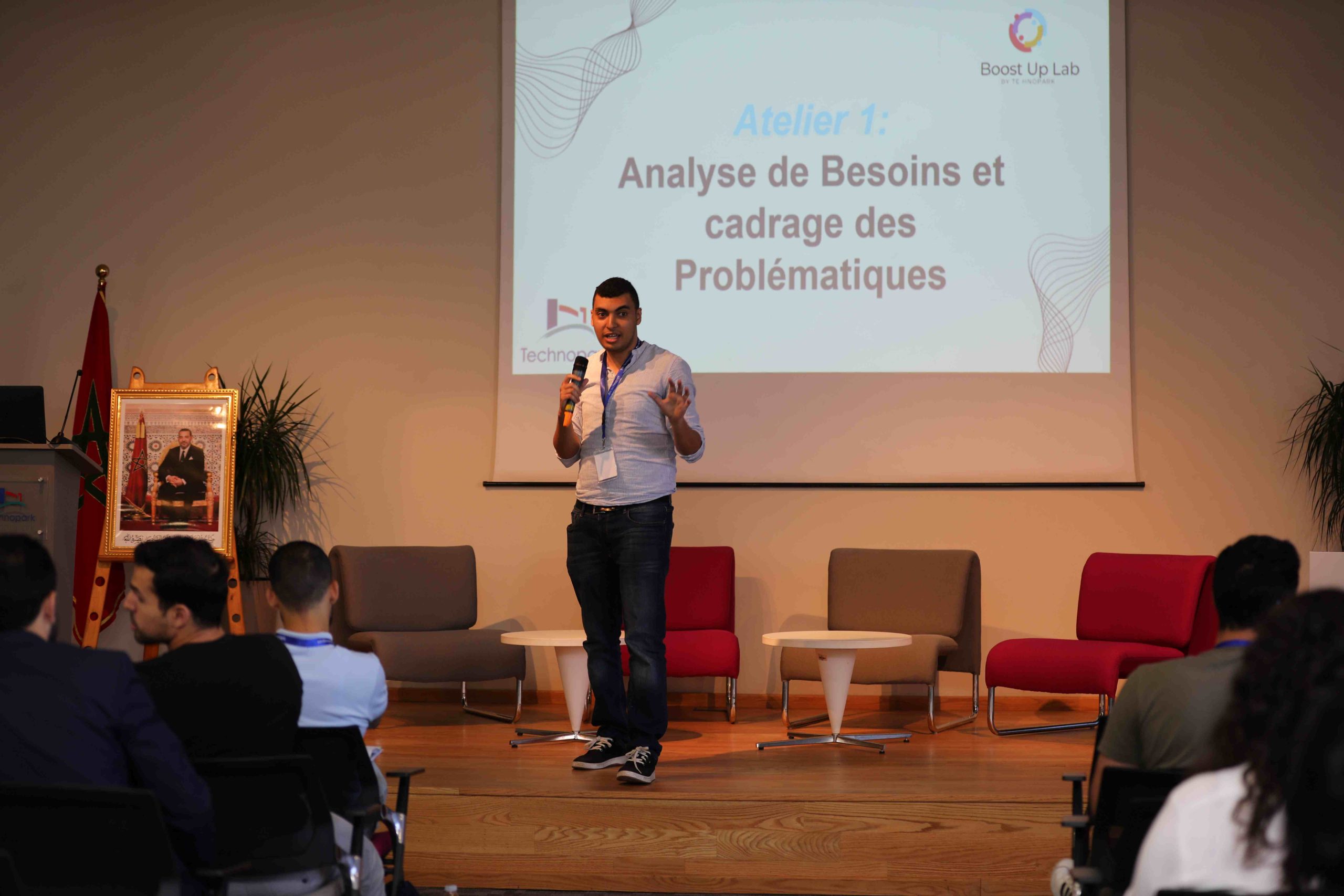
Boost Up Lab makes the sequence concrete. Launched in February 2023, its first edition attracted more than 330 applications. Around 40 project holders were selected; 25 projects reached the final stage. The subjects ranged from e-commerce and renewable energy to health technology, logistics and education.
A two-day hackathon preceded six months of bootcamps. Participants worked on customer needs, prototypes, business models, marketing, sales and pitching, then presented at Demo Day. The useful lesson is the order: an idea has to become an offer that someone understands before a polished pitch can do much for it.
The price of making room
The economics deserve dates. In June 2015, La Vie éco reported a monthly rent of MAD 50 per square metre for startups under 18 months, with higher prices as companies aged. That is a historical tariff. The same report described full occupancy, waiting lists and alumni including ReKrute and Dataprotect.
Workspace payments therefore supported an operating model with a deliberate turnover mechanism. Institutional backing and funded programs add other pieces. Expansion also costs real money: the Essaouira site, inaugurated in November 2023, represented an investment of approximately MAD 20 million. Buildings and introductions may share a purpose, but they have different budgets.
A local address, a wider conversation
The network expanded to Rabat in 2012, Tangier in 2015 and Agadir in 2021 before Essaouira joined. The geographical point is access: a founder should not need to relocate to Casablanca for every useful connection. Regional support can also address regional demand. Agadir’s September 2026 Green Business agenda, for example, focused on turning green innovation into commercial success.
A June 2025 partnership with Plug and Play added an international acceleration route. Technopark reported that the first Morocco Accelerator cohort included 18 startups, 12 workshops, more than 110 individual mentoring sessions and over 230 investor meetings. These figures describe delivered activity. An investor meeting is an opportunity; the investment still needs a separate decision.
The practical entry conditions matter. A September 2026 call sought scalable technology businesses with traction and revenue, plus a Moroccan founder, co-founder or diaspora connection. A project holder with an untested idea should assess incubation options instead. Membership cannot manufacture customer demand, and a network helps most when a founder brings a specific question to it.
The next measure is growth
Driss Lemjaouri was appointed director general on 18 September 2026. His published agenda describes a shift de l’espace vers la plateforme
, from space toward a platform. He proposes measuring progress through company growth, financing, new markets and jobs, alongside accommodation.
The useful question for a founder: which obstacle can this network help you remove next?
For other incubators, the copyable elements are concrete: match support to company stage, make introductions purposeful, cultivate alumni and keep space available for newcomers. The interpretation follows from Technopark’s services and history. Shared premises alone will struggle if decisions remain slow or tenants have little reason to help each other. The neighbour becomes valuable when there is something useful to exchange.