A startup making electronic puzzles for escape rooms has a rather literal problem: the thing has to open. A neat presentation will not rescue a lock that refuses to cooperate. EnigMaker, part of Zagreb Innovation Centre’s 2026 accelerator generation, is developing connected locks and modular puzzles. Its presence is a useful introduction to ZICER. This is a place for people whose business ideas eventually have to do something.
The City of Zagreb owns the company, which combines incubation, acceleration, technical facilities and business education. Its customers include technology founders, small business owners and professionals who need a desk. Researchers and established companies can also use development facilities. The proposition is practical: put several expensive, awkward steps in starting a business within reach of the same team.
There is competition for that help. ZICER’s June 2026 announcement reported 110 applicants for its acceleration programs and 20 selected teams. The city committed €300,000 to the cycle. That works out to roughly one place for every five and a half applicants. The cash is a shared program fund, allocated under its rules; it is not a €300,000 cheque for everyone who walks in.
The most interesting feature is the combination. An office, a mentor and a 3D printer solve different problems. Giving a founder access to all three can make it easier to discover which problem actually needs attention. That is the economic argument for ZICER, and the standard by which its attractive facilities should ultimately be judged.
About 18% made the cohort. Funding is competitive.
02Before the pitch deck, an industrial parent
ZICER’s roots are in engineering. KONČAR established its predecessor, a high-technology business incubator, in 1994. The City of Zagreb took ownership in 1998 and renamed it Technology Park Zagreb. It became the Zagreb Development Agency - Technology Park Zagreb in 2008. The current ZICER name arrived in 2018.
A physical expansion preceded that rebranding. In 2017 the organization moved into 7,300 square meters, with 108 modular offices. Its history says roughly 100 incubated technology startups moved in over the next two years. Those are figures for that expansion period, rather than a live occupancy count. A more recent IASP member profile describes more than 80 startups on-site.
The name supplies a small Croatian joke. In colloquial usage, a “zicer” is a sure thing or an opportunity too good to miss. Entrepreneurship is a bold place to put that word. Director Frane Šesnić states the more sober institutional ambition: “We build knowledge-based entrepreneurship.” The emphasis on developing proprietary technology helps explain why hardware and research commercialization sit alongside software here.
03The office has a price. The subsidy has conditions.
ZICER publishes an incubation base price of €300 a month plus VAT. The package lists a 20-square-meter office for up to four people, utilities, meeting rooms, mentoring and other shared services. Its own example describes a 28-year-old entrepreneur in the first year of business qualifying for a 75 percent subsidy, bringing the monthly bill to €75 plus VAT. That is an eligibility example, not a universal rate.
Teams without a registered company can enter a free, three-month pre-incubation program. Admission begins with an application, assessment and interview, followed by documentation. The published startup criteria include a Zagreb headquarters, at least one employee and majority ownership by natural persons. The individual or team route includes Zagreb residence requirements. Local public support comes with a local connection.
Coworking is another route in. Listed rates are €30 per day, €60 per week or €120 per month, excluding VAT. The packages include a desk, Wi-Fi and specified meeting-room allowances. Laboratory use is charged at commercial rates. A freelancer choosing a monthly desk is therefore making a different purchase from a startup applying for subsidized incubation. Comparing the two prices without comparing the services would miss the point.
Excluding VAT. Laboratory access is charged separately at commercial rates.
04A prototype needs more than encouragement
The ZICERLab equipment list makes the industrial heritage tangible. The 3D modeling center includes scanners, reverse-engineering software and FDM and PolyJet printers. Electronics facilities list oscilloscopes, analyzers, circuit-board equipment, a reflow oven and a climate chamber. These are tools for making and testing physical products, including the unglamorous business of finding out why a component misbehaves.
The centers were equipped through the European Regional Development Fund project “StartUp Factory Zagreb - Incubator for High Technologies.” ZICER’s 2019 business plan placed that project’s total value at approximately 19.59 million kuna. That historical project budget should not be confused with the current accelerator fund, the price of a desk or the company’s annual revenue. Public infrastructure and startup grants are separate expenditures.
For a hardware founder, shared equipment can change the sequence of spending: test an idea before buying a full workshop. It also creates a useful discipline. Decide what a prototype must prove, then choose the instrument and experiment. Access to equipment becomes valuable when it answers a question that affects the next product decision. A beautifully printed object without a buyer remains an object.
“We build knowledge-based entrepreneurship.”Frane Šesnić / ZICER director
05Four programs, four different jobs
The 2026 accelerator lineup separates Startup Factory, Growth, Global and Deep Tech. Startup Factory addresses ideas and early prototypes. Growth targets startups between one and three years old. Global focuses on international expansion, while Deep Tech addresses projects emerging from scientific research. The distinction matters because a scientist commercializing a result and a software company entering another country need different conversations.
The umbrella program describes a six-month cycle with bootcamps, mentoring, coordination meetings and a presentation at Zagreb Connect. It advertises an opportunity for participants to receive €5,000 at the beginning and a maximum financial award of €50,000 per startup. ZICER states that these four accelerators charge no fees and take no equity. Selection and awards still depend on the program rules.
Startup Factory also specifies concrete outputs: a developed business plan, pitch deck and improved prototype or minimum viable product. Applicants need at least two participating members with complementary skills. An unincorporated team must register a Zagreb-based business before receiving financial support. This is work with milestones, rather than a grant application followed by six quiet months.
Other financing follows different logic. ZICER introduced a convertible-loan instrument for its users in late 2018 to bridge a gap before a subsequent business stage. It also describes internationalization support and help accessing innovation programs. The equity-free accelerator promise should be read within that program’s boundaries; it does not define every financial instrument the organization offers.
06The customers behind the startup vocabulary
The portfolio becomes easier to understand when the industry labels come off. EnigMaker is working on the mechanics and electronics of escape-room entertainment. DharaOne, featured in September 2026, is developing software to simplify administration for Croatian family farms. One customer wants an entertaining puzzle. The other would like fewer agricultural records to manage by hand. Both need a product that fits an existing routine.
StayPicker offers a different lesson. Developed within tourism technology company MyRent, it connects accommodation guests and hosts. In a September interview, its sales lead explained that the idea grew from daily work with property owners and tourism professionals, and from observing Croatia’s dependence on large foreign booking platforms. The company is pursuing an additional local booking channel, while acknowledging the incumbents’ scale and marketing resources.
That is a concrete example of observation changing a product agenda. A team already handling reservation technology identifies another commercial problem among the customers it knows. The repeatable move is to examine recurring friction in an existing relationship, then test whether anyone will adopt the proposed fix. A familiar customer is a useful starting point, not proof that a new marketplace will succeed.
ZICER also builds connections around a named buyer’s needs. Its 2025 fintech hackathon with Hrvatska poštanska banka focused on AI-led personalization and PSD2 integration. Seven teams presented to a jury; first prize was €5,000, with €3,000 and €2,000 for second and third. The bank’s involvement gave participants a specific operating context. Winning a competition and earning a lasting customer remain different milestones.
07A business school with the door open
Not every useful business needs a laboratory. Through Plavi ured, or Blue Office, ZICER provides free individual advice and small-group education for entrepreneurs across fields. Its education page reports more than 200 topics and more than 2,000 people who have acquired foundational knowledge through the Blue Office Startup Academy. This broadens the audience well beyond the accelerator cohort.
The curriculum includes finance, taxes, legal aspects of business, intellectual property, marketing and sales. These subjects rarely supply the glamorous photograph. They do supply answers a first-time owner needs before sending an invoice, hiring someone or negotiating an agreement. ZICER’s expertise lies partly in assembling those disciplines around people whose original expertise may be engineering, science or an unrelated trade.
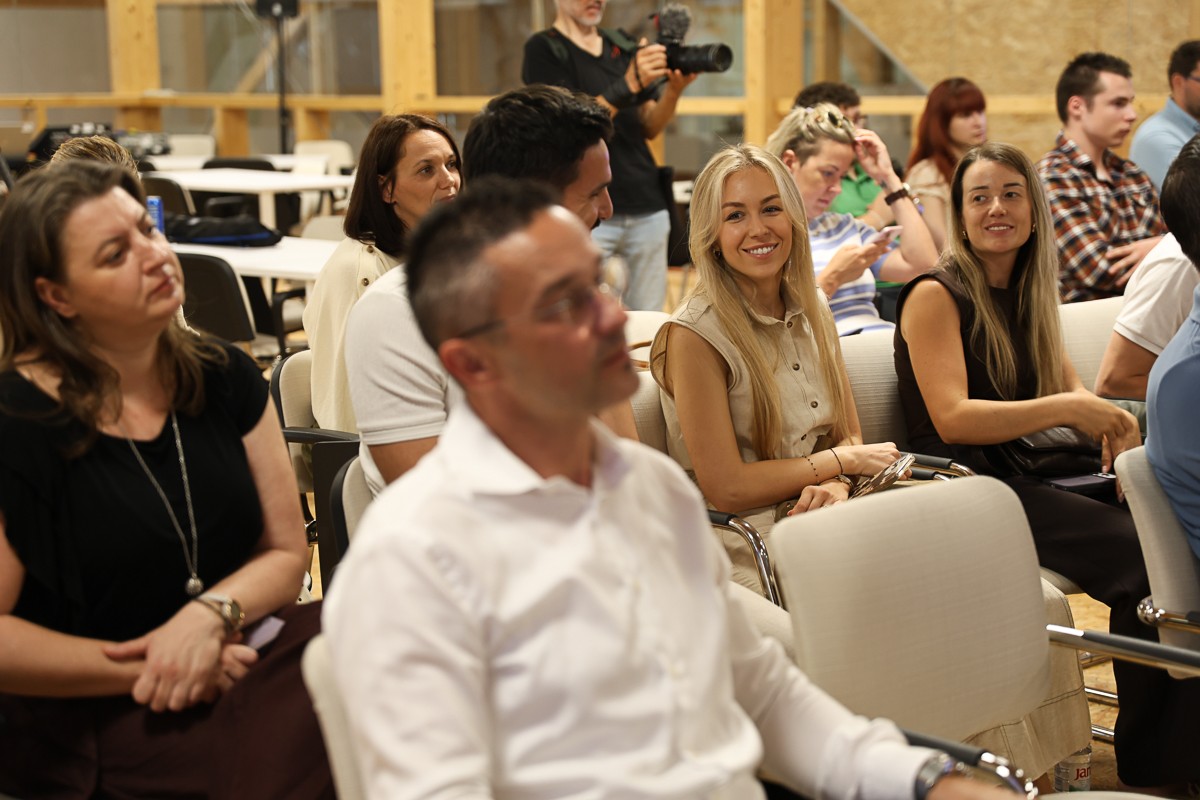
Community is given scheduled work, too. A September 2025 ZICER Connect event presented 15 participating startups, with projects ranging from demining robotics to automated waste sorting. The larger Zagreb Connect conference brings founders, investors and other institutions together. Its 2025 speaker list included Photomath founder Damir Sabol and venture investor Nina Dremelj. The culture being cultivated is one of showing the work and meeting people who can question it.
08Borrow the sequence, then do the selling
In the local market, ZICER sits between several alternatives: ordinary coworking, specialist incubation, university commercialization support and investor-backed acceleration. Zagreb’s BIRD, founded by Solvership, emphasizes AI-focused incubation and offers a seven-week, in-person pre-incubation program. ZICER’s distinguishing combination is broader: municipal support, physical product facilities, multiple startup stages and a public-facing education service.
A founder can copy its underlying sequence without copying the building. First identify the immediate constraint: knowledge, workspace, a technical experiment, customer access or money. Use the smallest relevant service. Tie that service to something observable, such as a tested prototype or a buyer conversation. Apply for the next program when the business has reached the stage it serves.
The fit has limits. A founder unwilling to establish the required Zagreb connection cannot assume eligibility for locally conditioned support. A team that only needs a desk may find an accelerator’s participation demands excessive. A company needing a large manufacturing investment cannot treat a capped startup award as a complete financing plan. And a product without demand will still have to find demand after the subsidized rent is paid.
The public bet is that removing some early costs gives more technically capable people a chance to build a business. The founders’ part is less architectural: demonstrate that the product works, learn what customers will pay for and adapt. ZICER supplies room to do that work. The customers still get the deciding vote.
Step inside
Explore the programs, meet the companies and watch the conversations.
ZICER website ↗Incubation and applications ↗Accelerator programs ↗Company news and startup stories ↗Blue Office education ↗LinkedIn ↗Instagram ↗Facebook ↗YouTube: talks and event videos ↗Video: how to reach ZICER ↗