A founder can spend months making a product more impressive without discovering whether anyone needs it. Startup Incubator Berlin has organized much of its work around interrupting that habit. Bring an idea, build something people can try, then watch what happens. The awkward pause when a tester cannot work out the next step may be the most useful part of the evening.
That is the proposition at SIB, the founding center of the Berlin School of Economics and Law, usually called HWR Berlin. Its tools include coaching, shared workspace, public scholarships, a prototyping workshop and recurring encounters with potential users. Together, they address a particular problem: how to give an unproven business enough support to test its assumptions before running out of money or patience.
The financial arrangement deserves attention. Early support through Startup Now is free. Selected founders can receive a public stipend, and the incubator takes no equity. The institution’s job is to help people build viable businesses. For someone still deciding whether to become an entrepreneur, that makes the first conversation considerably easier.
A university with a workshop habit
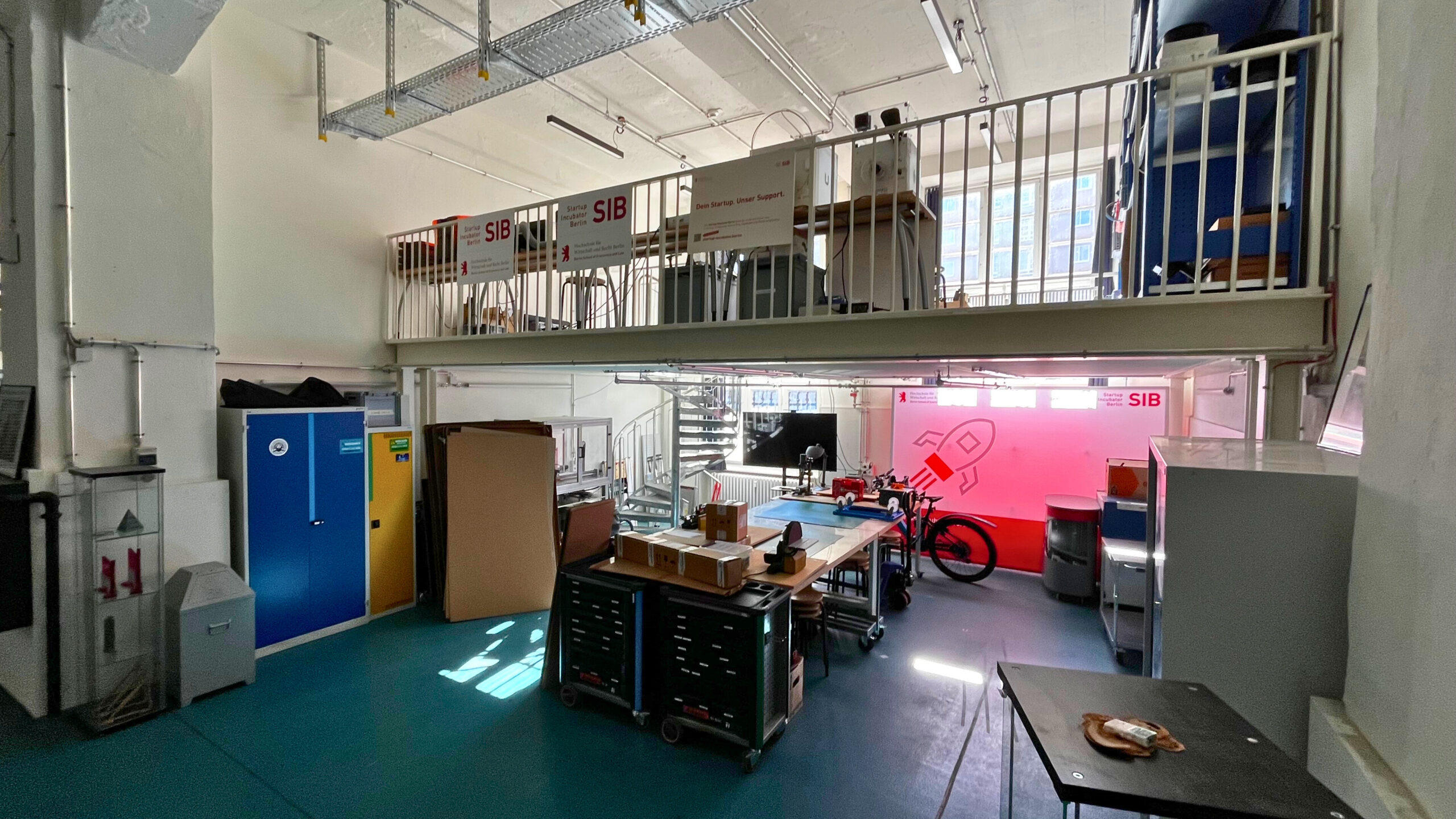
SIB’s institutional history begins in 2009, when HWR’s founding center operated from the Schöneberg campus. In 2017 it moved to Rohrdamm 88 in Siemensstadt, as part of development at the Siemens location. A design-thinking lab and prototype workshop followed in 2018. Entrepreneurship acquired somewhere to make a mess.
The university connection shapes the offer. Academic mentors bring subject knowledge; business contacts and external coaches help with commercial questions. Startup Now also connects startup problems with student coursework, including software engineering and product and sales management. Students get a real assignment. Founders get another set of minds working on something they need.
The practical menu reaches from company-law advice and customer acquisition to pitch preparation. Team matching addresses an earlier bottleneck: the person with the idea may lack the skills to build it, while the person with technical ability may need someone who can sell. SIB gives those people opportunities to meet before committing to a business together.
Two weeks to earn a better question
The Lean Startup Sprint compresses the introduction into two weeks onsite, in English. Participants work toward a proof of concept, experiment with a prototype and develop a business model. The September 14-24, 2026 edition has already closed applications. Its published agenda is a useful window into what SIB thinks beginners need.
Problem interviews come early. No-code prototyping follows. Later sessions cover financing, leadership, legal basics, pitching and team development, with founder conversations woven between them. The order carries a lesson: understand a problem before spending too much effort polishing the proposed solution. A workshop on presentation cannot rescue a business whose intended customer does not care.
The sprint is free, but it asks for time and physical presence. Its listed requirements include Berlin residence, appropriate visa status and a venture that has not yet been incorporated. Onboarding is mandatory, and a certificate requires at least 50 percent attendance. This is a scheduled working commitment with attendance records, instructors and other founders expecting you to turn up.
For continuing support, Startup Now offers coworking, coaching, workshops and community without a fixed program duration. Students and graduates of other universities can participate. Those without a settled idea can begin with events and workshops; teams with a concrete concept can work with the incubator on the next practical step.
The scholarship buys time
The Berlin Startup Scholarship addresses the household economics of founding. SIB advertises €2,500 gross per person each month for six months, with an extension possible up to twelve. A six-month award therefore amounts to €15,000 gross per funded founder. That arithmetic is personal support, not a valuation of the company.
Berlin and European social funds finance the program. Coaching, workspace and mentoring accompany the allowance. The advertised BSS VI round closes applications on September 13, 2026, with funding scheduled to begin November 1. Selection is a separate process; joining an introductory program does not automatically produce a scholarship.
The conditions narrow the audience. This call targets ventures with a prototype or minimum viable product, before company formation and market activity. Founders must live in Berlin and commit full-time. Teams can have up to four people and must meet the published 51 percent female, diverse or nonbinary composition rule. Applicants should work from the live call when assessing eligibility.
€2,500 gross × 6 months
Illustrative total for the initial award period. Extension is conditional. SIB takes no equity.For innovative ventures rooted in technology or research-based knowledge, SIB also helps prepare EXIST Startup Grant applications. That route involves an academic mentor and an assessment of the idea before submission. Choosing the right funding route is itself part of the work. A founder needs support that fits the project’s stage, team and circumstances.
The evening when the founder stops talking
SIB’s recurring UX-testing sessions make its method visible. Startups bring products, prototypes or services. Visitors try them, attempt typical tasks and report their impressions. The next advertised session runs from 5 p.m. to 8 p.m. on September 24, 2026, in the Venture Café setting at CIC Berlin. Visitors attend free, with drinks included.
External teams can register too. Exhibitors receive practical infrastructure, including a table and electricity, while SIB helps assemble an audience. Confirmation matters: a requested date is not guaranteed. For a small team, arranging access to testers can be a substantial part of the research burden. A recurring event lowers that logistical barrier.
“build, measure, learn”
SIB’s description of the method shared across its startup programs
The format also explains what founders should watch for first. In a test, it might be an instruction, an unfamiliar label or a step that requires an explanation. Those are examples of things to investigate, not documented failures of a particular SIB company. The useful evidence is behavior: where someone hesitates, what they miss and whether they can finish.
There is a limit to what one friendly evening can establish. As a matter of research design, a room of interested visitors may not represent a product’s paying customers. Testing a care-home tool, for example, calls for attention to the people and conditions in actual care work. Event feedback can guide another experiment; willingness to buy requires its own test.
A portfolio that refuses one industry
SIB’s published startup directory lists 293 supported entries since 2015. Read that as a historical record of participation, rather than a count of companies currently occupying desks or a survival-rate claim. The variety is more revealing than any single headline number.
AUF AUGENHÖHE develops fashion for people of short stature. Bearcover works on supporting care-home staff with nighttime checks and supervision. Susteyn offers automated office farms supplying microgreens and herbs through a subscription. These ventures do not share a customer, manufacturing process or sales cycle. They share the need to establish that a particular problem has a workable business answer.
That breadth places SIB in the market for early entrepreneurial support. A founder comparing programs should examine the kind of help needed: sector expertise, machinery, academic access, a living allowance or sustained coaching. SIB’s distinguishing combination is its university base, practical facilities and public support routes. A mature company seeking expansion capital would be looking for a different transaction.
Who gets to try
EXIST Women expands the starting point. At SIB, prospective women founders can participate without arriving with a concrete business idea. The offer combines twelve months of qualification, workspace and mentoring with a three-month personal scholarship whose amount depends on qualifications. It also supports ideas outside science and research.
That distinction matters. Someone considering entrepreneurship may first need to discover a problem worth pursuing, meet collaborators or learn how self-employment works. Treating those activities as legitimate preparation opens a door earlier. The program has its own exclusions and interactions with other funding, so the order in which someone joins programs can affect later options.
The network extends beyond university life. In December 2025, SIB joined TH Wildau and the German association of women entrepreneurs, VdU, for a CIC gathering of scholarship participants, alumnae, mentors and established business owners. FiberFlow founder Lena Strobl shared experience from building her company. Such meetings put people considering a first business in contact with people already responsible for one.

New neighbors, familiar tools
In its 2025 relocation announcement, SIB described a new home at CIC Berlin on Lohmühlenstraße: 450 square meters, 40 workstations and two workshop rooms. It also announced that its prototyping lab, video studio and podcast studio would move with it and open to the wider CIC community.
The move gave the university center new neighbors while retaining its practical equipment. Laser cutters and 3D printers help make physical ideas testable. Video and audio facilities can help explain a product or prepare a pitch. These resources have value when they shorten the distance between a question and an experiment. Access alone does not decide what is worth building.
Start with the smallest honest test
The part a reader can copy needs neither a Berlin address nor a scholarship: write down one assumption, make the simplest version that can test it, and ask an appropriate user to try. Decide beforehand what evidence would justify changing course. Otherwise, every compliment can become a reason to continue and every objection an exception.
For founders who fit SIB’s programs, the next step is concrete: contact the team with the idea’s current state, choose an entry point and check its requirements. The incubator supplies time, tools and people. The founder still has to bring a willingness to let the first answer change.