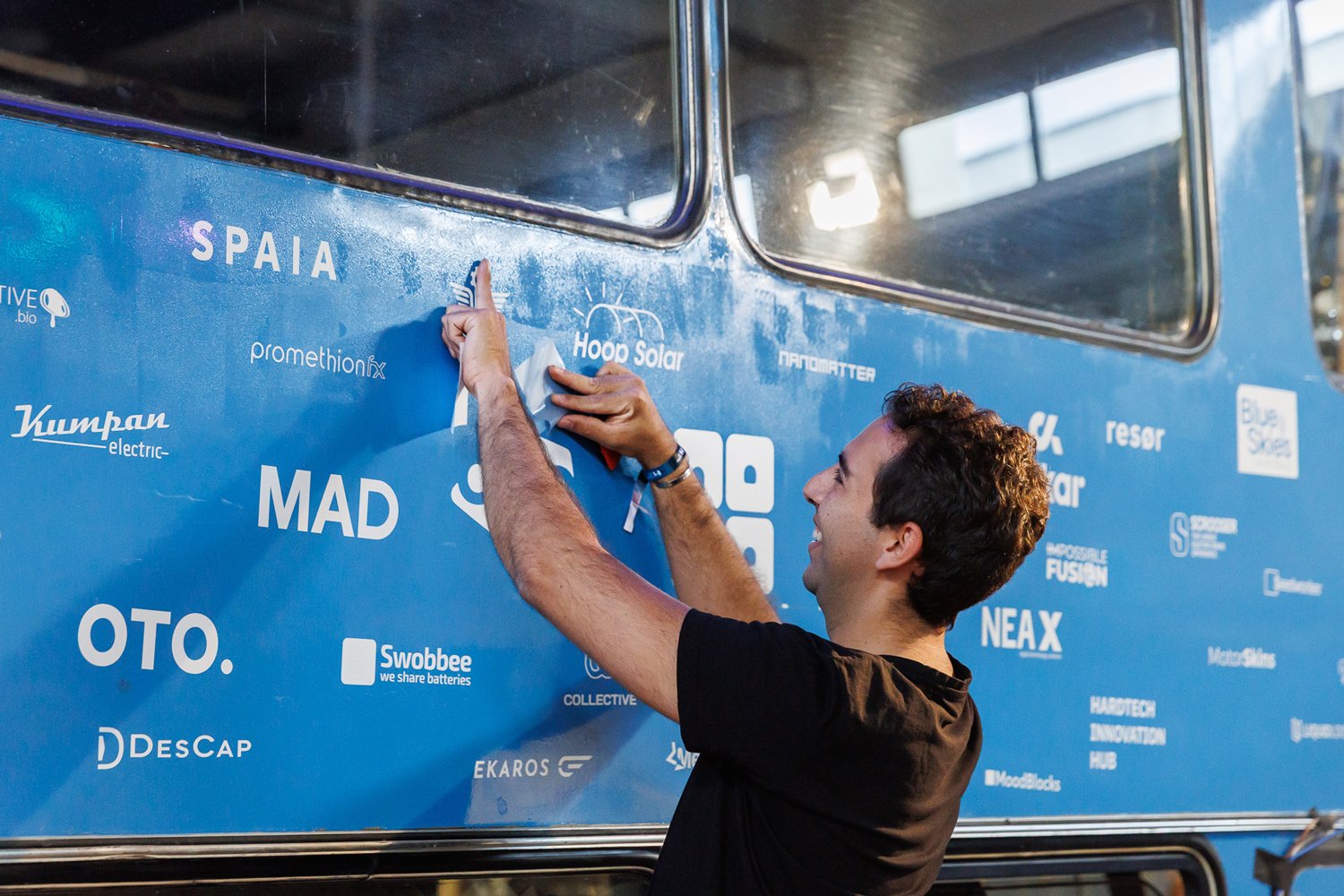
The double-decker bus cost €1,500 on eBay. Getting it to the workshop cost almost as much again. Once inside, it became a meeting room, a quiet corner and a place to take a call. For a business concerned with the future of mobility, MotionLab.Berlin had found a pleasingly stationary mascot.
The bus also captures the company’s practical streak. A hardware founder needs somewhere to build, somewhere to leave the half-built thing, and someone who understands why it still does not work. MotionLab.Berlin sells access to that combination: shared machinery, workspace, technical help and a community with reasons to keep showing up.
The prototype outgrew the room
Founders Christoph Neye and Christoph Iwasjuta met at Berlin’s FabLab. They were interested in alternative vehicles, but their projects ran into an unglamorous limit: machines were too small, and storage was scarce. Fridtjof Gustavs joined them. The company took shape in December 2017; the founders occupied their hall in January 2018, and startups began moving in the following month.
In Neye’s later account, the search began with a bicycle idea manufacturers had dismissed. Working on it revealed a bigger opportunity: other people needed the same missing infrastructure. That is the useful change of direction here. The founders understood the problem by being customers of the facilities that could not accommodate them.
Even their own floor plan needed revision. Neye recalled that the 12-ton bus initially stood in the wrong place. Around 20 community members helped push it into a better position. A later blue paint job made it recognizable outside the building. Then marketing head Nadine Obermeier recalled people responding: “Oh yeah, the coworking space with the blue bus.”
A workshop you can subscribe to
Today, MotionLab.Berlin reports more than 2,000 people in its community and over 110 companies. Those are company-reported community figures, rather than a count of people simultaneously occupying desks. Its original Alt-Treptow campus and its Marzahn location serve different stages of physical product development.
The machinery catalogue is the clearest explanation of the offer. It includes 3D printers, laser cutters, woodworking equipment, metalworking tools, electronics benches and industrial sewing machines. A large WASP printer has a listed build volume one metre across and one metre high. These are tools for objects that have to exist outside a slide presentation.
Prusa Research is the official 3D printing partner. Würth Elektronik supplies another useful layer: electronics components, design kits and access to professionals who can help with component selection and technical questions. For a small team, knowing which part to use can matter as much as having a soldering iron nearby.
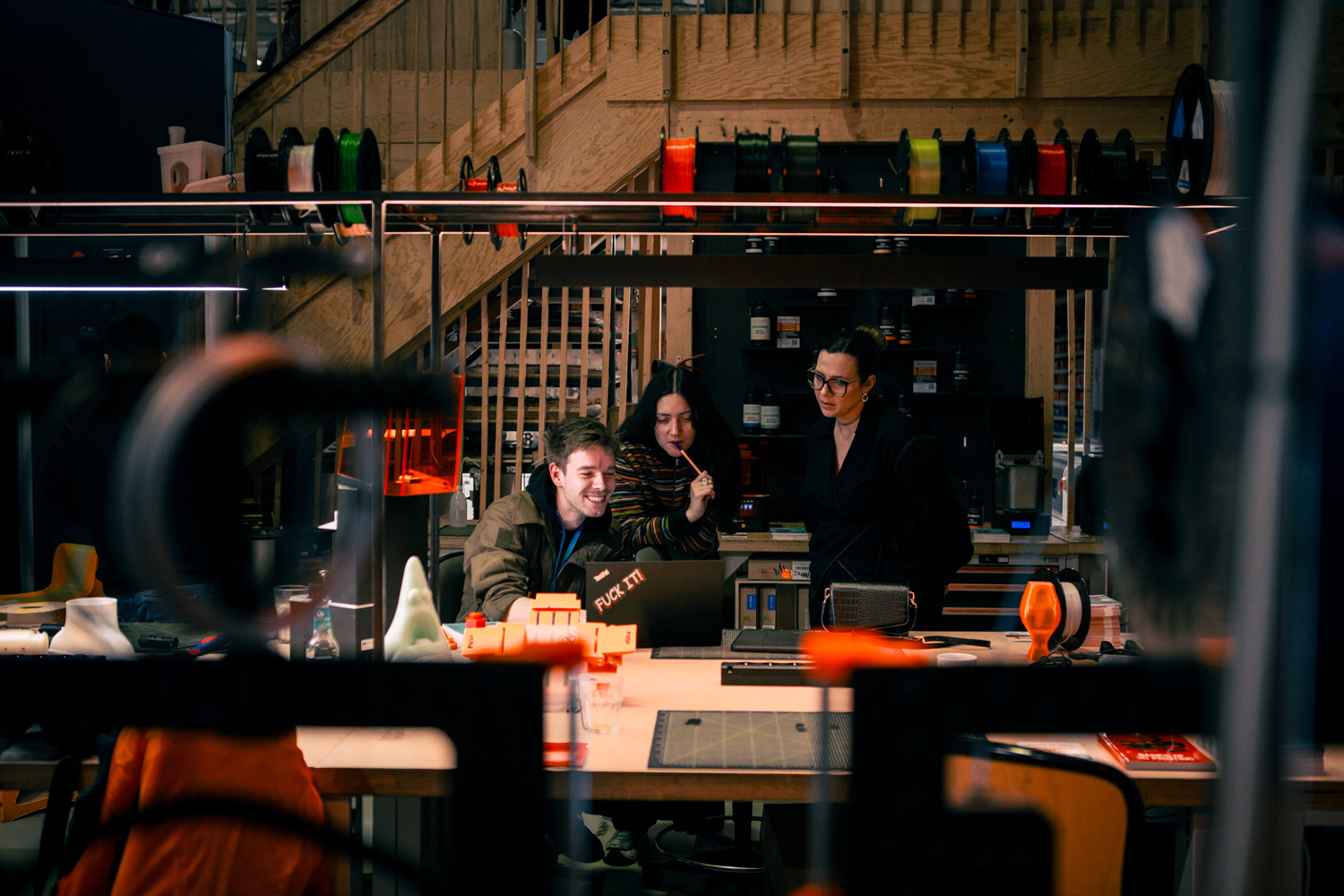
A MakerGarage gives a team its own workshop bay, with room to leave work in progress. Alt-Treptow advertises these from €400 a month and private offices from €525. There is also commissioned prototyping for customers who want the in-house team to make something for them. The service can accommodate a brief as well as a founder carrying tools.
What the membership actually buys
The published membership ladder starts at €129 a month for Hardtech Coworker, including coworking and limited machine access. Hardtech Professional costs €249 a month and advertises full lab access and unlimited machine bookings. Eligible students and creatives pay €169 for the professional-level offer. Booking portals list prices excluding VAT.
Access differs by plan; discounted membership requires eligibility.
A €10 day pass covers weekday coworking during opening hours. The separate €1,999 annual Ecosystem membership includes two Coworker memberships, investor introductions and industry connections. The sensible purchase depends on the bottleneck: a place to sit, equipment to build with, or help meeting the next commercial partner.
For budgeting, treat a membership as one line in a development budget. A physical product still needs materials, engineering time, appropriate testing and eventually production. Unlimited bookings describe access terms; they do not make every manufacturing process suitable for every project. Bring the actual part requirements to the tour.
The model earns money from several related activities: memberships, private space, commissioned work, corporate services and event hire. A company can enter through one and need another later. A designer may initially want a laser cutter; a growing team may need a dedicated bay; a corporate partner may arrive with an engineering challenge. Publicly supported programs add another route into the same facilities.
This places MotionLab.Berlin in a market with several alternatives. UnternehmerTUM MakerSpace offers professional prototyping facilities in Munich and Garching. Berlin’s xHain provides a community hack-and-makespace. A contract manufacturer can take on fabrication directly. MotionLab’s particular proposition combines a working base with product development and company-building support.
Nine months, without an equity bill
The Hardtech Innovation Accelerator packages a more intensive version of that support. Its current format runs full time for nine months, accepts up to five startups per batch and takes no equity. It is funded by the State of Berlin and the European Union’s European Social Fund Plus.
The advertised support reaches up to €200,000 per company. That combines cash and services: €2,500 per month per founder, plus €28,600 of in-kind support per founder for resources including labs, materials and workshops. The distinction matters when founders calculate how much money can actually pay their living expenses.
- 01-03Feasibility & discovery
- 04-06Working prototype
- 07-09Investor readiness
Applicants need physical technology and must be based in Berlin or willing to relocate. The program proceeds from feasibility to a functioning prototype and investor preparation. As of September 2026, its page advertises the next application opening for March 2027. Joining the wider makerspace is a separate decision from winning an accelerator place.
Business support extends beyond the pitch. In June 2026, HEUKING announced an exclusive legal partnership covering the broader MotionLab community. The relationship had developed since 2023 and now includes structured onboarding and an Ask-a-Lawyer format. The practical benefit is earlier access to advice while a company’s arrangements are still being formed.
Five students meet a real engineering problem
The Tech Talent Program gives corporate partners another reason to participate. Teams of five students spend twelve weeks working on company challenges, with access to labs and mentors. Participation is free for selected students at eligible universities. The advertised projects include an e-bike charging and payment unit, industrial heating equipment and a four-legged robot.
For students, the deliverable is something they have helped build. For companies, it is a chance to explore a defined problem and meet potential recruits. In a testimonial published by MotionLab, DiaMonTech CTO Michael Kaluza says that DiaMonTech subsequently hired two of the students. That is a concrete outcome, albeit one company’s account.
“two of the students have since joined DiaMonTech”Dr. Michael Kaluza · CTO, DiaMonTech
Published program testimonial
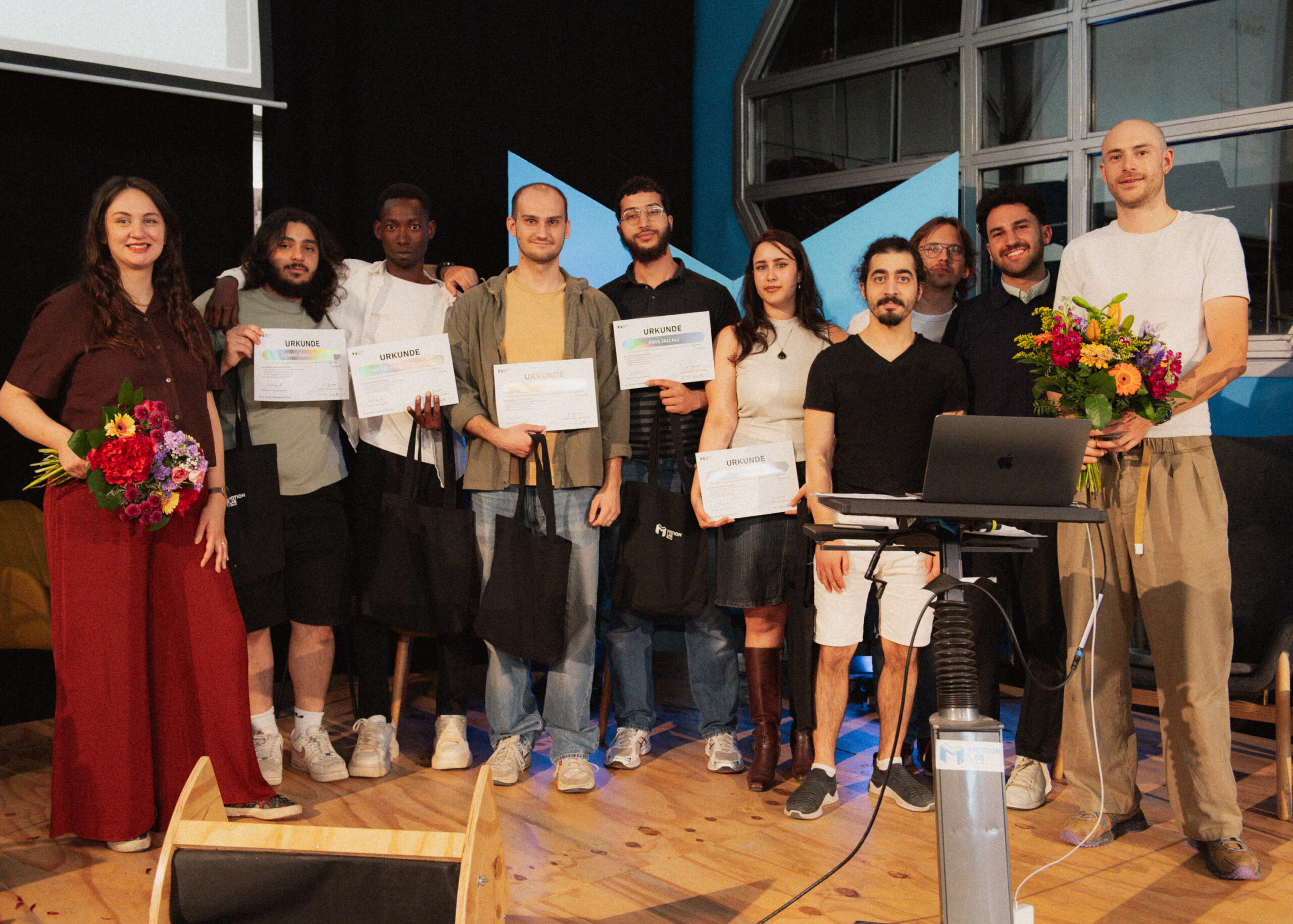
The wider customer mix includes corporate vehicle developers such as Mubea U-Mobility, alongside companies including Berlin Green and Heatle. Artists and freelance designers can also use the workshops for client commissions. Shared tools connect these groups even when their customers, business plans and ambitions have little in common.
The arrangement needs a well-defined task and enough time to participate. A student team cannot resolve an entire company’s research agenda in a term. Equally, a founder looking only for occasional fabrication may have little reason to pay for a continuing community relationship. The benefit grows when people repeatedly use the equipment and the expertise around it. That is the underlying bet of a shared workshop business.
MotionLab has also tried to make introductions less dependent on luck. Its Databank brings together member profiles, manufacturers, suppliers, investors and practical resources. The company describes a team sprint and community testing during development. The lesson is worth copying: useful contacts become more useful when people can find them without knowing whom to ask first.
When the prototype needs a factory neighbour
Marzahn addresses a different stage: pilot production and industrial operations. The campus sits within a 50,000-square-metre industrial site shared with Berlin Industrial Group businesses, including laser-technology company Scansonic and metal 3D printing specialist Gefertec. MotionLab offers manufacturing support there, including small-series work.
The commercial logic is easy to follow. A young company’s space requirements change as a prototype becomes equipment that must operate repeatedly. Being near manufacturers gives founders opportunities to ask production questions early. The important comparison is with the space and expertise a team would otherwise have to assemble itself.
The planned ringberlin facility takes that approach to 17,000 square metres in Mariendorf. Berlin announced MotionLab’s selection as operator in March 2025, following a Europe-wide tender. The founders’ centre involves investment exceeding €60 million, with roughly €36 million of public GRW funding supporting construction of subsidized areas.
Space planned for the ringberlin founders’ centre
That funding belongs to the property-development story; it is not a disclosed venture round for MotionLab.Berlin. The company currently advertises a 2027 opening. Planned facilities include controlled laboratory environments and larger production spaces. Their usefulness will depend on what is delivered and which companies choose to build there.
Berlin’s policy role also helps explain the company’s position. The Deep Tech Hub initiative brought MotionLab together with the city’s economic administration and Berlin Partner in 2024. That September, it joined the federal de:hub network. The designation connects the workshop to a wider effort to turn research into businesses, giving public agencies and industrial partners a defined place to engage.
International reach comes through programs as well as buildings. Deep Tech in Motion organizes market-entry delegations for Berlin-registered companies. Its 2026 itinerary includes Paris, Amsterdam and a September New York trip around Climate Week. Participants cover their own travel and accommodation, which makes the overseas introduction another decision to budget for.
For founders considering the workshop, the practical starting point is a specific job: a housing to print, a circuit to assemble, a test setup to build. Compare the required equipment, time and space with what a membership supplies. For anyone copying the business, the founders’ original discovery remains useful: find the work people cannot fit into the facilities they already have. Then give that work a home.
Step inside
Plan a visit through the website, compare memberships, browse the machine catalogue or read the company blog.
Follow the workshop on LinkedIn, Instagram, Facebook and X.
▶WATCH / THE HARDTECH COUCHInside DiaMonTech’s work with MotionLab.Berlin ↗