In May 2024, eight technology companies pitched their solutions to Cambridge Display Technology, the European R&D centre of Sumitomo Chemical. The brief concerned materials for the future of telecommunications. The winner, Jiva Materials, was developing naturally derived materials for printed circuit boards. An industry thinking about its next generation of connections had found a company rethinking the board underneath them.
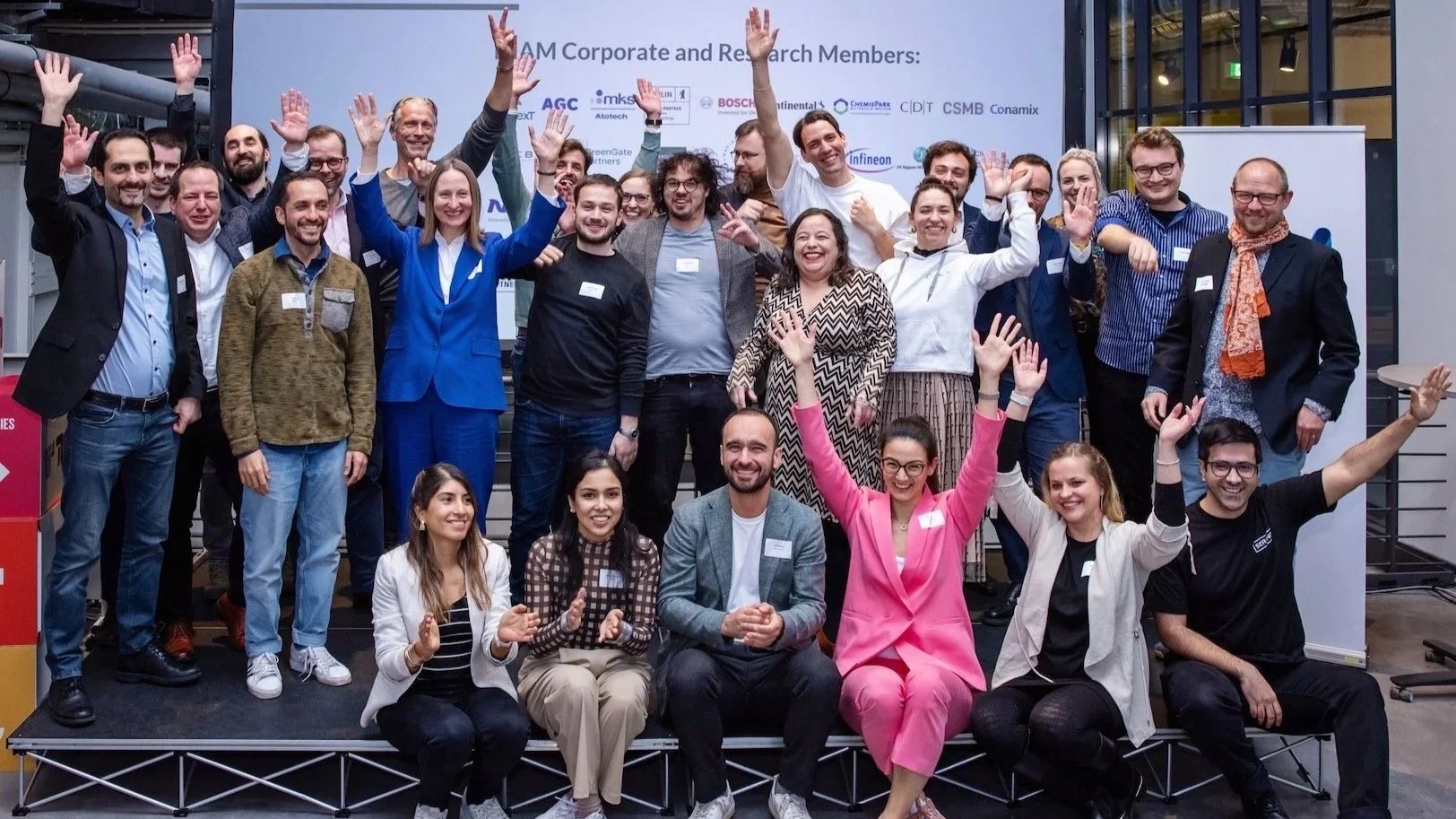
INAM organised the challenge. Its contribution was the work around the invention: finding candidates, arranging the selection and bringing them before a relevant industrial audience. A laminate does not introduce itself. Someone has to put it in the right room.
- Three equity-free programs address research, prototypes and commercial scaling.
- Corporate challenges start with a defined technical problem, then scout for suitable startups.
- Founders gain mentoring and introductions; industrial validation still has to happen.
A discovery looking for an address
The problem INAM addresses is easy to underestimate. A scientist can explain why a material is interesting. A manufacturer needs to know where it fits, how it behaves in a process and whether it deserves a trial. Those are different conversations. The commercial difficulty begins somewhere between the evidence that a technology works and the evidence that somebody wants it.
The Innovation Network for Advanced Materials grew out of Berlin’s research and industrial community in 2016. Humboldt University, IRIS Adlershof, Berlin Partner and WISTA were among its founding organisations. Contemporary accounts also identify OSRAM as an industrial partner. The early agenda covered electronics, optics and photonics, including conductive coatings and organic light-emitting diodes.
There was an encouraging early result. WISTA’s 2016 annual report records fourteen startups in the first accelerator and four new collaborations. A collaboration is an intermediate result, with commercial value still to prove. But it is a sensible thing to measure when the initial problem is that researchers and companies are insufficiently connected.
Three speeds for stubborn science
INAM’s programs organise support around technology readiness. The distinction matters: a team still validating research needs different help from one negotiating its first industry pilot. Treating both as interchangeable pitch-deck projects would be wonderfully convenient for the organiser and rather less convenient for the science.
AdMaLab, the Advanced Materials Lab, serves early teams at technology readiness levels two to four. Its published format is five months, with six selected startups and work on market fit, intellectual property, product development and public funding. It gives founders time to investigate which commercial problem their research might solve.
AdMaCom, the Advanced Materials Competition, targets levels four to six: a prototype or proof of concept ready for industry pilot testing. The 2026 edition runs for three weeks, from 28 September to 15 October, with more than twenty hours of workshops and mentoring and a final week in Berlin. Investor feedback and introductions sit beside work on market entry.
TRL means technology readiness level. These are program stages, not guaranteed outcomes.
AdMaCom Scale is the five-month option for market-ready, industry-tested products. Here the topics change to pricing, international expansion, hiring, valuations and board composition. The curriculum acknowledges something founders discover painfully: finding a use for a material and building a business around that use are separate jobs.
The price of the introduction
INAM advertises its startup programs as free to join and equity-free. They also include network membership, with different terms for each stage. That makes the offer attractive to a scientific team already contemplating expensive development work.
Participation cost and development cost remain separate. AdMaLab’s terms say laboratory access may carry a fee. Berlin attendance requires planning; INAM says travel grants depend on sponsorship. A founder should budget for the actual work around the program, rather than assume an equity-free accelerator has somehow made experiments free.
“We don’t charge you, and you keep full control over your startup.”
INAM · AdMaCom participation terms
The organisation also offers memberships for startups, corporates and investors, alongside scouting and tailored innovation challenges. Corporate members receive discounted challenges and access to a startup database. Investors can use deal sourcing. INAM occupies the service layer between research, industry and capital, with nonprofit association status and publicly funded collaborative projects also part of the picture.
Ask a narrower question
The CDT example illustrates the difference from a general accelerator. INAM helped organise a search around an industrial need. Its challenge process begins with defining the problem, proceeds through scouting and selection, and aims at solution development with the chosen startup. The buyer’s question gives the search a useful boundary.
Founders can copy that discipline without joining anything. Specify the application, identify who can evaluate it and ask what evidence would justify a pilot. For corporate teams, the equivalent lesson is to write a technical brief before inviting pitches. Otherwise, an innovation event risks becoming a very agreeable collection of unrelated ambitions.
The approach needs a technology suited to the stage and an industry partner willing to engage. Introductions cannot supply missing test results, certification or manufacturing capacity. A company seeking guaranteed purchase orders will need more than access to a network. INAM’s value is strongest where a relevant connection can make the next experiment or commercial conversation possible.
From the board to the laboratory
The eleven AdMaCom finalists announced in September 2026 show how broad that territory has become. Switzerland’s qCella develops thin heating mats from copper-cellulose hybrid fibres. US startup Symmetry Wood develops a food-waste-based hardwood alternative. Other participants work on semiconductor measurement, antimicrobial coatings and battery materials. The common feature is the need to turn a technical proposition into an industrial use.
INAM has also joined ELIgnite, a European consortium awarded €5 million through Horizon Europe. The project combines access to laser and photonics infrastructure with commercial support; its first company funding calls are expected in early 2027. That award belongs to the consortium. For INAM, it extends the same practical idea: help the people with an invention reach the people, facilities and tests that could make it useful.
INAM website ↗ Find a program ↗ News & startup stories ↗ LinkedIn ↗ X ↗ Facebook ↗ INAM videos on YouTube ↗