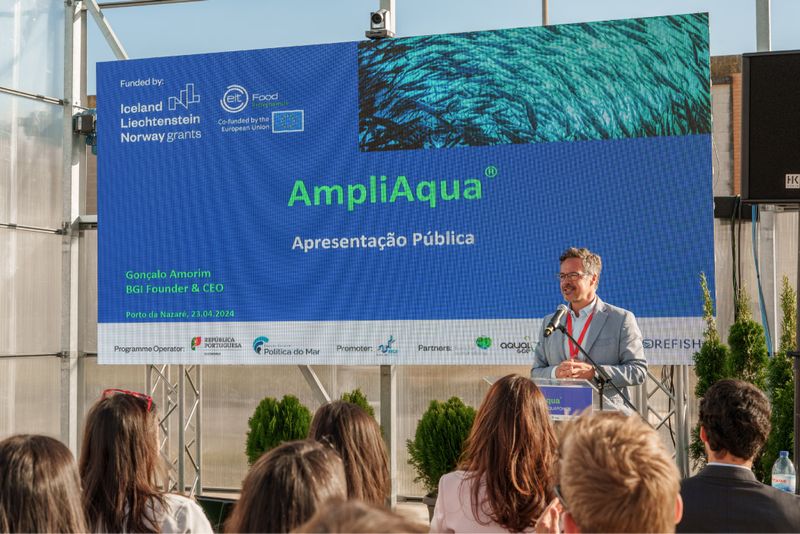
A fish tank is a merciless editor. A founder can make a circular-aquaculture system sound inevitable in a pitch deck; fish, microbes and pumps have no patience for adjectives. At AmpliAqua, a pre-commercial research facility associated with Lisbon's BGI - Sustainable Ventures, an idea has to circulate nutrients, reduce waste and keep living things alive. This is startup acceleration with wet floors.
It also explains what BGI has become. The organization started in 2010 inside the MIT Portugal orbit, when Portugal's technology ecosystem had clever researchers but fewer paths to international capital and customers. Building Global Innovators supplied a route: select technical teams, interrogate their business logic, surround them with mentors, then take some of them into the Boston entrepreneurial network. The bridge itself was the product.
Today the bridge runs through agrifood, green biotechnology, climate, urban mobility, health and digital systems. BGI still teaches founders how to frame a market and talk to investors. But it increasingly does the less photogenic work between laboratory proof and a purchase order: customer discovery, pilot design, technology assessment, industry introductions, test-bed access and evidence gathering.
First, make the weak assumption lose
Accelerators are often mistaken for finishing schools for pitch decks. BGI's older flagship program was more demanding. An academic case study described teams passing through intense self-examination and feedback before approaching investors, with more than 1,150 hours of expert mentoring available across a venture's journey. The aim was to prevent premature scaling - the expensive habit of building a company around a proposition nobody has properly tested.
That principle survives in newer programs. A blue-economy founder moves from training to bootcamps, then through customer discovery and a go-to-market plan. An agrifood researcher is pushed to identify a market before creating a company. A mobility team works on an operating problem and data supplied by a transport partner. In the ideal sequence, the first casualty is not the startup. It is the founder's least defensible assumption.
Name the problem
Turn a technical achievement into a precise customer promise.
Leave the lab
Interview buyers, operators and regulators before scaling.
Build the pilot
Choose a site, partner, KPI and test that can fail honestly.
Raise on evidence
Approach investors after the market story has acquired receipts.
The €1.36 million receipt
BGI has an unusually visible early cost record. A study of its first three editions put total accelerator operating expenses at €1.359 million: €485,000, €492,000 and €382,000. Those cohorts raised €51.807 million in dilutive and non-dilutive funding and created 250 full-time-equivalent jobs within the study window. The funding-to-operating-cost ratio was about 38 to one; the average accelerator expense per job created was €5,436.
About €38 raised by participating startups for every €1 spent operating the first three accelerator editions. Correlation is not a solo victory lap: founders, markets and investors did the company-building.
What did it cost a founder? The answer has changed with the program. A later account of the flagship model described a success fee: BGI received 3 percent equity only when a startup reached a €3 million post-money valuation or an equivalent funding or earnings threshold. Many current programs charge participants nothing because EIT or public partners underwrite them. The 2025 Blue Economy program was free and offered a €2,500 prize pool. Agrifood Disruptor asked for no equity or intellectual property. Innov4Mobility is different: its listed fee is €950, while eligible students can receive scholarships and travel support.
“A startup is like Swiss cheese: interesting in its making, but full of holes.”Gonçalo Amorim, on the work of mentoring
How a Boston accelerator became a sustainability venture builder
The shift did not arrive as a sudden rebrand. In 2014, BGI made what Amorim called an “audacious realignment” of its sectors, adding an Ocean Economy track with a ten-year impact horizon. The team expected applications to drop. More than 130 companies from 30 countries applied, roughly consistent with earlier editions. Demand did not punish specificity.
In 2016, BGI became a Portuguese delivery partner for the European Institute of Innovation and Technology and created the i-Danha Food Lab. In 2019 it secured €1.6 million for a collaborative laboratory in Idanha-a-Nova. Food4Sustainability CoLAB opened in 2020. From 2021 onward, “Sustainable Ventures” became the banner, with more attention flowing toward food, agriculture, climate and circular production.
MIT Portugal roots
A transnational technology accelerator takes shape in Lisbon and Cambridge.
The European layer
EIT programs and i-Danha widen the model beyond one flagship cohort.
Research gets a workplace
Food4Sustainability CoLAB connects scientific capability with market development.
Proof moves on site
Test beds and AmpliAqua bring pilots into production-like conditions.
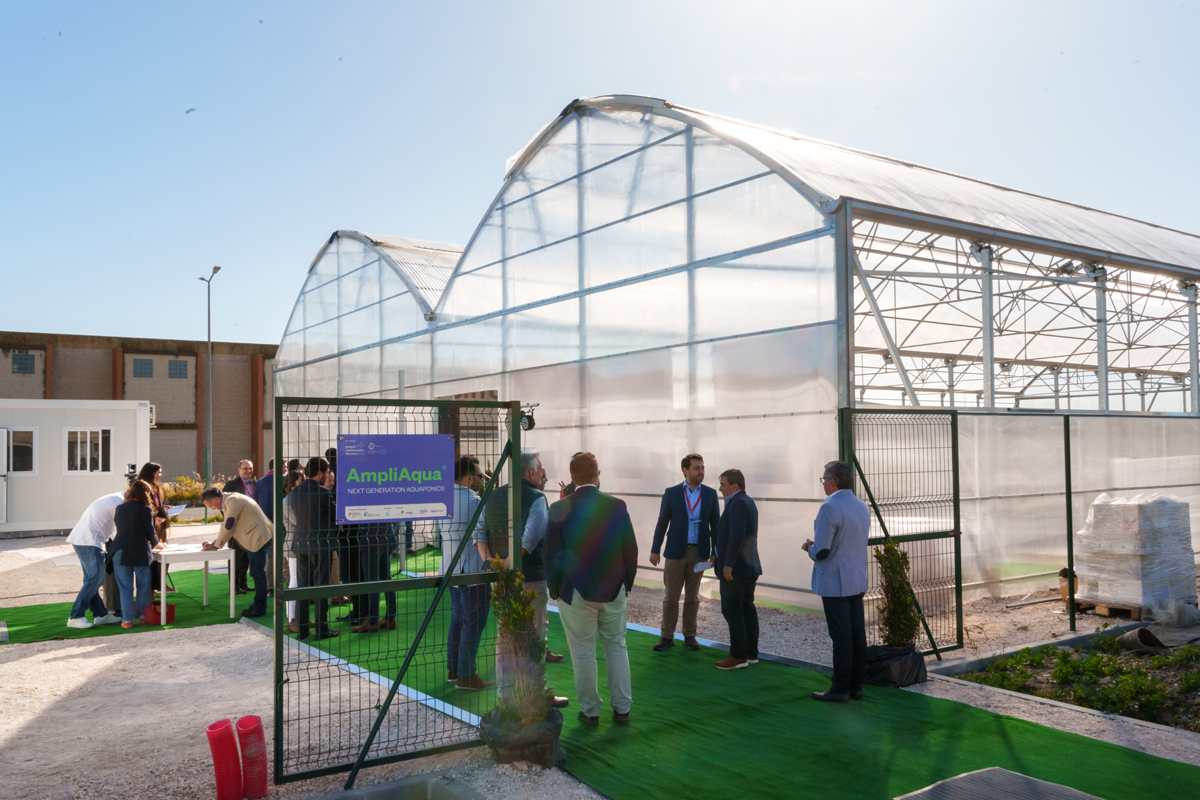
The current catalog shows the result. The Sustainable Foods Test Bed combines physical production environments, digital twins and simulation, with a stated goal of helping 45 products advance from laboratory validation toward operational readiness. AmpliAqua opens aquaculture infrastructure to work on fish welfare, nutrient upcycling, hydroponics, microalgae, packaging and automation. Mobility programs pair founders with city and transport stakeholders. EIC services focus on fundraising, pilots and a US soft landing.
Customers on both sides of the table
BGI serves two markets at once. On one side are researchers, PhD students, pre-company teams, startups and SMEs. They need commercial vocabulary, sector mentors, pilot partners and investor access. On the other are European bodies, universities, corporations, municipalities and operators that need credible ventures, structured experiments and programs they do not want to build alone.
This makes BGI different from a generalist accelerator selling a fixed cohort experience. Its competitive set stretches from Lisbon incubators such as Beta-i and Startup Lisboa to international programs such as Techstars, Seedcamp and Startupbootcamp, plus university transfer offices and specialist consultancies. BGI's advantage is the combination: MIT Portugal history, European program machinery, a cross-border mentor network and, increasingly, somewhere physical to test the thing.
The public-private arrangement also explains the breadth of its menu. EIT Food can underwrite researcher training. EIT Urban Mobility can connect a hackathon to Transportes Metropolitanos de Lisboa. Food4Sustainability supplies scientific depth. A corporate partner can bring a use case; BGI can translate it into a selection process, mentoring sequence and pilot. The company is less a single accelerator than an operator of temporary innovation systems.
The alumni are a catalog of difficult things
A useful way to understand the market BGI chose is to look at what passed through it. Early cohorts included Veniam, which built networking technology for connected vehicles; doDOC, which tackled complex document production in regulated industries; Movvo, a retail analytics business; and Sensefinity, an industrial internet-of-things company. The 2014 Ocean Economy group included CorPower Ocean, developing wave-energy equipment, and Aequor, working on control of marine biofilms. Other teams were trying to improve cancer imaging, radiation therapy and children's ear diagnostics.
These were not weekend-app businesses. They carried hardware risk, clinical or industrial validation, long sales cycles and regulatory questions. A generic growth seminar could help at the margins, but the hard problems required domain experts and patient capital. That portfolio explains why BGI moved deeper into sector programs: specialization was already hiding inside the general accelerator.
BGI now reports nine exits and two unicorns across its wider portfolio. Those top-line outcomes are useful, but its quieter metric may say more about the work: more than 1,000 jobs created. For a regional innovation program born during a Portuguese macroeconomic crisis, a technical job that remains after Demo Day is a sturdier artifact than applause. It also keeps the claim appropriately shared. BGI can select, coach and connect; founders still have to build, sell, hire and survive.
The bridge has a weight limit
There are conditions. BGI's own reported survival rate is 70 percent, which is strong evidence that acceleration is not an escape hatch from startup mortality. The model is a poor fit for a founder who wants an immediate cheque but not months of validation, a mature consumer company that has no need for technical pilots, or a team unwilling to expose its cherished premise to customers. Some calls are limited by country, sector, company age or technology-readiness level. Hands-on incubation can eventually require presence in Portugal.
Copy this
Attach every workshop to a customer conversation, every mentor to a named gap, and every pilot to a measurable decision.
Do not copy blindly
A transnational network and specialist test bed require patient institutions, credible operators and years of trust. A logo wall cannot substitute for them.
Works best when
The technology is real but the market path is fuzzy, regulated or dependent on industry infrastructure.
Works poorly when
The team needs unrestricted capital now, refuses customer discovery or cannot meet the program's geography and time commitments.
The most portable lesson is almost boring: sequence matters. First challenge the proposition. Then find an operator with a real problem. Design a pilot whose result can change a decision. Only after that should the founder polish the financing story. BGI began by overcoming geography - linking Lisbon to Boston. Its sharper recent work overcomes a different distance: the stubborn few metres between a laboratory bench and a customer willing to pay.