A startup is Swiss cheese. That is Gonçalo Amorim’s chosen comparison, and it has the advantage of being rather less solemn than the language usually served at a venture conference. There are holes. There are quite a lot of holes. A founder might prefer to discuss the cheese’s considerable potential; the person helping the business along must pay attention to the missing pieces.
In February 2026, Amorim used that image in a conversation about leadership, focus, failure and the courage to tell partners the truth. It is an apt entrance to his work. As founder and CEO of BGI - Sustainable Ventures, he operates in the awkward interval between having something technically interesting and having something another person will buy.
His own route into that interval began with engineering. Before the accelerator, the mentoring and the agricultural projects, there were scientific experiments and semiconductor components. The subjects have changed considerably. The practical question running through the career is remarkably consistent: how do the parts fit together, and what happens when they do not?
A component has to fit somewhere
Amorim’s early career took him to England. In 1997, he began a period of work that included designing scientific experiments at the Rutherford Appleton Laboratory in Oxfordshire. In 2000, he joined Hewlett Packard’s semiconductor division in the United Kingdom. His work there included international patent filings. This was engineering with a destination beyond the drawing board.
He studied mechanical engineering at the University of Brighton and earned a master’s in Engineering Management at the University of Bristol. He also became a Chartered Engineer through the Institution of Mechanical Engineers. Management entered a professional life already concerned with the behavior of physical things.
One patent application gives that background an unusually concrete form. Published in September 2003, it names Goncalo Agra Amorim alongside Daniel Keeble and Christopher John Ord as inventors of an electro-optical module assembly. The assignee was Agilent Technologies. The document concerns a module that can be inserted into and removed from a dense wavelength division multiplexing system.
The proposed assembly uses grooves, slots and matching protrusions to guide insertion. It also incorporates electromagnetic interference shielding. It is a modestly instructive object to place beside a later career in entrepreneurship: a useful component requires a workable connection to the larger system. Technical merit has to survive the business of fitting.
By 2008, Amorim had founded his first company within the Sonae Group. Moving from a component to a company changes the number of moving parts. It also adds people, money and customers, none of whom can be persuaded to behave quite like a carefully specified groove.
- 1997Engineering work in England
- 2000HP semiconductor division
- 2008A first company within Sonae
- 2013BGI becomes an enterprise
The university needed a door to the market
BGI grew out of a competition. The ISCTE-IUL MIT Portugal Venture Competition began in 2010 within AUDAX. Three years later, its activity warranted a separate organization with an international remit and a plan for sustaining itself. Building Global Innovators became that organization, with Amorim as executive director and José Paulo Esperança as president.
Its institutional connections included MIT Portugal, the Deshpande Center, the Martin Trust Center for MIT Entrepreneurship, Caixa Capital and the University Technology Enterprise Network. That list matters because the project addressed a problem that belongs to several professions at once. A laboratory can establish that an invention works. A business must work out who needs it, how to deliver it and how to pay for the attempt.
The academic setting is a revealing detail. A social sciences and management institution was helping move scientific work toward commercial use. Engineering supplied much of the material; business knowledge supplied another set of questions. The organization was built around the conversation between them.
The mentoring centered on a go-to-market plan and a network linking alumni with investors, partners and customers. Those three groups have different reasons to take a meeting. Connecting them is patient work, and a promising piece of research does not automatically make the introductions for itself.
A pitch with the bones taken out
Amorim’s explanation of the accelerator in 2016 was refreshingly operational. Selected teams would attend bootcamps, work with mentors over several months, test assumptions and prepare for investor presentations. Weekly mentoring gave the process a rhythm. A presentation day was a milestone within the work.
He described the second bootcamp as the moment to clean up the pitch. Investors, in his telling, preferred their fish without bones. It is a memorable culinary requirement for a technical founder: resolve the awkward questions before expecting someone else to swallow the proposition.
The questions were commercial and specific. Who would buy? What was the strategy? What did the team intend to execute? He also stressed the finite nature of a founder’s time. The point of concentrated mentoring was to save resources and accelerate learning, rather than simply accumulate meetings.
His distinction between investor interest and an actual investment was equally useful. An encouraging response at a demo day did not mean money had arrived. Founders still had to get through the work between the two. In a profession fond of announcements, that is a fairly consequential distinction.
The scale of the operation has since changed. At the time of this profile, BGI reports 335 accelerated startups, $660 million in capital raised and a 70 percent survival rate. These are organization-level figures reported by BGI. The capital belongs to the story of its participating ventures, and the results reflect the work of founders, teams, partners and investors alongside the accelerator.
Europe as a working network
The American connection was present from the beginning, but Amorim also wanted BGI’s companies to have a route into Europe. BGI started working with EIT Digital through ARISE Europe in 2015. The partnership helped connect Portugal’s entrepreneurial activity with a wider network of businesses, expertise and finance.
His concern was the financing available after a company’s earliest stage. In 2017, he described the difficulty of finding larger rounds in Portugal and the need for a follow-on network capable of supporting growth. Starting a business and providing room for its next stage were separate tasks.
There was a personal history behind his European outlook. Amorim grew up in Brussels from the age of 14. “I feel totally European,” he said in 2017. He wanted entrepreneurs to work across cultural and language barriers and Europeans to speak more confidently about their shared achievements.
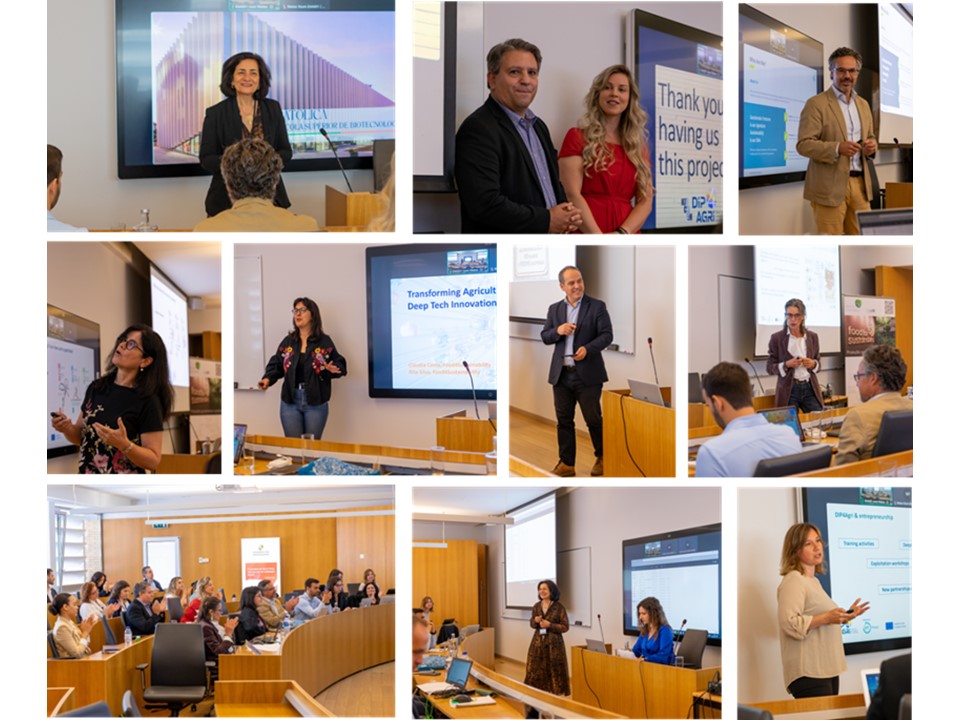
The cross-border approach extends into teaching and partnerships. At the DIP4Agri final conference in June 2024, he presented BGI’s work to an audience concerned with agricultural innovation. Contributors included Universidade Católica Portuguesa, Wageningen University & Research, Aarhus University and Food4Sustainability. The program put startup support in the same room as cultivation research, laboratory work and university entrepreneurship.
That event’s subject was the use of deep technology to create value from agrifood by-products. The gathering makes his professional network visible: researchers and business builders working on related problems from different starting points. It is the kind of company in which an engineer turned accelerator founder has a practical reason to be present.
The next customer might be a farmer
Food and agriculture now occupy a substantial part of Amorim’s attention. He serves on the executive board of Food4Sustainability CoLAB, a collaborative laboratory based in Idanha-a-Nova. The EIT Food partner directory describes BGI’s work in food-related venture acceleration, open innovation and entrepreneurial learning. Research, training and business development sit alongside one another.
Another part of this work is the Smart Sustainable Farms Foods and Trade European Digital Innovation Hub, managed by BGI. Its remit runs across farmers, food producers and distributors. It supports testing, experimentation and the adoption of digital technology, including artificial intelligence, connected devices and data science.
The hub’s account of the challenge is telling: adoption, culture and trust matter. A farmer choosing a new system has to consider an operating business, rather than a demonstration in isolation. The proposed uses are concrete, from sensors and production monitoring to traceability and digital tools on factory floors. That gives innovation a set of everyday jobs to do.
Amorim’s public work also includes the people who get to build those businesses. In December 2024, he joined a Lisbon session on building alliances in female entrepreneurship at Women in Agrifood Stories. Entrepreneurship programs can widen the circle of founders and connections through which a sector develops.
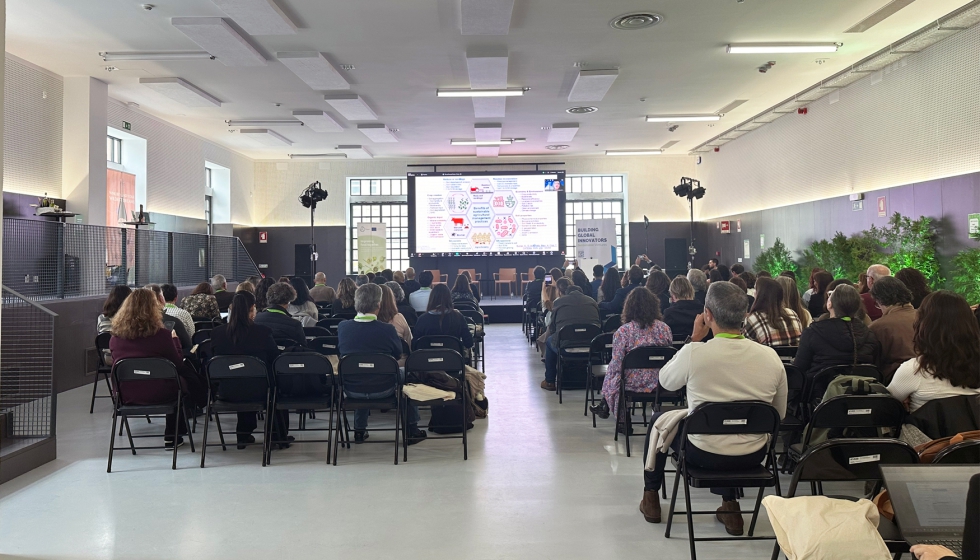
At BGI’s Agrifood Open Day in November 2025, biotechnology, entrepreneurial training and startup pitches shared the program. Discussing the work in February 2026, Amorim returned to the reuse of resources. “Para nós não há resíduos, há nutrientes,” he said: for us, there is no waste, there are nutrients.
He described AmpliAqua in Nazaré as a place where fish production and the recovery of by-products can support microbial cultivation and agricultural inputs. His concerns also included the gap between available techniques and their adoption by growers. He argued for evidence and confronted the difficulties of changing established practices. The proposed circular economy has to function for the people expected to use it.
“Para nós não há resíduos, há nutrientes.”
Gonçalo Amorim · “For us, there is no waste, there are nutrients.” (Translated from Portuguese.)
An idea earns its place in use
In January 2026, BGI announced AI4Agrifood, an acceleration program for early and intermediate-stage companies developing artificial intelligence for the food sector. Its offer included specialist mentoring, the definition of use cases, preparation of pilots and validation in real settings. Amorim described an ambition to turn ideas into tested, scalable solutions with a direct market application.
The program is implemented through the agrifood digital innovation hub and supported by the European Digital Innovation Hubs Network. Its stated scope runs from production to distribution. For all the novelty attached to artificial intelligence, the sequence is familiar in Amorim’s career: identify a problem, prepare the work for testing, and bring it into contact with its intended users.
There is a distance between a patent drawing and a farm, and his working life has covered much of it. Along the way, the same uncomfortable questions keep returning. Does it fit? Who will use it? What does the team still need? The holes in the cheese are useful information. Somebody has to keep looking at them.
Follow the work
- BGI - Sustainable Ventures
- Gonçalo Amorim on LinkedIn
- Listen: the Swiss-cheese startup conversation
- The European view: Amorim’s 2017 interview
- Read his 2026 conversation on circular agriculture
- Watch: DIP4Agri conference video on YouTube
- AI4Agrifood’s 2026 program announcement
- The electro-optical module patent application