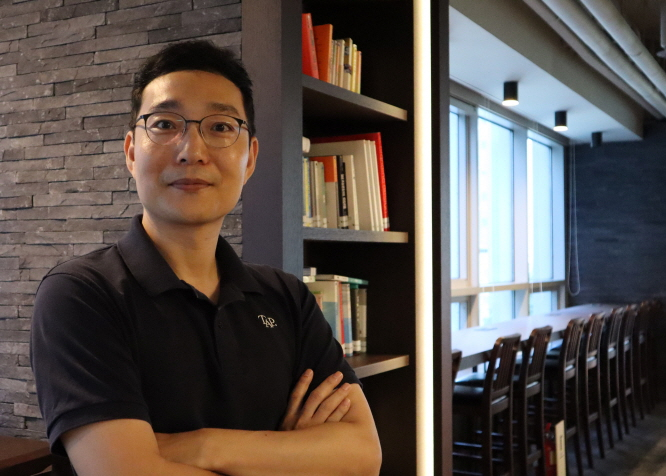
Running shoes are an unusually candid welcome gift from an investment firm. They suggest that somebody expects you to move. At TAP Angel Partners, new employees were given a pair - a small, practical expression of a business built around accompanying founders. Park Jae Hyun, the firm’s founder and CEO, works in an industry fond of celebrating the handshake. His organization has made a business of the stretch that follows it.
That stretch has acquired a substantial itinerary: specialist advice, startup programs, corporate introductions, regional investor meetings and funds. The pieces make sense together. A founder can need an investor, a customer and somebody who understands a patent problem in the same week. Arranging three separate appointments is already a part-time occupation. Building a company is supposed to fit in somewhere.
The opportunity that changed the job
Park came through law and investment management. During the latter, he saw a struggling investee acquired by a major Korean IT company within months. The reversal helped draw him toward startups. He founded TAP in 2018, assembling expertise around young businesses. The attraction was the possibility of helping a company develop, with all the uncertainty that implies.
The firm’s initials stand for Tech Angel Partners. Its operating proposition joins three activities: acceleration, venture investment and corporate innovation. Acceleration supplies organized business support. Investment puts money at risk. Corporate innovation connects startups with established businesses. Park’s company has chosen to do the connecting work as well as the financing.
A specialist with a seat at the table
The working method was visible early. In 2021, TAP team leader Kang Hyunjin described an operation that could place its own specialists inside a portfolio company. Lawyers, accountants, patent attorneys and engineering PhDs were part of the internal mix. When necessary, expertise could travel to the problem. The company being helped could keep more of its attention on developing its technology.
Kang’s own route into TAP also says something about how the organization was taking shape. With experience at two startups and a doctorate in supply-chain management, he joined after an internship, choosing the investment team over a large-company career. His account of the work emphasized acting like another member of the founder’s team. That is a demanding description: colleagues generally expect you to be available after the presentation.
There is a practical reason to build such a group. Advice becomes more useful when it belongs to a particular decision. A general discussion of intellectual property can wait indefinitely; a question about what to protect before a commercial discussion has a deadline. The appeal of an internal specialist is the shorter distance between the question and someone qualified to answer it.
Three jobs around one young company
Incheon, and the value of being nearby
In August 2021, Incheon city marked TAP’s opening in Songdo’s Michuhol Tower as part of its effort to develop a local investment ecosystem. For Park, the relationship with Incheon became a continuing part of the firm’s identity. TAP is now headquartered at Incheon Startup Park, where young businesses and support organizations occupy the same professional neighborhood.
In 2024, TAP and Incheon Technopark agreed to cooperate on mentoring, specialist consulting and lectures for resident startups. This was proximity expressed as a schedule. A nearby office becomes useful when people inside it have work to do together. The partnership gave that work a more explicit structure, tying the accelerator’s capabilities to companies already using the park.
The distinction matters in a profession built on introductions. Knowing where a founder sits can make another conversation easier. Repeated conversations let a business show change between formal pitches. An investment ecosystem becomes tangible in these ordinary encounters: the appointment that can happen, the specialist who can come over, the follow-up that finds its way onto a calendar.
Park builds a room called CORI
On September 27, 2024, TAP gathered public institutions, businesses and startups at Dreamplus near Seoul’s Gangnam Station. The event was called CORI. Its Korean name, gori, means a link. Park’s explanation was straightforward: Korea’s startup ecosystem involves both public and private participants, and working within only one part of it has limits.
“We will act as a link between the public sector, private companies and startups.”
Park Jae Hyun / CORI, September 2024 / translated from Korean
By November 2025, CORI had brought roughly 60 participants together at another Dreamplus gathering. Park described a problem he had encountered through investing and acceleration: funding and consulting alone could leave companies short of help entering a market. Corporate cooperation offered another route, particularly when young firms needed commercial experience and a quicker way to test an opportunity.
The name was chosen in Korean before the English expansion, Connect with Our Rising Innovation. Business language often takes the opposite journey, beginning with an English phrase and waiting for somebody to explain it. Here the link came first. The title had a job to do.
Park’s own professional network also extends into the sector’s collective organization. KAIA, the early-stage investment and accelerator association, named him a vice president in its fourth leadership team, effective September 19, 2025. His work therefore includes a forum beyond TAP’s own programs, alongside other investors and accelerator leaders.
The team grows, and so does the obligation
One consequential recruit was Jang Anna, who joined TAP in 2023 after working at Incheon Technopark and the Incheon Center for Creative Economy and Innovation. She later described Park’s repeated efforts to bring her aboard. What persuaded her was his intention to find promising companies very early and help develop them.
By September 2025, Jang was describing a portfolio approach centered on sustained consulting and follow-through. She said TAP’s companies secured follow-on investment in an average of 1.3 years, against the 2.5-year comparison she cited for early companies generally. That is the team’s account of its experience, rather than a guarantee for the next founder. It does show which outcome the organization wanted to discuss: the interval before another investor arrived.
The firm’s scale has changed along the way. A September 2024 snapshot put its managed funds at KRW 38 billion. By October 2025 it reported KRW 55 billion in assets under management, with about 60 companies backed and KRW 32.3 billion invested cumulatively. Its 2026 content-program materials reported KRW 65 billion AUM and 64 portfolio companies.
Dated organizational snapshots. Assets under management describe capital managed by the firm; they do not measure returns or Park’s personal wealth.
Expansion also brings different obligations. In October 2025, TAP was selected for the early-stage accelerator track of Suwon’s second Saebit Fund initiative. Its work there included tailored investor meetings, mentoring and a program intended to connect seven Suwon companies with Singaporean investors and partners. The regional work and the overseas work were being placed on the same itinerary.
From an agrifood fund to a wider map
In March 2025, TAP and the Seoul Center for Creative Economy and Innovation won selection to manage an early-stage agrifood investment fund. The plan called for KRW 8 billion, including KRW 5.6 billion from the agricultural policy funding institution. It was a proposed fundraising effort at that point, with investment requirements attached. A specialist fund comes with a defined assignment.
By May 2026, TAP had selected 14 companies for Agri·Nexus, its agrifood accelerator previously called UniFarm. Six were in a technology track and eight in a lifestyle track. The planned assistance included commercialization funding, overseas-market consulting and links to LIPS and TIPS. Agriculture, in this account, was a setting for different kinds of company-building work.
6 technology / 8 lifestyle
TAP’s March 2026 selection as a LIPS and Scale-up TIPS operator widened that assignment again. The programs serve different businesses and stages: LIPS connects private investment with government support for small businesses, while Scale-up TIPS links investment and development support for companies further into growth. Park’s operation was accumulating ways to work with a company as its needs changed.
The map also extends south. In August 2025, TAP’s regional matching initiative brought 102 startups into contact with investors from the capital region. Park emphasized the value of investors coming to Busan, allowing regional companies to meet them without first traveling to Seoul. For a founder, the location of an investment conversation can be a very practical matter.
Another meeting, another next step
On October 20, 2026, TAP held its fourth-cohort Blockbuster content meetup at Entreble in Gangnam. Companies from games, animation and the wider content business joined to exchange experience and discuss cooperation. Lee Jisu of Korea Investment Partners spoke about fundraising; Lee Youngrak of MBC Chungbuk discussed content production and collaboration with a regional broadcaster.
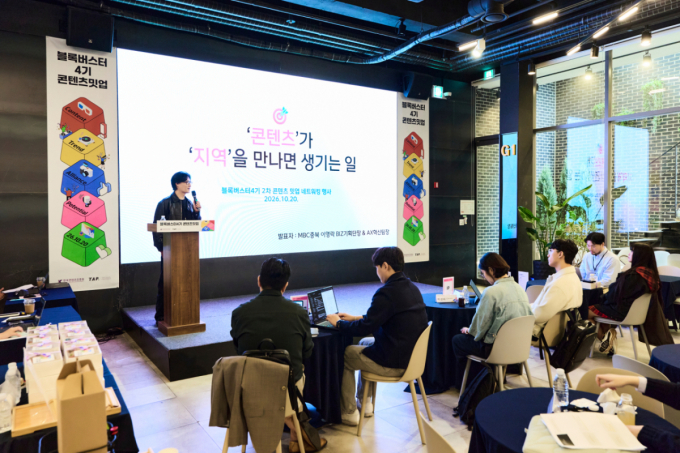
The gathering offers a recent view of the work Park has organized around founders. There are investors in the conversation, but also people who can discuss making something and finding an audience for it. Participants introduced their technologies, services and business progress, then considered joint projects, service connections and possible new channels.
A handshake can open each of those conversations. The company still has to return to its desk and decide what comes next. Park has built an investment practice around having something useful to contribute at that moment - when the introductions are finished and the work has acquired a deadline.