A startup can have a clever product and still spend Tuesday hunting for someone who understands its accounts. TAP Angel Partners has made that awkward gap part of its investment proposition. The Korean accelerator works on the business around the invention: the people, the commercial relationships and the preparations that make another investor willing to listen.
Its own description of the job is unusually plain: “Saving Time for Startups.” TAP says it can bring lawyers, patent attorneys, accountants and engineering PhDs into the work, including deploying specialists when needed. For a founder whose calendar has become a collection of unfamiliar problems, that is a more tangible offer than another afternoon of inspirational slides.
The firm combines early investment, acceleration and corporate innovation. These services meet at a practical question: what does this company need to accomplish next? Sometimes the answer is capital. Sometimes it is a business capability that capital has yet to buy.
A founder’s problem became an investor’s job
Park Jae Hyun established TAP in 2018 after working in asset management. In a 2024 account of the firm’s origins, vice president Jang Anna described the mismatch that interested him: startup teams could move quickly and develop technology, yet struggle with management and marketing. The initial professional mix reflected those gaps.
TAP moved its headquarters to Incheon in 2019. Its base at Incheon Startup Park puts it near young companies and the institutions supporting them. An August 2024 agreement with Incheon Technopark formalized work on mentoring, specialist consulting and educational programs. The choice of location makes sense for a firm whose service depends partly on being available when a company needs help.

The company also lists offices in Seoul, Busan and Changwon. That footprint gives the story a different geography from the familiar Seoul-only portrait of Korean venture capital. Its programs bring it into regional business communities as well as corporate networks.
The missing person in the business plan
A September 2025 Money Today interview offered two concrete examples: Cinnamon Lab and MOP. TAP helped with finance and marketing personnel and supported connections to strategic and financial investors. These are operating interventions with a clear purpose: address a company’s missing capabilities while preparing it for further investment.
In that interview, Jang said TAP portfolio companies obtained follow-on investment in an average of 1.3 years, against a broader early-company benchmark of 2.5 years. Treat that as a management-reported comparison, rather than proof that TAP caused the difference. Selection, market conditions and the companies included all matter.
Reported averages, not a forecast or a controlled comparison.
The useful lesson is narrower than a promise of faster fundraising. Before asking for introductions, identify what an investor would need to believe. Then work on the evidence: a credible financial picture, a suitable commercial partner, or a team able to deliver the plan.
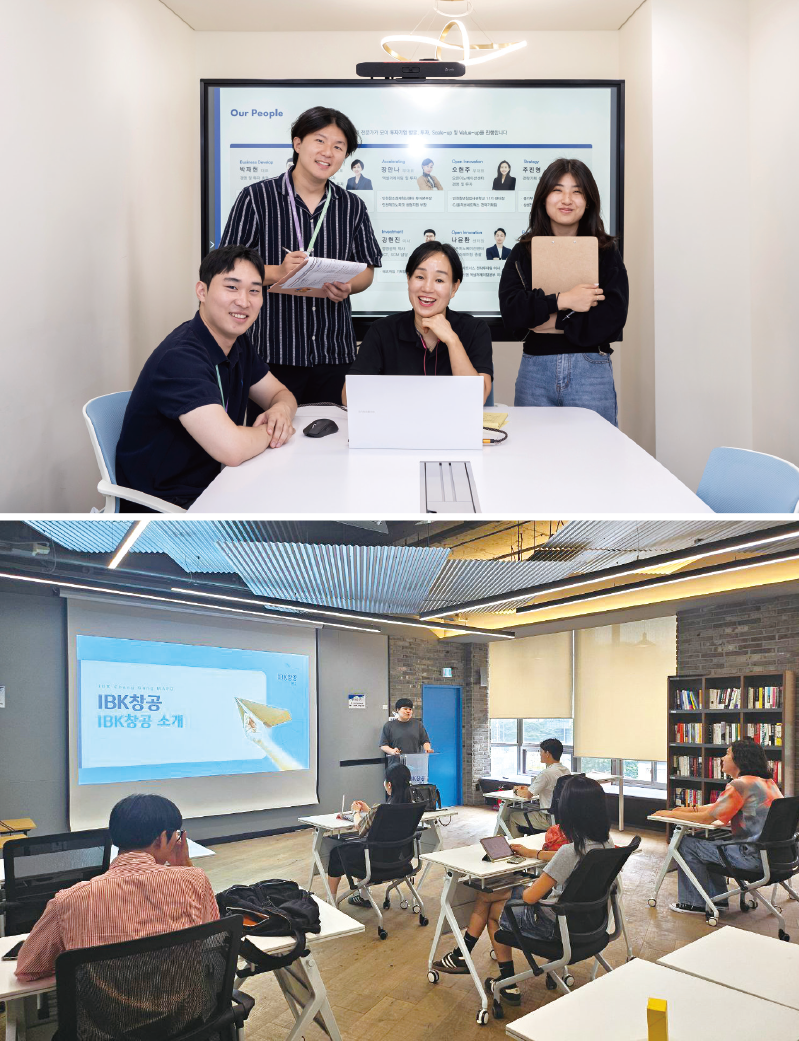
A beauty brand walks into the network
CJ ONCUBATING shows how this work extends into consumer businesses. The program’s official site names TAP as a partner for mentoring, management advice and hiring support. CJ OnStyle supplies the commerce context, including dedicated merchandising support and access to its selling channels.
For a young brand, the attraction is the possibility of connecting decisions that would otherwise happen separately. Product development affects the marketing claim; marketing affects demand; demand affects production. A founder can use the program to bring those conversations closer together. Whether that produces a viable business still depends on the product and its customers.
In March 2026, CJ OnStyle announced a KRW 11 billion dedicated K-lifestyle fund and described potential support of up to KRW 1 billion per selected brand, including investment and government matching funds. These are program financing figures, subject to selection and conditions. They are not TAP’s revenue or a standard cheque for everyone who applies.
The April cohort announcement put 30 selected brands against roughly 300 applicants. It described support running through year-end, including merchandising, marketing, research and development, live commerce and overseas channels. By August, CJ reported that the program had supported about 80 brands over three years. Those results belong to the wider CJ program and its partners.
“Run For The Crazy Ones”
TAP Angel Partners’ company motto
When the next customer is a corporation
TAP also operates where a startup needs a larger business to test an idea. The 2026 WITH Samsung Fire & Marine Insurance program made the distinction explicit, with separate TIPS-investment and proof-of-concept tracks. Its recruitment covered fields including health, mobility, insurance technology, AI and operational automation.
The advertised benefits included Samsung Fire investment and TIPS recommendation, proof-of-concept support of KRW 30 million per company, and consideration of a TAP club deal. A club-deal review is an investment possibility, not an approval. The pilot support is a particular program’s offer, not a general TAP pricing policy.
A useful corporate pilot needs a specific question. Can the proposed tool improve this process? Can the product perform in this setting? This is the practical implication of the program’s structure: match the startup’s capability to a corporate problem before treating the introduction as progress. A friendly meeting, by itself, settles very little.
Different industries, different homework
For an environmental business, getting to market can involve demonstrations, certification and regulation. TAP’s 2026 Eco-Startup operator description addresses those tasks, with sector mentoring, corporate links for testing and a Green IR Day connecting companies with environmental and energy investors. It also describes supplying staff and space as part of company building.
The agrifood offer has a different entry point. Korea Agriculture Technology Promotion Agency’s March 2026 notice lists TAP’s Agri-Nexus among its accelerator programs. The initiative covers prospective founders and young agrifood or advanced-technology businesses, with mentoring, education, demo days and potential direct investment. It specifies that investment decisions and amounts follow each operator’s criteria.
Content companies have another route. TAP’s fourth Blockbuster cohort lays out a sequence from company diagnosis to mentoring, investor meetings and commercial networking. Its 2026 operator profile reports KRW 65 billion in assets under management and 64 portfolio companies. Those are dated, reported measures of investment activity, useful for scale without implying how much cash is available to any applicant.
- 01DiagnoseSpecify the business obstacle.
- 02MatchBring in the relevant specialist or partner.
- 03DemonstratePrepare evidence for the next commercial or investment decision.
An editorial reading of TAP’s published program activities.
There is an overseas dimension as well. A 2023 Incheon program document listed TAP’s target destination as the United Arab Emirates and described a network of about 20 international partners. Named organizations included CIC Tokyo, Lmarks and Mind the Bridge. Its earlier activities included international investor presentations and support for market entry. For a founder, the useful distinction is between knowing an overseas organization and having a defined reason to approach it. A relevant introduction should serve a specific expansion decision.
Who is buying what?
TAP occupies several positions in the same market. A founder uses its investment and operating support. A public institution engages an accelerator to deliver a startup-development program. A corporate innovation team wants suitable companies and workable collaborations. An investment fund needs businesses that can grow in value. These groups share interests, but they do not ask identical questions.
The business therefore combines investment and fund management with commissioned acceleration and corporate programs. It is reasonable to read those activities as complementary: program work creates repeated contact with companies, while investing gives TAP an economic interest in their progress. That is an interpretation of the structure, not a claim about the proportion of income each activity produces.
The cost question needs the same precision. In assessing an offer, founders should separate any investment agreement from the program’s participation conditions and the resources a pilot requires. A headline support amount does not answer who pays for development, how much founder time is involved or what happens after the scheduled activities end. Those are questions to resolve around the particular offer. The published examples here give useful budget boundaries, but the commercial decision belongs at the level of the individual company and program.
Founders can compare TAP with other Korean accelerator operators. The 2026 agrifood notice, for example, also names Y&Archer, Krypton and MYSC across its recruitment rounds. The meaningful comparison is specific: sector experience, eligibility, relevant partners and the help attached to a place. A broad promise to support growth is hard to compare; a defined program is easier.

The work a founder can copy
Start with a short list of obstacles, each attached to a decision. If the obstacle is a commercial trial, name the prospective customer and the result that would justify moving forward. If it is fundraising, name the evidence still missing. This is an editorial takeaway from TAP’s approach: use outside help to complete work that has a next step.
Choose the program only after defining that need. A beauty-commerce network has a different purpose from an agrifood cohort or an insurer’s pilot track. Eligibility also matters. The agrifood notice limits company age and disallows duplicate final participation across its programs. Access to a busy network will not repair a mismatch between the company and the program.
There is a human requirement, too. Founders have to spend time with the people brought in to help. TAP’s 2026 internship coverage describes assignments in technical matching, environmental investment analysis and tourism-startup outreach. That is a reminder of what much acceleration consists of: reading carefully, understanding a business and getting the right people into a conversation.
A company that needs a large late-stage round, or whose immediate problem falls outside a program’s remit, should judge the offer accordingly. For the young business facing several unfamiliar operating decisions at once, TAP’s appeal is easier to understand. It offers people who can share some of the work. The test is what gets finished.
Follow the work
Explore TAP’s current programs, company updates and founder-focused media.
Website & current programs ↗LinkedIn ↗TAP’s Naver Blog ↗YouTube: Founder Day 1 ↗Explore CJ ONCUBATING ↗The Incheon visit & interview ↗