In 2021, Marcos Mueller recalled a classroom exercise with other accelerators in the United States. Each participant had to name a distinguishing strength. The Darwin Startups CEO chose psychological support. There were surprised murmurs. By the course’s end, he wrote, his peers were saying they would hire psychologists. It is his account, of course. But it makes a revealing opening to an investment story: the asset that needs attention may be the person holding the pitch deck.
- Early-stage investment, corporate introductions and founder support under one roof.
- A Brazilian base, with programs extending across Latin America.
- Batch #15: R$100,000 for 2%, with further investment decided separately.
Darwin operates between two audiences. Founders want capital, customers and someone useful to call when things become awkward. Corporations and institutions want promising technology, a way to evaluate it and help working with the people who make it. Darwin supplies the introductions and the work around them. A meeting is easy to arrange. A productive relationship requires rather more furniture.
A cheque cannot settle a co-founder argument
The company began in Florianópolis in 2015, supported by Fundação CERTI and people from its team. Its founders include Mueller and Mateus Eckert Xavier. Today, the company lists Mueller as CEO and André Hotta as COO. Its stated mission is to develop the entrepreneurial ecosystem and transform the lives of people and companies. That is a wide ambition. Its founder services give it a more specific shape.
Product validation, pricing, fundraising and customer development sit alongside psychological support. Darwin describes work on leadership, relationships between business partners, hiring and organizational design. These are operational questions with human consequences. Two founders who disagree about their destination can spend a financing round travelling very efficiently in opposite directions.
The emphasis has a history. In a 2019 account of his years at Darwin, Mateus described a psychologist, Ug Cobra, working with founders from the first cohort. He also described his own departure: minority ownership meant a consultative role, and he wanted to return to running a business. The distinction is useful. An accelerator can advise an entrepreneur; the entrepreneur still has to decide.
“We are human driven”Darwin’s own description of its approach
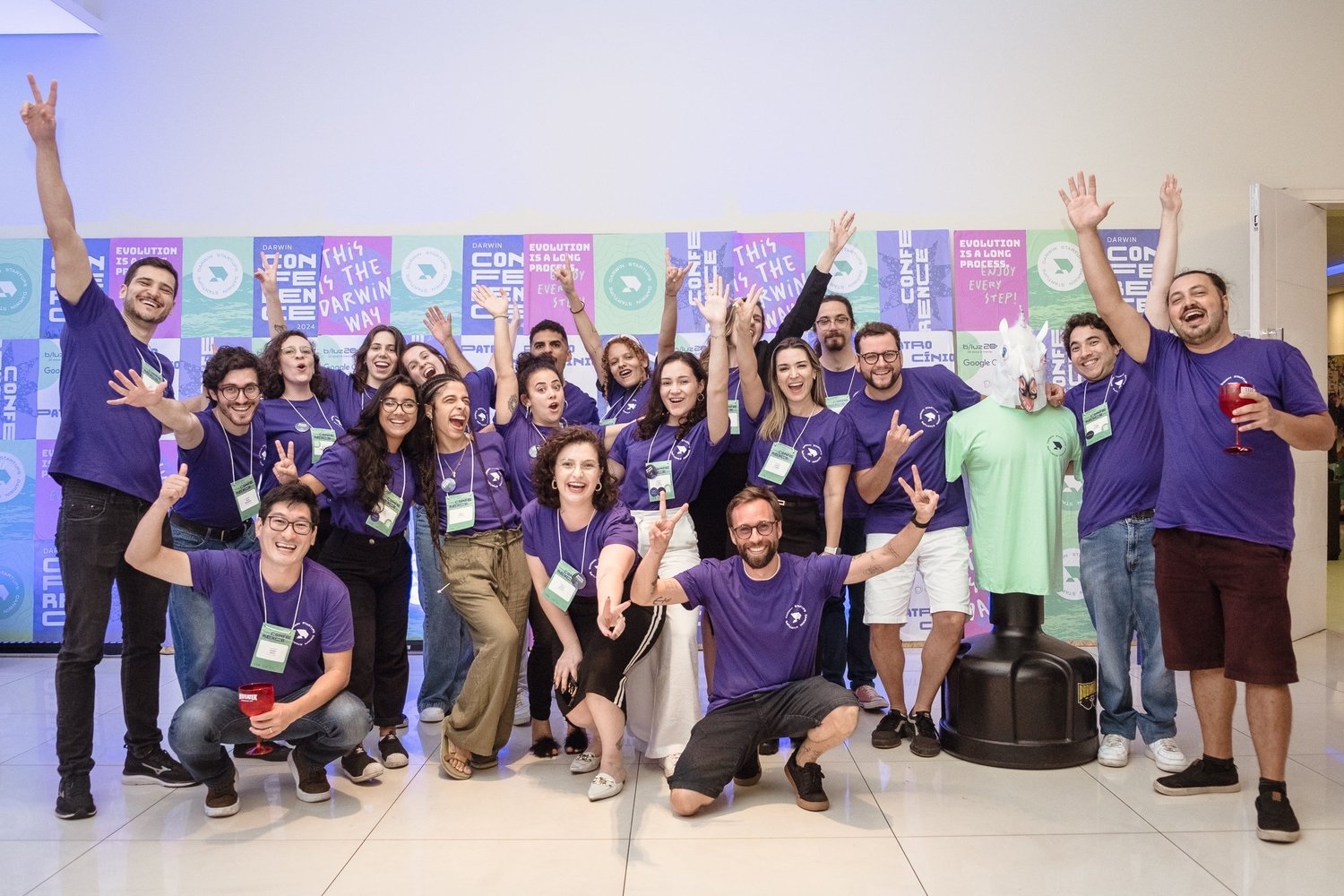
The customer may already be in the room
Darwin’s corporate network helps explain its place in the market. B3, Safra, RTM, Sinqia and TransUnion appear among its acceleration partners. For a financial-technology founder, proximity to an institution can make a business hypothesis testable. Does the proposed solution address a problem somebody owns? Can it survive the requirements of an actual organization? A polished presentation cannot answer either question by itself.
Darwin offers corporations startup scouting, selection, investment support and help preparing internal teams to work with startups. For founders, it offers assistance with experiments and proofs of concept. The distinction matters: access creates an opportunity to earn a customer, rather than a customer on demand. Buying decisions remain with the buyer.
Darwin also operates investment vehicles and delivers commissioned programs. Historical financial statements describe participation in gains from managed investment partnerships. That gives the business several kinds of work: selecting companies, supporting their development and running programs for organizations with a defined brief.
There is substance behind the network. Darwin reports roughly 100 invested startups and 11 exits. Earlier reporting identified PagueVeloz, sold to Serasa Experian, and Meetime, sold to Sankhya, among its portfolio names. Exame reported Darwin’s participation in MindMiners’ R$6 million round in 2021. These examples show investment and acquisition activity, without making every introduction a success story.
A count of portfolio sales, not a disclosed investment return.
When the corporate calendar stopped cooperating
The arrangement also exposed Darwin to the rhythm of corporate innovation budgets. In August 2026, Startups reported that the firm was returning to open cohorts after two years of selective investing. Mueller linked the decision to a colder venture market and weaker corporate innovation activity. The company had reasons to stop waiting for the old pace to resume.
Its return also reflects a change in how young businesses can be built. Mueller pointed to AI tools making product experiments faster. Darwin now welcomes solo founders, a profile it previously treated cautiously. This is a change in selection assumptions, rather than proof that one-person companies are preferable. Knowledge of the problem and the ability to execute remain central.
Capital ambitions should be read with similar care. A 2023 report described an R$80 million fund target; a May 2024 interview discussed a proposed R$100 million FIP. Those figures described plans for investment vehicles. They should not be mistaken for confirmed cash raised by the operating company. Nor is the aggregate value of portfolio companies Darwin’s own valuation.
The small cheque comes with a price
The published Batch #15 offer is R$100,000 plus perks for 2% through a convertible loan. Further investment of up to R$1 million is discretionary. The scheduled January 2027 cycle lasts 12 weeks and uses a tailored acceleration plan. The practical bargain is cash, support and access in exchange for dilution, participation and the scrutiny that accompanies an investment decision.
An alternative such as Bossa Invest or ACE Ventures belongs in the founder’s comparison. The useful questions concern the terms, the people doing the work and the relevance of their network. Darwin’s distinctive combination is corporate access plus attention to founder dynamics. Its appeal depends on whether those are the problems the startup actually has.
A network with more than one habitat
The broader program business reaches beyond financial services. Darwin’s offerings include forest and bioeconomy initiatives, work with Google for Startups, and entrepreneurship programs with 2Gether-International and IDB Lab. Its ICM Lab Solana partnership with Solana Foundation and Superteam Brasil focuses on financial infrastructure and Web3. Here, technical novelty is attached to payments, credit and capital-market use cases.
Readers can copy a modest practice from this model: identify the immediate constraint before shopping for general encouragement. Find a buyer who can test the product, a specialist who understands the problem and a candid way to discuss founder expectations. For a business unwilling to dilute ownership or pursue venture-style growth, the investment route may fit poorly. And even a well-connected accelerator cannot make a reluctant customer buy. Darwin’s wager is that better decisions early make the subsequent cheque more useful.
Follow the next experiment
Darwin website ↗ · Batch #15 and next-cohort registration ↗ · ICM Lab Solana ↗
LinkedIn ↗ · Instagram ↗ · Facebook ↗ · Darwin videos ↗ · Darwin News ↗ · Inside the 2026 cohort restart ↗