A startup founder can spend a funding round buying time, hiring people and discovering that customers still do not want the product. WOW Aceleradora de Startups has built its business around getting involved before that expensive discovery. The Brazilian accelerator brings investors into the work: evaluating young companies, advising their founders and introducing them to people who might actually buy something.
Its proposition has an appealingly practical twist. The person offering advice also has money exposed to the outcome. WOW calls this “Smart Money,” an expression common enough in venture capital to deserve interrogation. Here, there is an organizational answer behind it: a network of more than 500 angel investors and a portfolio spanning business software, marketing, agriculture and other technology markets.
The current offer is an initial investment of up to R$500,000, with equity determined in a future round and the possibility of additional investment. WOW reports 195 accelerated startups and 17 exits on its website. Those are useful measures of activity. They are not a promise about what happens to the next founder through the door.
Four founders, several generations, one shared wager
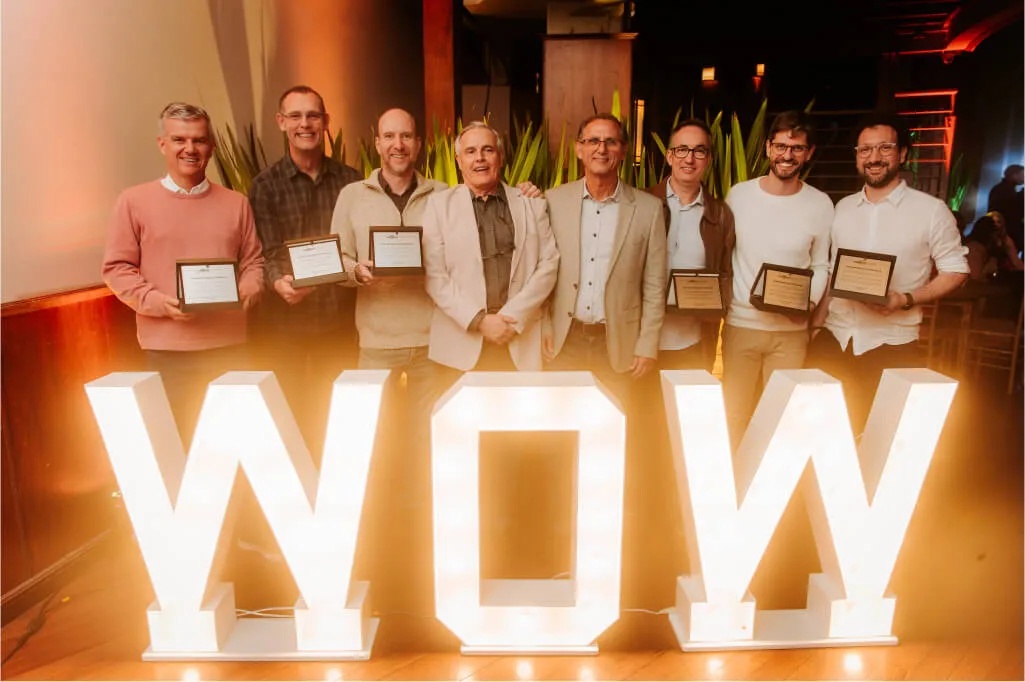
WOW began in Porto Alegre in 2013 with Bruno Peroni, Cássio Bobsin Machado, André Ghignatti and Jaime Wagner. Their backgrounds crossed company building, software and angel investing. Contemporary reporting described the founding group as four generations of entrepreneurs: people with different professional histories trying to make the next generation’s route into business less lonely.
The mix matters. Bobsin was a cofounder of Zenvia; Peroni came from Semente Negócios; Ghignatti brought experience associated with Neogrid; Wagner had built Plug In and invested in Vakinha. WOW assembled people who had already encountered the awkward gap between a technically plausible idea and a business someone will pay for.
There is also a pleasingly unpolished footnote. In a retrospective LinkedIn post, longtime operator Filipe Garcia joked that, although he was not a founder, he had made the first coffee. His account describes an organization growing from its first three investments into a much broader portfolio. The coffee is a better origin-story detail than another photograph of a handshake.
The cheque comes with a future claim
WOW’s operating model pools angel capital through investment vehicles called Investacs. These groups finance both the accelerator’s operation and startup investments. The second vehicle was its hardest fundraising exercise, according to WOW’s retrospective: the first portfolio had not yet produced realized returns. Investor enthusiasm had to survive the wait for evidence.
Terms evolved. By 2017, WOW used an 8 percent equity stake for its two standard investment amounts. In 2021, it moved to equity set in a later round. The current R$500,000 ceiling belongs to that later-round model. A founder’s economic cost therefore includes future dilution; the headline cheque does not tell the whole ownership story.
The size of that cheque has changed recently enough to matter to applicants. InovAtiva’s notice for Batch 31, with a May 2025 application deadline, advertised R$100,000 to R$400,000. WOW’s current homepage promotes pre-registration for Batch 36 at up to R$500,000. Old recruitment pages should not be treated as a current term sheet.
WOW also advertises access to more than R$2 million in partner benefits. Its partner directory includes AWS, Google for Startups, Microsoft for Startups, HubSpot, Stripe and Notion. These are tools, credits or preferential commercial conditions, not another cash transfer. Their practical worth depends on what a startup needs and which offers it qualifies to use.
Partner benefits are separate from investment cash.
A year spent asking unfashionably basic questions
The accelerator describes a process averaging 12 months, adjusted to each startup. It begins with a cohort kickoff and an individual diagnostic meeting called Dig Deep. Founders and the accelerator identify the next growth milestone, choose metrics and match the company with relevant mentors. Periodic checkpoints turn a broad ambition into work that can be revisited.
Four questions anchor the method: Who is the customer? What is the product’s value? How does the business acquire buyers? How should it charge them? Governance, founder responsibilities and finances sit alongside that commercial work. Post-acceleration support addresses the next funding round, while relationships and learning resources continue.
TownSq illustrates why this help has a market. Its founders were software engineers from SAP, originally building a condominium platform called Social Condo. They entered WOW in 2014 needing commercial and management knowledge alongside their technical skills. The problem was recognizable: neighbors lived close together but communicated poorly, and property management had room for better software.
That is a more useful description of an accelerator’s customer than “innovators.” A competent builder may need help choosing a buyer, setting a price or making a sale. Technical progress can be measured in releases; commercial progress demands evidence from people who have alternatives and budgets of their own.
The first thing to break was the sales plan
Felipe Junges, WOW’s head of acceleration, describes a recurring portfolio mistake: hiring a salesperson before the founders understand how selling works. The expected surge in revenue fails to arrive. Customer acquisition becomes more expensive and the company’s remaining cash buys fewer months of operation. An extra employee has arrived before a repeatable process.
His counterexamples include Anota AI’s Jonas Casarin and Marcos Fagundes and Aegro’s Pedro Dusso. Junges says these founders made their first 40 to 50 sales themselves. The purpose was to learn objections, sharpen the proposition and understand why a buyer said yes. A low-priced subscription cannot support the same lengthy sales effort as a large enterprise contract.
A reader can copy the discipline without joining a cohort: record what prospects ask, why they hesitate and which customers keep using the product. Treat the next sales hire as someone who can improve a process you can explain. Asking that person to discover the market while meeting a revenue target creates two jobs disguised as one.
“Não sabemos tudo.”
“We don’t know everything.”
WOW’s own introduction to its methodology
Squid changed the product. Movidesk found a buyer.
The portfolio offers more than a parade of logos. Squid began with user-generated content before shifting toward an influencer-marketing marketplace. WOW’s account describes a further commercial adjustment: working directly with major brands as well as agencies. The company’s changing customer relationships were part of the business, rather than merely a way to distribute an unchanged product.
In October 2021, Locaweb announced its purchase of Squid for R$176.5 million. That is an acquisition price for the company, not WOW’s return. It provides a concrete endpoint to a story that otherwise risks becoming a collection of cheerful growth claims. The difference matters whenever an accelerator lists a portfolio exit as evidence of its own performance.
Movidesk addressed another ordinary, costly problem: customer conversations scattered across support channels. Its software brought interactions and service workflows together. WOW’s historical case page describes a team of three in 2017. Zenvia subsequently acquired the company, with the transaction reflected in its 2022 financial reporting. The buyer’s accounts also describe later changes to the acquisition payment schedule.
Together, these examples show what early acceleration can sit upstream of: a company that changes its route to customers, or a software business valuable to a strategic acquirer. They do not establish that mentorship alone caused an exit. Founders still have to build, sell and negotiate; later investors and buyers have their own roles.
Remote access, with a reason to leave the house
WOW accepts startups from across Brazil without requiring them to move cities. That makes the network accessible to a founder whose customers, team or family are outside a major investment center. Its independence from a single corporate sponsor also gives it room to consider different sectors and business models, rather than fit every applicant into one company’s strategic priorities.
Yet remote participation has not eliminated physical gatherings. Community manager Anna Sulzbacher describes an annual Community Meetup in São Paulo and smaller events around South Summit Brazil, Web Summit Rio and Startup Summit. The point is repetition: seeing the same people again can turn a brief introduction into a relationship with enough trust for useful help.
The culture shows up in who returns. WOW’s site has a “de founder a investidor” roster, featuring entrepreneurs who have become investors. These include Becon’s Bruno Siedschlag and Mutuus’s Andress Barão. For a new founder, an adviser who remembers the awkward early years may be easier to question than an investor whose only visible activity is writing cheques.
An AI-built demo now has more to prove
WOW’s investment thinking is changing again. In an essay about its selection criteria, the accelerator says reviewing more than 300 startups in one batch revealed a shift: AI and no-code tools make functional products easier to assemble. A working demo consequently carries less weight by itself. The team looks harder at distribution, engagement, willingness to pay and the founders’ judgment.
This puts WOW in a busy part of Brazil’s funding market. ACE Ventures is one alternative, with an investment thesis emphasizing B2B and B2B2C businesses, including SaaS and marketplaces. Its venture-capital page advertises investments up to R$3 million. The overlap is real; founders must compare the stage, cheque, people and expectations behind the offer.
WOW fits founders who want early capital and are willing to expose unfinished commercial assumptions to scrutiny. The fit weakens when a business needs far more capital before it can test demand, when its owners do not want outside equity, or when the relevant expertise is absent from the available mentors. Those are consequences of the model, not defects a bigger networking event can solve.
The useful question for an applicant is specific: who here can help with the next decision that might kill my company? WOW’s answer is a community organized around those decisions, with money attached. Whether the answer is worth the dilution depends on the work that follows the introduction.