A student needs a first job. A founder needs a first customer. An investor needs a reason to believe. Marina de Empresas puts all three in the same patch of Valencia’s waterfront, where business education, startup coaching and investment share an address. Its most interesting product may be the distance it removes between one conversation and the next.
The arrangement has substance behind it. EDEM students undertake internships at Lanzadera startups; chief executives from Angels-backed companies teach at EDEM. Those are the everyday exchanges described by the investment arm. For a founder struggling to hire, or a student wondering what a young company actually does all day, the connection is rather more useful than another inspirational slogan.
First came the school. Then came the neighbours.
The component parts existed before the shared campus. EDEM became a foundation in 2002. Angels began in 2008 with an industrial investment focus, then redirected its strategy toward startups in 2014. Lanzadera started accelerating businesses in 2013. Their respective education and investment histories show an organisation assembled from working institutions, each with its own job.
Juan Roig, the businessman behind the initiative, brought them together in September 2015. The original project involved €30 million and approximately 18,000 square metres, occupying former America’s Cup team bases. BMW Oracle, Shosholoza and +39 had once been associated with the sites. The opening announcement offered a pleasing change of competitive discipline: the next occupants would try to build companies.
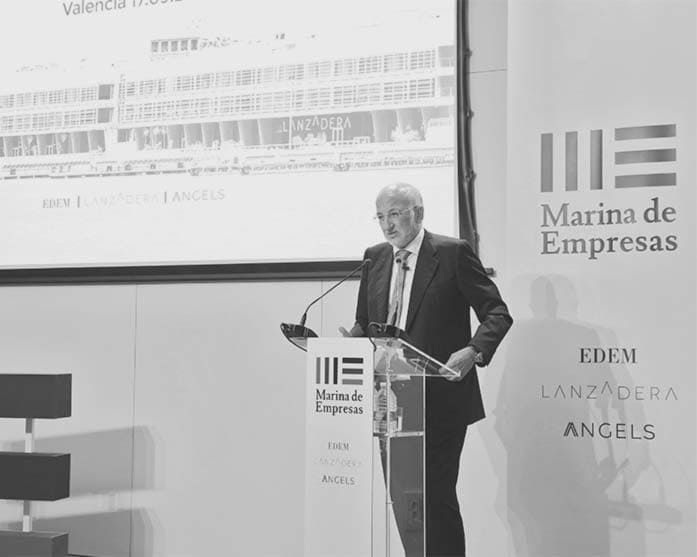
EDEM describes the purpose as developing entrepreneurs and supporting wealth and employment. Roig’s formulation, in the school’s English account, is blunt enough to survive a boardroom:
“If you give people the opportunities and the means, they become leaders”.Juan Roig · published by EDEM
That belief comes with a particular operating philosophy. Lanzadera teaches Mercadona’s Total Quality management model and encourages founders to apply it to their own businesses. Its description of the accelerator also makes room for disagreement: founders receive methods and feedback, while the decisions remain theirs. The culture asks participants to learn from an established operator without surrendering responsibility for their own company.
Six months, with homework that has customers
Lanzadera’s offer begins with an assessment of the business and a target. Its current programme maps six months from diagnosis through execution, review and a final decision about continuing. The premise is appealingly specific: work out where the company stands, identify what it needs next, and allocate help accordingly.
- 01DiagnoseStarting point, target, plan
- 02–04ExecuteTraining and specialist mentoring
- 05CalibrateReview results and adjust
- 06DecideMeasure progress; assess continuation
Meeting objectives can unlock another six months.
The format has changed. In an August 2025 explanation, Lanzadera said earlier cohorts had operated over three months; the revised programme lasted six, extendable to twelve. A diagnostic tool and tailored learning routes organise the support. A company trying to win customers has different work to do from one preparing its first investment round. The published redesign treats that difference as the starting point.
It also preserves two commercially significant terms: participation is free, and Lanzadera takes no equity. That removes a programme fee and a dilution decision from the application. It does not pay the founder’s rent. The programme’s FAQ says financing accessible through it is intended for the business, with no living allowance for entrepreneurs.
The founder supplies time, attention and presence. International applicants are welcome, but teaching is in Spanish and participants must travel to Valencia several days a week for at least six months. That makes this a substantial commitment for someone with a family elsewhere or another job. A pleasant view does not shorten a weekly commute.
The search engine nobody was buying
One of Lanzadera’s more useful published examples concerns Hutrit, a business connecting companies with technology and marketing talent in Latin America. It arrived with 30,000 profiles, a sophisticated search facility and no customers. The original proposition had plenty for a buyer to browse. It had yet to persuade anyone to buy.
According to the accelerator’s January 2026 case study, conversations with more than 120 businesses changed the offer. Hutrit began interpreting the customer’s need, filtering candidates and recommending a solution. The account reports a move from zero to €17,000 in monthly recurring revenue in four months. These are company-reported results from one case, rather than a forecast for the next applicant.
The useful lesson is modest and testable: before expanding a catalogue, check whether customers want help choosing. A founder can investigate that question through interviews and a small service experiment. It is especially relevant when buyers lack time or specialist knowledge; customers who value independent browsing may want something quite different.
Three activities, three different money questions
Calling Marina de Empresas a venture-capital business captures only one part of it. EDEM offers degrees, postgraduate study and executive education, alongside training for companies. Its 15x15 programme, for example, centres on business leaders’ experience of strategy, management and leadership. An executive seeking better judgment does not need to launch a startup to have a reason to come here.
The school also has a foundation’s support network. Its website lists corporate members and patrons spanning food, transport, finance and professional services. Education fees and institutional support belong to a different economic activity from an investor acquiring shares. Marina’s education offering reaches both people at the beginning of their careers and managers already making consequential decisions.
Angels supplies the investment function. Its current criteria describe a generalist approach, seed investment with capacity for follow-on funding, and an interest in businesses with traction that use capital efficiently. It looks for founders from Lanzadera who can identify a real customer need and execute. Admission to the accelerator therefore does not amount to an investment commitment.
Investment into portfolio companies, separate from campus construction and relief donations.
Angels reports those cumulative investment figures on its website. Its portfolio includes businesses as different as Internxt’s cloud storage, Imperia’s planning software and Timpers’ footwear. The range helps explain the market position: Marina brings business-building capabilities to multiple sectors. A founder should still examine whether the available mentors understand the particular customers, regulation and sales cycle of their company.
For someone comparing options, the practical alternative is to assemble education, advice, workspace and finance from separate providers. Marina makes coordination easier by bringing those functions close together. That is an organisational advantage, not evidence that every founder will receive better advice here. A specialist elsewhere may still be the right person for a narrowly technical problem.

The company that comes here to hire
Established businesses have several entrances. EDEM’s employment service lets employers register, publish opportunities and select candidates for jobs or internships. Student placements require a collaboration agreement. For a young company, this offers a route to talent; for an established employer, access does not depend on being an accelerator participant.
Corporate innovation is another route. Lanzadera’s UBE opportunity seeks technologies addressing industrial processes and materials, including energy storage, water treatment and recycling. This is a more concrete brief than a general request to “be innovative.” A startup can judge whether its product addresses an identified industrial problem before spending time preparing an introduction.
Marina DataHub works with real business datasets and Google Cloud support. Its Baleària challenge concerns forecasting demand and recommending ferry fares for passengers and vehicles. Teams move from understanding the problem toward a functional prototype and demonstration; further testing depends on fit with the company’s systems. The appeal for participants is practical experience with a business decision that has consequences beyond a classroom exercise.
When the urgent objective was reopening
After the devastating 2024 floods, Marina’s Alcem-se initiative addressed an immediate business problem: getting damaged enterprises operating again. Roig’s initial €25 million allocation increased to €35 million. By December, the initiative had delivered grants to 4,600 businesses. The reported reason for the increase was to cover eligible applications submitted on time.
The associated assistance directory shows how varied recovery work can be: commercial furniture, transport, cleaning, packaging and professional advice. Here, helping a business meant addressing the material things required to reopen. It gave the entrepreneurship mission a different audience from the founder preparing a pitch, and a much shorter list of acceptable outcomes.
Another sailing base, another bet on proximity
In September 2026, Marina added the Alinghi building, occupying another former sailing-team base. The approximately €25 million expansion contributes 7,600 square metres and capacity for 1,000 people. Reporting on the new building describes flexible desks, meeting spaces and shared areas; a September 7 update reported it entering full operation.
The physical commitment is easy to admire and difficult to copy. A more accessible lesson lies in the organisation of help. Put an identifiable customer problem before a general training menu. Give someone responsibility for the next step. Bring learners into contact with businesses doing the work.
For prospective founders, the selection criteria provide a useful final filter: full-time commitment, an operating product or real customers, and willingness to participate in person. A part-time idea or a founder unable to travel is a poor match. For those who can make the commitment, the proposition is tangible: people who can teach, challenge, hire and invest, close enough to meet again.
Open the right door
Explore Marina de Empresas, EDEM courses, Lanzadera’s programme and Angels.
Follow LinkedIn, X, Instagram or Facebook. Browse founder stories.
Watch EDEM’s YouTube channel, or listen to the Spicy4tuna visit to Lanzadera featuring its project team and founders.