The coffee beans make the point better than a mission statement. In June 2026, Base27 described its part in a project testing natural gas in the drying of conilon coffee in Espírito Santo. The work involved ES Gás, the Centro do Comércio de Café de Vitória and a farm in Linhares. Base27’s role included integrating technology and helping adapt drying systems. There was a practical question to answer: could a different process improve quality and make technical and financial sense?
That is a useful introduction to an organization whose industry label, “nonprofit organization management,” reveals almost nothing. Base27 arranges encounters between established businesses and people who might solve their problems. Sometimes that means a startup introduction. Sometimes it means a university project. Sometimes the work ends up beside a coffee dryer.
Its home territory is Espírito Santo, the Brazilian state where it began with engineering and construction companies. The proposition is easy to grasp: businesses with customers, operations and difficult problems should spend more time with entrepreneurs and researchers who have something useful to offer. Making those encounters productive is the actual job.
A community before the keys
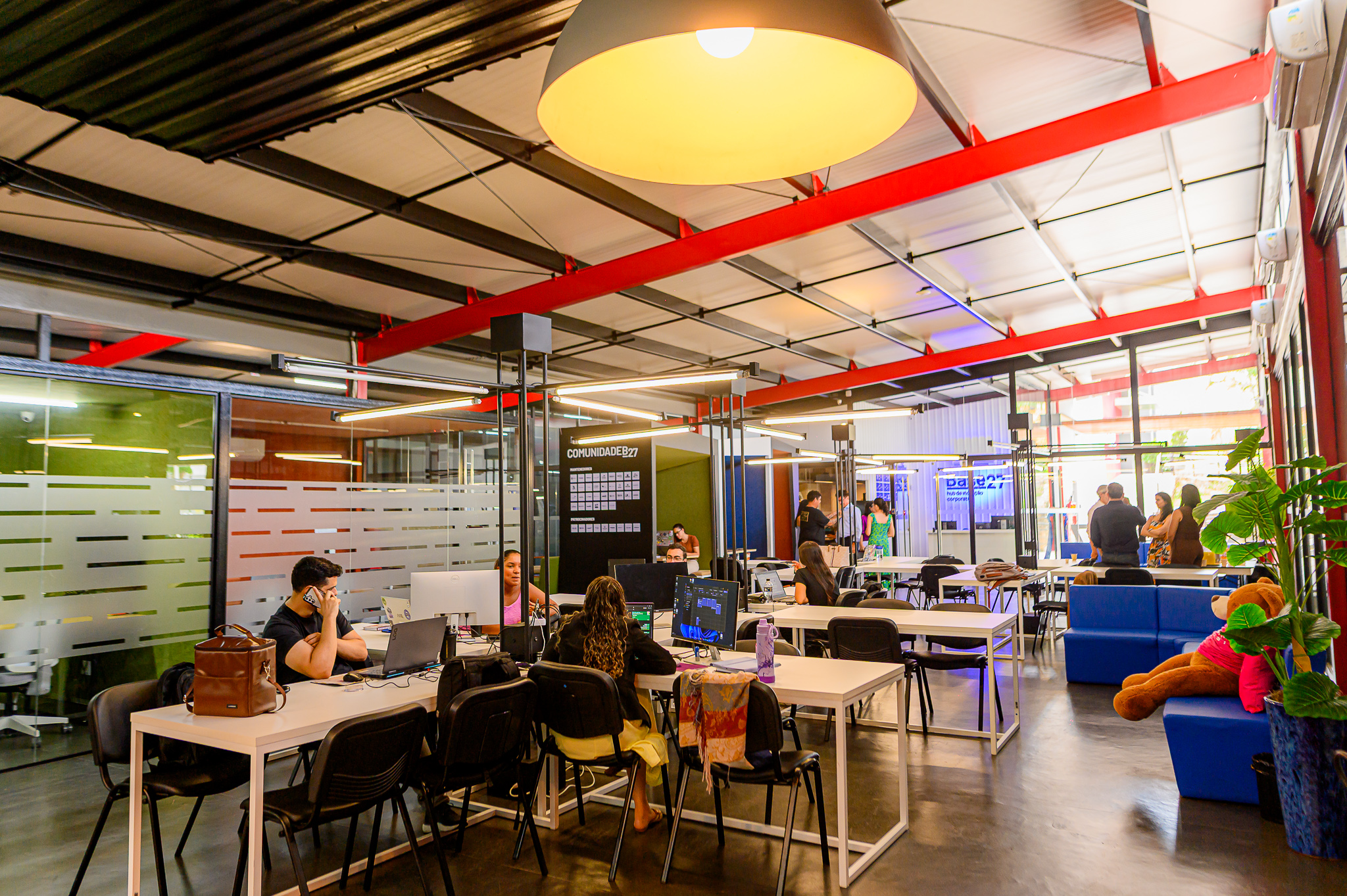
The origin story has familiar ingredients: business leaders travel, see another region’s innovation culture and wonder why their own cannot do something similar. Early reporting traced Base27’s formation to Francisco Carvalho, a cofounder of engineering company Time-Now, and Wilson Calmon of CBL. Silicon Valley, Santa Catarina and Recife provided inspiration. Coverage of the 2021 opening also identified Flávio Aguilar among the project’s initiators.
By May 2020, eight maintaining companies had committed. They included engineering, property and investment businesses. The pandemic was already under way, but the organizers planned to begin activities in June. The building could follow. Base27’s June 2021 launch invitation celebrated both its physical space and a year of remote operation.
That sequence is worth borrowing. A would-be hub can test whether companies will show up, share problems and keep talking before it asks an attractive interior to do the work. Base27’s early asset was a participating group of businesses. The address made that group easier to gather.
The first job was persuading the buyers
Carvalho’s account at the 2021 E-Commerce Brasil forum put the early challenge in human terms. Established business leaders needed to make room for startups and understand their development. A regional economy could have substantial companies without giving young ventures an easy route into them. Base27 was designed to create more of those routes.
“Fazer em comunidade é mais fácil do que fazer sozinho.”
Francisco Carvalho, 2021
“Doing it as a community is easier than doing it alone.”
In that first-year account, Carvalho reported 117 connections, 84 events and 3,600 event participations. Some participating companies competed with one another. Their willingness to learn together was part of the experiment. Those figures describe activity, and repeat attendance can contribute to a participation count. They should not be read as 117 signed customer contracts.
The corporate circle subsequently widened. In July 2024, Base27 announced Vale and Samarco as maintaining companies and said the property-technology business Housi would establish its Espírito Santo base inside the hub. Engineering roots remained visible, but the potential conversations now crossed more corporate boundaries.
October 2025 snapshot · company-reported community figures
By October 2025, the organization reported more than 40 maintaining and sponsoring companies, alongside 180 connected startups. The important word is “connected.” Membership, event participation, an introduction and a paying customer are different relationships. A founder evaluating the hub should ask which of those relationships its programs can help advance.
What the R$500 entry point buys
Base27 is a nonprofit association with a business model built around corporate support, sponsorship and services, including paid startup residency and space rental. Its 2026 residency page advertises two monthly plans. Both combine community access with mentoring and workspace; the more expensive option expands time in the building and meeting-room provision.
Part-time
R$500/month
3 coworking days per week
2 mentorships per month
Meeting-room access
Full
R$700/month
5 coworking days per week
2 mentorships per month
2 meeting-room hours per week
Both list community tools, business introductions and priority access to Ignição.
The posted difference is R$200 a month. Choosing between them should depend on how often a team will use the space and meeting rooms. Access to a network creates an opportunity to sell; it does not establish that a particular corporation needs what a resident is building.
The fit is quite specific. Base27’s startup thesis targets operating B2B or B2B2C ventures, with solutions for construction, industry, logistics, retail, productivity or ESG. A founder with a relevant product and a corporate use case has a clearer reason to participate than someone looking only for somewhere to sit. A consumer venture without a connection to those buyers would need a different rationale.
There is an earlier price tag in the history, too. In June 2021, the hub said it intended to invest more than R$1 million in innovation projects and initiatives through maintaining-company and partner contributions. That was a proposed program investment. It describes the ambition behind collective support, rather than the price of the building or a completed venture-capital round.
Introductions need an owner
The service menu shows how Base27 tries to make contact repeatable. Startup scouting searches for answers to company challenges. Matchmaking covers needs such as partnerships, hiring and benchmarking. Speed Dating puts companies and startups into short meetings. Base Conecta presents cases from the maintaining-company community. Workshops and thematic committees give people a reason to return.
For a company using these services, the useful starting point is a defined problem and an employee responsible for it. For a startup, it is a clear explanation of what its solution changes. This is the practical implication of Base27’s design: an introduction works better when the people involved can name the next decision.
- 01 / Name the problemA company brings a need that someone owns.
- 02 / Find the capabilityA startup, researcher or peer offers a possible approach.
- 03 / Agree on a testDefine what would justify the next step.
Editorial reading of the model; an introduction does not guarantee procurement.
The digital side matters as well. In January 2025, Base27 introduced its Portal da Comunidade, with individual logins, an event calendar, recordings and supporting materials. These are modest tools with an obvious purpose: make the community’s useful information available between meetings. A conversation can begin in the building and continue after everyone leaves.
The university gets a real brief
Base Educação gives educational institutions a separate route into this corporate world. Base Científica directs basic and applied research toward company challenges. Jornada Empreendedora offers practical entrepreneurship learning for adolescents in vulnerable circumstances. The audiences differ, but the educational work keeps talent development in the hub’s activities alongside business introductions.
Desafios i9 makes the format tangible. The FAESA and Base27 initiative, executed by Semente Negócios, advertised five company challenges and an eight-week university marathon. Participants would work through workshops, consultations and contact with company teams, then pitch their proposals. The advertised prizes were R$3,000, R$1,500 and R$500.
A corporate brief gives students something an invented classroom exercise cannot: a real organization whose needs may resist an elegant answer. For the company, the format opens a route to fresh thinking and prospective talent. The arrangement is most useful when staff can spend time explaining the problem and responding to proposals.
Startups receive a more business-focused form of support through Ignição. Its January 2024 acceleration call sought 17 ventures based in Espírito Santo or willing to operate there. The announced 12-month cycle used Ventiur’s methodology and personalized mentoring, covering entrepreneurship, product and technology, capital, management and market development.
Nine teams walk into an industrial fair
Hack27 brings the same challenge-based approach into a compressed format. At MEC SHOW in August 2026, Base27 and co-organizer Sebrae ES brought together 27 participants in nine teams. EDP and Grupo Estel supplied challenges. The event also involved five mentors and 12 companies, according to the post-event account.
The setting gave the exercise a particular advantage: participants were inside an industrial trade fair, close to the businesses and technologies surrounding the problems. Teams had to understand their brief, consider possible approaches and prepare presentations for a judging panel. The advertised format offered R$4,000 to each of three winning teams.
A pitch is an intermediate product. The coffee project shows a further stage, where an idea encounters equipment and production conditions. In that trial, the stated aims included checking grain quality and technical and financial feasibility. Those were questions under examination. Treating them as questions is what makes the experiment useful.
A new address, and harder questions
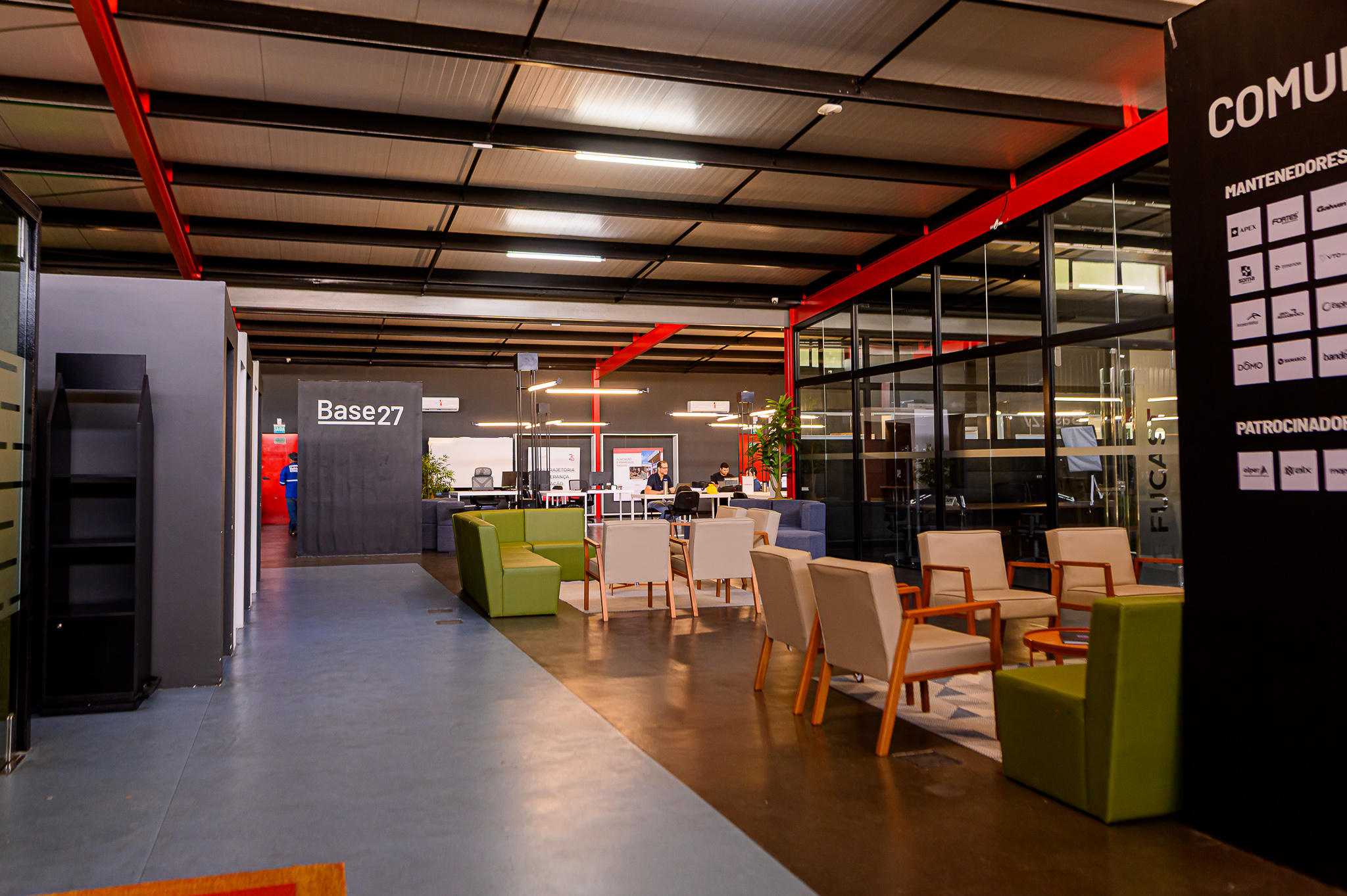
In March 2026, Base27 moved to the Fucape Business School address in Mata da Praia. CEO Michele Janovik said demand for programs and projects had outgrown the previous space. The move was also intended to deepen links with executives, research and applied projects. Capacity and proximity supplied the stated reasons for changing location.
Later that month, its Recarregar 2.0 learning track brought corporate innovation representatives together to discuss return on investment. The session also introduced an engagement ranking to track company participation. The pairing is revealing: attendance tells the hub whether members are involved; a financial assessment asks what a project is worth.
Base27 sits among other regional innovation organizations, including Findeslab and TecVitória. Its particular appeal is the combination of a corporate member community, engineering origins, startup programs and educational relationships. The choice for a prospective member is therefore practical. Who can help with the problem at hand, and who will stay involved long enough to test an answer?
That is also the lesson another region can copy. Begin with businesses willing to describe a need, bring in people with relevant capabilities, and give them a way to work together. Base27 has assembled several ways to make that happen. The work earns its value when someone carries the conversation into an actual business decision.
Step into the conversation
Explore Base27, the residency plans and the hub’s news and program updates. Follow its community on LinkedIn and Instagram, or visit Base27’s YouTube channel. For a conversation about the hub, see ES360’s interview feature.