A Porsche pilot project is an unusually good place to test a startup's sales pitch. The technology has to survive contact with engineers, suppliers and a business that already knows how to build things. By the end of 2021, Porsche reported nearly 80 projects through Startup Autobahn, the innovation platform co-founded by Plug and Play. Around one-third of the results entered series development. That fraction is the interesting part: an introduction can open a door, but the work still has to earn its place.
Plug and Play Europe operates in that space between a promising young company and an established customer's machinery. It connects entrepreneurs with corporations and investors, runs accelerator programs and draws on an in-house venture operation. Its European identity belongs to the wider Silicon Valley organization. The point of the network is practical: help startups find customers, and help customers find technology they would struggle to discover and evaluate alone.
Collaboration results entered series development.
A historical result for one partner, not a Europe-wide conversion rate.The customer behind the customer
The obvious audience is the founder: someone with a product, a demonstration and a short list of people who ought to buy it. The equally important audience sits inside a large business. An innovation manager may have a brief to improve manufacturing, reduce emissions or explore a new service. Finding a startup is only one task. Finding a relevant startup, then getting the right business unit to test its work, is a different proposition.
Plug and Play's service combines that search with introductions, program management and access to investors. The company's global corporate offering advertises more than 550 partners and over 60 locations. Those are worldwide figures, rather than a count of European customers. They explain the attraction: a local program can draw from a network much wider than its postcode.
Europe gives this approach several distinct settings. Stuttgart supplies the industrial example. Paris supplies a financial-services one: in 2017, BNP Paribas expanded its Plug and Play partnership into a fintech and insurtech accelerator at Station F. The bank described tailored support, coaching, business opportunities and fundraising access. For the startup, a bank participating in the program is potentially more valuable than another room full of startups.
Stuttgart puts the introductions to work
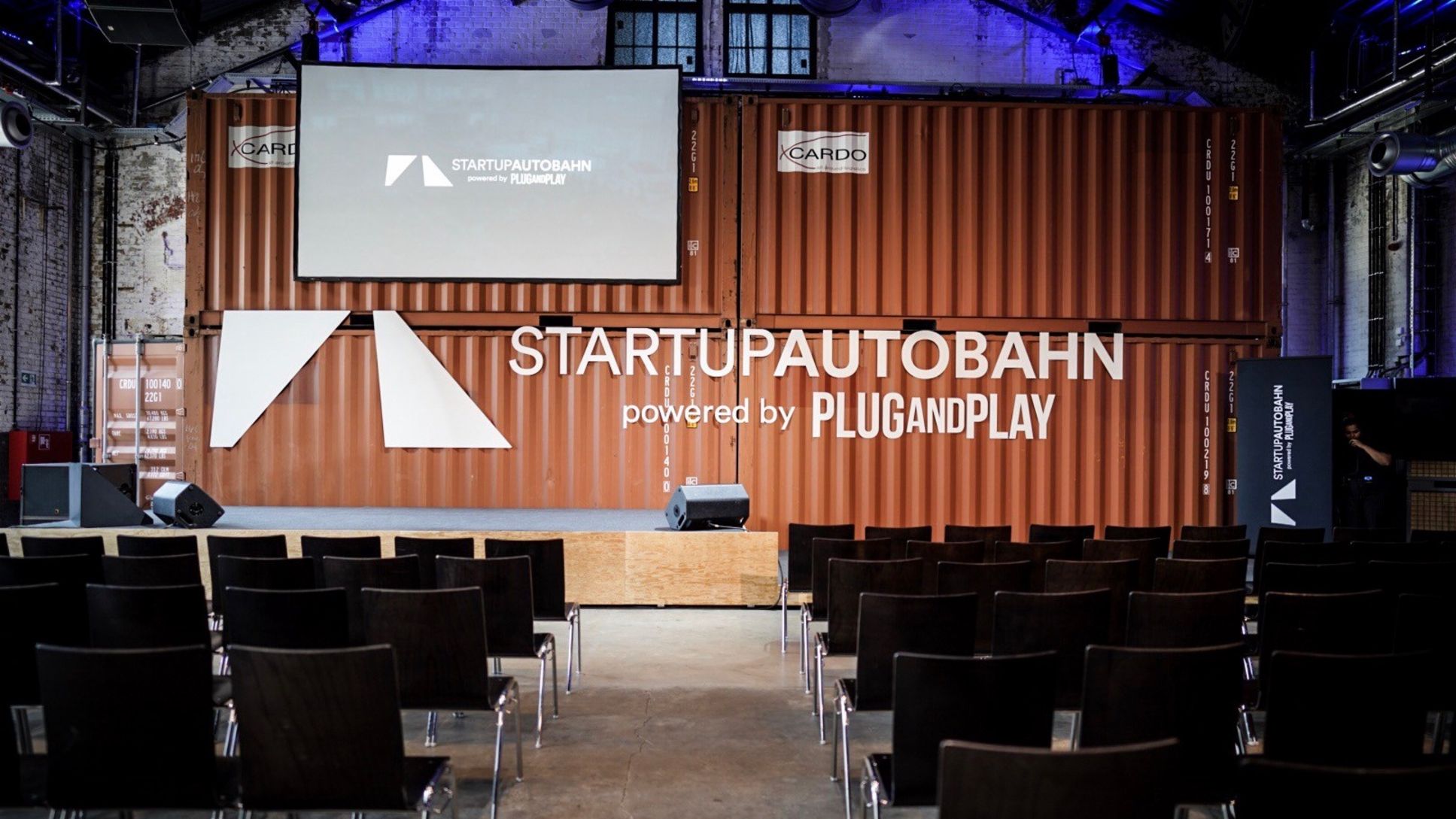
Startup Autobahn began in 2016 with Plug and Play, Daimler, the University of Stuttgart and the research campus ARENA2036. Porsche joined in 2017. The appeal was access to outside technical talent in a region where carmakers and suppliers could help turn ideas into working prototypes. Porsche's first round produced 14 completed pilot projects, with the collaborations then organized around 100-day assignments.
The program's published process gives a founder something more specific than a promise of exposure. Selected companies meet corporate teams in technical discussions called Deep Dives. Partners consider which startups to bring into the program. Joint projects follow, and the results get shown at an Expo. Afterward comes the decision about further use. A demo is therefore an intermediate event in a commercial relationship, rather than its natural finish line.
The work can be pleasingly unglamorous. In Vitoria, Spain, Nexmachina and Mercedes-Benz explored wireless monitoring for hundreds of fluid meters across two assembly plants. A meter is a more demanding audience than a pitch competition: it produces a reading, or it does not. The pilot asked whether connected devices could make that monitoring efficient and economical.
Another project connected Porsche, Berlin startup CircularTree, BASF and Motherson around supply-chain emissions. Their CarbonBlock pilot passed component-level carbon information between companies using blockchain. It won a Plug and Play innovation award in 2020. The business problem was information scattered across suppliers; the technology's job was to make those separate records useful together.
- 01Technical
meeting - 02Partner
selection - 03Joint
pilot - 04Demo +
next step
Free admission has a business model
Plug and Play's Innovation Platform FAQ describes an arrangement in which startups join without a program fee or an automatic equity transfer. Corporate partners fund the program through annual fees. Any investment in a startup is negotiated separately. That separation matters: participation, investment and a customer contract are three different transactions.
For Plug and Play, the model also creates a way to observe potential investments. Corporate teams help assess whether a young company's product answers a real need. The FAQ explicitly connects the annual partnership fee with senior management commitment and an internal executive champion. Money buys a program, but someone inside the corporation still has to make it matter.
Program-specific economics can look different. For its Lithuania accelerator, Plug and Play announced a commitment to invest €5.9 million over three years. That is planned investment into startups, not money raised by Plug and Play Europe and not a price charged to each participant. The six-month CASSINI Business Accelerator for European space companies, meanwhile, is described as equity-free.
A sensible founder should budget for the work even when entry is free: preparing a demonstration, assigning engineering time and following up with a potential customer. Those are practical implications of a pilot, rather than a published Plug and Play tariff. Before joining, settle who pays for custom development and what a successful test would unlock. A free seat can still take a substantial amount of the team's attention.
When a building became a neighborhood
One revealing admission comes from Thomas Bardawil, described in a BNP Paribas Real Estate interview as director of Plug and Play Smart Cities. Separate programs around property technology, connected devices, mobility and sustainability had proved less effective than they could be when kept apart. Buildings were being asked to interact with transport, energy and the surrounding neighborhood. The problem had outgrown the industry category.
“working in siloes like that was not as effective as it could have been.”
Thomas Bardawil · Plug and Play Smart Cities
In an interview with BNP Paribas Real Estate
Bardawil connected the Paris program's development to projects such as Le Grand Paris and the Olympic Village, where tenders covered whole areas. His account describes a change in scope: bring several industries into the same conversation because the customer's problem crosses their boundaries. The lesson for a manager is easy to borrow. Organize a search around the outcome you need, and invite the people whose systems will have to cooperate.
A landlord's idea travels
The network's origin is less futuristic than its vocabulary. Saeed Amidi's family business owned a Palo Alto building and rented spare offices to young technology companies. Its tenants included Google and PayPal. Plug and Play's later accelerator business grew from that proximity to founders. The group launched in 2006; its leadership materials identify Amidi as founder and CEO and Jojo Flores as co-founder.

In a 2010 Wharton interview, Amidi compared a founding team with a sports team, stressing mutual trust between commercial and technical founders. That is a useful window into his stated working philosophy. It also fits a business whose value depends on getting people with different expertise to cooperate. A network can arrange a meeting; it cannot manufacture respect between the people attending.
The mission is to make innovation accessible through connections among startups, companies and investors. In Europe, the interesting translation is geographical. An industrial program can borrow Stuttgart's manufacturing depth, while a smaller market can seek access to buyers and capital abroad. Plug and Play supplies a recurring format; local partners supply the problems, expertise and reasons to show up.
The map reaches Cyprus
That expansion continued in April 2026 with the launch of operations in Limassol. The Cyprus initiative is co-funded by the republic through its technology ministry and Research & Innovation Foundation, with corporate support from ASBIS, Tototheo, Mastercard and ECOMMBX. Its announced interests included financial technology, regulation technology, gaming, shipping and energy. The pairing of public backing with commercial partners makes the economic-development role visible.
By August, Plug and Play Cyprus had named ten startups in its first cohort, according to local reporting. That is a concrete step beyond opening an office, though a cohort announcement says little by itself about eventual revenue or investment. For a new location, the useful next question is what those companies manage to do with their introductions.
Elsewhere, the network has a longer record. In its June 2026 tenth-anniversary announcement, Startup Autobahn reported more than 500 projects involving over 350 startups since inception. The numbers describe sustained activity. Porsche's earlier account of results reaching development supplies a different measure: what a participating company actually carried forward.
Pick the buyer, then the program
Plug and Play shares territory with Techstars and Startupbootcamp, which also offer accelerator networks, mentorship and corporate relationships. It sits between venture investing, startup development and outsourced corporate innovation. Its distinctive combination is an in-house investor alongside partner-funded programs and repeated access to business units. That makes the identity of the participating customer particularly important.
For a founder comparing programs, the practical test is whether a relevant buyer has a problem the product can solve. For a corporation, it is whether a named team has the time, budget and authority to act on the result. Those are deductions from how the model works. Without them, a technically successful demonstration may have nowhere to go.
The Porsche fraction deserves the last word. Results entering series development are evidence of progress, not proof that every collaboration becomes a product. Nor does the remainder automatically represent failure: testing can help a company decide what to stop pursuing. The part worth copying is the discipline of a bounded experiment with a real counterpart and a decision afterward. The meeting is the beginning. Eventually, somebody has to use the thing.