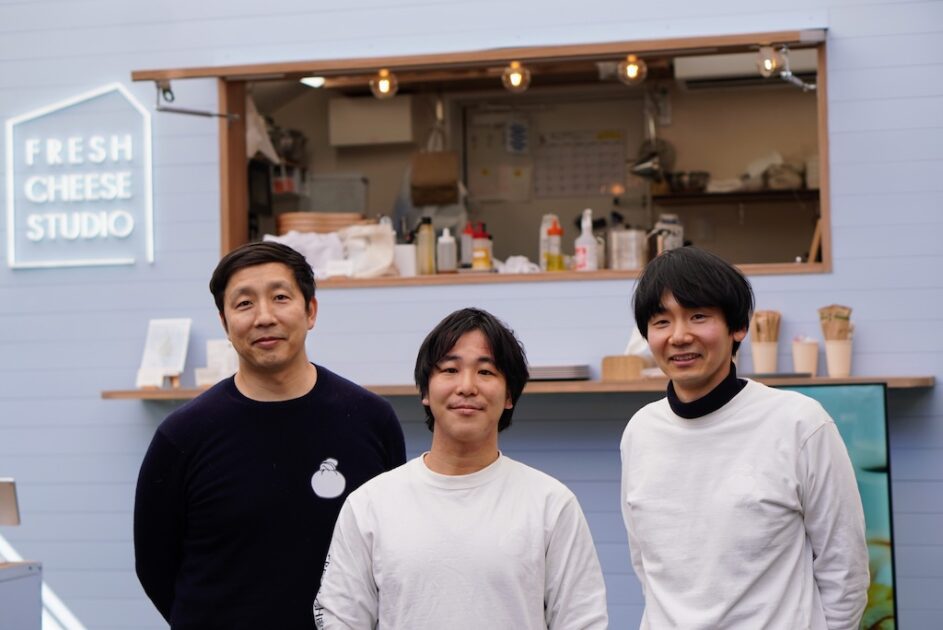
In 2021, four employees at Meiji, the Japanese food company, had an idea: bring the pleasure of freshly made cheese to customers in Japan. They worked on a business plan and won approval that December. Then came the awkward part. Much of 2022 went into internal coordination. Trial service at Tokyo hotels began in January 2023. The cheese could be fresh; the process was taking its time.
- Corporate-startup programs need someone inside the sponsor who can act.
- Secondments give employee founders a different environment for testing ideas.
- Test demand before committing to the expensive shop.
In January 2024, members of the team were seconded to 01Booster, working among entrepreneurs at its SAAI community. Their project, FRESH CHEESE STUDIO, would open a permanent Omotesando shop that November. The revealing detail is the change of setting. A corporate idea was given room to behave like a small business, with customers close enough to contradict it.
An accelerator with work on both sides
01Booster occupies a useful, slightly untidy corner of Japan’s innovation market. It designs and operates programs for companies developing new businesses, supports startups, trains employees, works with public institutions and runs a working community. Venture investment belongs to its affiliated 01Booster Capital. Calling the whole operation a venture capital firm leaves out much of the work.
Its corporate accelerator model puts an established company’s resources beside a startup’s ideas and execution. The customer list includes programs associated with Yamaha, Kirin, Nikon and Mitsubishi Estate. A startup may need expertise or access to buyers. Its corporate partner may need a way to explore an unfamiliar market without demanding that a young venture behave like an established supplier.
The intermediary’s task begins before the pitches. 01Booster helps define the sponsor’s resources and areas of interest, recruits and selects startups, then pairs participants with corporate staff who can connect internal and external resources. These people are called catalysts. It is an unusually practical job title: somebody must make the introduction useful after everyone has exchanged business cards.
- 01 Map corporate resources
- 02 Select startup partners
- 03 Run joint experiments
- 04 Decide the next relationship
The founders had crossed the border already
Norifumi Suzuki and George Goda brought experience from both corporate and entrepreneurial life. Suzuki founded the after-school business Kids Base Camp and sold it to Tokyu. Goda worked at Toshiba and Murata before joining mobile-advertising startup Nobot, whose acquisition by the KDDI group gave him another view of the meeting between a young business and a large institution.
The company began with shared-office operations in 2012. That origin matters. A shared office makes proximity a product; an accelerator tries to turn proximity into commercial activity. Over time, 01Booster added support for employees building ventures inside companies and for founders building them outside. Its published values include trust, reciprocal contribution and taking action together. The recurring concern is how people become willing, and able, to act.
A shop is an expensive hypothesis
The cheese project offers a concrete lesson in sequencing. According to 01Booster’s account, the team revised its business and activity plans, used exhibition feedback to sharpen its pitch to business buyers, and put a trial shop ahead of a full launch. A summer 2024 test in Karuizawa preceded the permanent Omotesando location.
That choice addressed a plain risk: rent and interiors become expensive mistakes if customers reject the cheese. The public account describes testing within an acceptable loss. Readers can copy the sequence: identify the costly commitment, move a smaller customer test in front of it, and decide what evidence would justify proceeding. A signed-off business plan is permission to investigate; it cannot substitute for demand.
01Booster formalized its secondment offering, Intrapreneur Beyond Residence, in September 2024. Corporate employees develop businesses in an external environment, with operational and administrative support and guidance from people who have founded companies. The service also allows launches under 01Booster’s name. This is a specific intervention in the relationship between an experiment and its parent company’s procedures.
“Make business creation routine.”
01Booster’s published vision, translated from Japanese
Learning gets more time than the lecture
The training business follows a related logic. 01School’s published design allocates 70 percent of the program to activities such as workshops and developing ideas, 20 percent to mentoring and 10 percent to group training. Participants choose problems and work on business plans. The allocation makes a useful point: entrepreneurial education needs something for the student to do.
There are several ways into the operation. An innovation department can commission a tailored program. An employee team can pursue secondment-based development. A founder can seek a corporate collaboration or use the community. SAAI lists a tax-inclusive community membership at ¥16,500 a month for 30 hours of use, plus a matching joining fee; a free-desk membership is ¥33,000 monthly, with a ¥33,000 joining fee. Those are workspace prices, a separate purchase from a corporate development program.
For a manager, the purchase begins with identifying the bottleneck. A team short of customers needs access and experiments. A team held up by internal procedures may need a different operating arrangement. A team still learning to frame a problem needs practice and mentoring. Buying the same event for all three would be convenient, but the convenience would belong to the buyer.
The commercial model combines commissioned program operations, training and business-development services with community memberships; the affiliated investment company runs venture funds. At its first fund’s final close in July 2023, 01Booster Capital reported investments in 14 startups. Harada, a fund investor, described contributing industry knowledge, business connections and access to its domestic and overseas activities.
The industry still sets the speed limit
01Booster also builds ventures rather than waiting for finished startups to apply. In November 2024, it reported that its studio had supported roughly 60 teams and helped create five companies over about two years. STUDIO 10X extended the approach across construction, property, city development, logistics and environmental businesses. These are dated results, rather than a forecast dressed up as an achievement.
The studio’s own interview identified a shortage of aspiring founders in construction and property, lengthy project timelines and difficulty earning trust. Those constraints matter when choosing a provider. An accelerator needs usable corporate resources, people with authority to cooperate and founders willing to test assumptions. Introductions have limited value when nobody can authorize a pilot. A fast experiment cannot make a construction project instantaneous.
Alternatives include hiring a consultancy, running an internal incubator or joining a corporate-startup network such as Plug and Play. 01Booster’s particular appeal is the combination of program management, employee development, a physical community and venture-building experience. Its 2026 work includes operating a Vietnam-Japan startup connection program backed by UNDP and Vietnam’s National Innovation Center. The geography has widened; the central problem remains familiar. Getting an idea approved is one milestone. Getting it into somebody’s hands is another.