In February 2025, 87 teams entered Georgia Tech’s Klaus Startup Challenge. Before anyone could collect an investment, they had to attend workshops, meet mentors, and practice pitching. Then came a small, revealing assignment: explain the business in a 90-second video. Twenty-four teams reached the live final. Five received $150,000 each in investment funding supplied by Fusen. A student could arrive with an idea for helping restaurants find diners and leave with the backing to form a company.
The brief / 30 seconds
- Startup education and mentorship for student founders.
- Free signup; selective programs and investment opportunities.
- University partnerships connect local teams with an international network.
That sequence explains Fusen World better than the usual vocabulary of startup support. The company brings education, a founder network, and early investment into the same orbit. Its audience is students who want to build businesses, including people still working out what to build. The interesting question is how much can change before a young founder has a résumé that makes investors comfortable.
A founder remembers the starting line
Christopher W. Klaus founded Fusen in 2022 after a career that began with Internet Security Systems while he was a Georgia Tech student. IBM acquired that business in 2006. His subsequent work included helping establish CREATE-X and backing student entrepreneurs. Fusen takes that campus experience into a platform intended for founders across countries.

The premise is easy to recognize if you have ever tried something for the first time. Technical ability does not automatically supply a cofounder, a customer introduction, or the nerve to ask for money. Fusen organizes access to people who can help with those steps. Universities contribute a setting where potential teammates already meet. The business opportunity is in connecting the pieces early enough to matter.
“Every founder needs someone to believe in them early.”
Christopher W. Klaus / May 2025
The homework has a customer
Startup 101 Launchpad gives the idea-stage founder a practical sequence: assess an opportunity, find cofounders, build a minimum viable product, validate it with customers, examine the business model, and prepare a pitch. The minimum viable product matters because it gives somebody outside the team something to react to. An argument about a hypothetical feature can run forever. A person trying to use it gives the argument a deadline.
Fusen’s public signup is free. Its open entry point sits alongside selective opportunities: industry challenges, pitches for investment, and a fellowship organized around building a startup with Fusen as a cofounder. Ignite serves portfolio companies. These are different commitments. Joining a community gives a founder access to a starting place; earning an investment requires a further decision.
That combination places Fusen between entrepreneurship education, a venture studio, and early-stage investing. A student choosing an alternative might use a campus incubator, seek an angel investor, or apply to a broader accelerator. Fusen’s particular appeal is the connection between those activities for student founders. The company can meet someone while the question is still, “Where do I begin?”
Ignite’s current listing advertises more than $350,000 in partner cloud and hardware benefits, plus coworking space and founder meetups. Credits can conserve cash when they cover services a company needs. The weekly agenda concentrates on traction, marketing, sales, customer acquisition, and team building.
Put a price on the first step
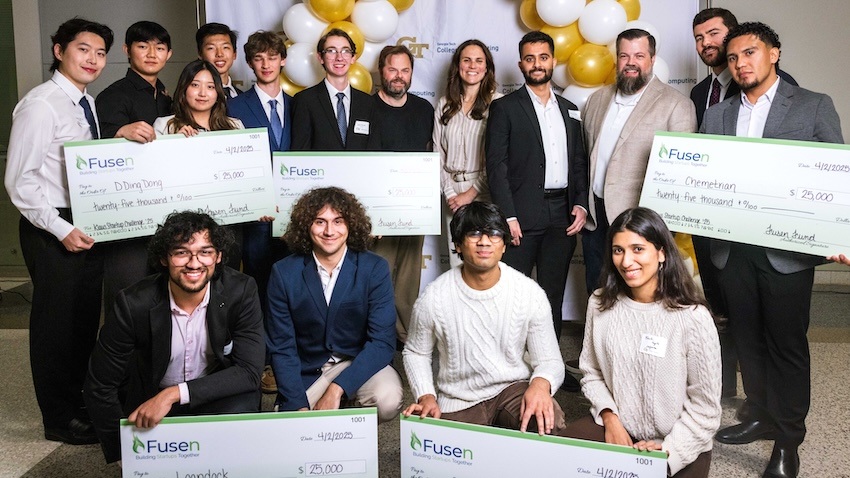
The amounts become concrete in university competitions. Georgia Tech’s 2025 challenge distributed $750,000 across five teams. In 2026, four winning teams each received $150,000 in Fusen funding support, a total of $600,000. Their ideas included contractor software, automated patient intake, and a tool for arranging dance formations. The range is useful: student entrepreneurship includes ordinary operational headaches, as well as frontier research.
There is another, smaller obstacle before a startup can operate formally: incorporation. At Georgia Tech’s May 2025 commencement, Klaus offered to cover incorporation costs for graduates starting companies. By December, the university was describing founders who had used the gift, including Overcast’s Raghav Balasubramaniam. He credited both formalizing the business and the accompanying network with helping it move forward. The gesture attached support to a specific action a graduate could take.
The 2026 allocation / USD
Concepción is part of the map
Fusen’s international ambition has a working example in Chile. At Universidad de Concepción, Gearbox’s 2025 7th Gear Challenge selected ten finalists from 138 applications. Three teams won: Chambify, PAIR, and PetFile. The competition offered initial investments of $25,000. IncubaUdeC then provided the winners with preincubation support. Local preparation and access to an international network worked together.
PAIR, which develops tools for industrial inspections, describes a January 2026 visit to Atlanta with Fusen: product feedback, mentoring, training, and work sessions at the accelerator’s founders’ house. In its own account, the visit helped it start thinking about two countries. That is a specific change in perspective. For a young company, meeting people in another market can turn “international expansion” into questions about actual buyers.
An earlier participant shows what follow-on support can look like. In October 2024, Universidad de Concepción reported that greenhouse-technology startup Permacultura Tech received a second $135,000 investment through Fusen after achieving more than $12,000 in annual sales. Its founders described adding specialized staff and improving sensor technology. Those are tangible uses for capital, tied to a business already testing whether customers will pay.
The code was easier than the conversation
The difficulty changes once a product exists. In its account of the first Ignite cohort in early 2026, Fusen described work on defining customers, sharpening messages, testing marketing channels, and building repeatable revenue. AppealAlly founder Vien Ha identified a habit many engineers will recognize: choosing more coding over conversations. His reported progress included a launch date and a distribution plan. The bottleneck had become getting the product into people’s hands.
That example suggests a useful way to read Fusen’s promise. Mentoring pays off when a founder can turn advice into an experiment and report what happened. A venture investment also assumes a business capable of meaningful growth; a small enterprise with deliberately modest ambitions may want a different kind of backing. Access to experienced people becomes useful through the work done between meetings.
There is a copyable exercise here, even for someone who never joins. Build one usable thing. Put it in front of a prospective customer. Record the objection. Revise the offer. Then explain, in 90 seconds, who needs it and why they might pay. Fusen has built programs and investment opportunities around those early steps. The student still has to make the next call.
Borrow the exercise
- 01Build
One usable thing - 02Test
One real customer - 03Pitch
90 seconds