The revealing detail in Suraj Kripalani’s career is a piece of software that worked without the internet. In 2013, after years in investment management, he helped launch the Nalanda Education Technology Program in India. The project used an offline version of Khan Academy in schools serving low-income communities. An educational resource could be available online and still be out of reach in a classroom. Someone had to close that distance.
That small word, offline, gives this career change its substance. Access required more than pointing teachers toward a website. Technology had to fit the place where learning happened. Kripalani’s work brought him into education through the practical business of making a program function, before he founded a company devoted to helping other people build companies.
He had begun at BlackRock in 2004. His next eight years included fixed income risk and portfolio management in New York and London. The educational preparation was technical: a bachelor’s degree in computer engineering from Purdue University, followed by a master’s in financial engineering from Columbia University. These were jobs and qualifications concerned with how systems behave, how assumptions hold up and how risk can be understood.
A move into education might look like an abrupt turn on a résumé. Look at the work itself and a connection appears: an idea becomes useful when somebody can apply it under actual constraints. In finance, the constraints involve a portfolio. In a school, they include the technology available to a teacher. The sequence is concrete: investment management, a classroom initiative, then entrepreneurship.
Nalanda is a useful starting point because it places implementation near the beginning of his social enterprise work. His subsequent biography also records a period from 2015 to 2017 helping management teams in Indian businesses execute transformation plans. By the time BonBillo arrived in 2017, he had worked on established financial portfolios, an education initiative and operating businesses. He was approaching startup support with experience of organizations that already had people, systems and obligations.
- 2004BlackRock
Risk & portfolio management - 2013Nalanda
Offline classroom learning - 2017BonBillo
Founder education - 2025AI agents
Specialized startup guidance
A founder who kept taking notes
In 2017, Kripalani attended MIT’s Entrepreneurship Development Program. His LinkedIn writing from that year has the character of a student comparing notes after class. He published takeaways from the program, reflections on a session with HubSpot’s Brian Halligan, observations from the Babson India Symposium and thoughts on what makes a startup pitch work. The titles are unusually useful clues to what occupied him before BonBillo had much history of its own.
The habit matters. A founder can present a method as a personal revelation; Kripalani’s public work repeatedly identifies the methods he has learned and then teaches people to use them. BonBillo draws on Bill Aulet’s Disciplined Entrepreneurship and the Google Ventures Sprint approach. There is something disarming about an accelerator founder willing to show the reading list. The competitive work begins when a particular entrepreneur tries to apply it.
His own teaching gets specific quickly. In BonBillo’s business-model lessons, he discusses how a company chooses to get paid and explains customer lifetime value and acquisition costs. A founder with a social purpose still needs to understand the relationship between the cost of winning a customer and the value of keeping one. Arithmetic has a regrettable habit of attending even the most idealistic meeting.
This is where his financial background belongs in the story. It gives context to the material he teaches, without requiring a fairy tale about discovering purpose and discarding everything that came before. He can discuss social entrepreneurship and discounted future profits in the same curriculum. The founder listening has to make both parts work in one business.
The hours between the pitch events
The personal evidence for his mentoring is often quieter than an accelerator’s announcement. In June 2019, Azra Mboweni wrote about spending ten weeks in BonBillo’s Boston Spring Impact Accelerator on behalf of LULA. She singled out the weekly individual mentoring, the time the team gave participants and the people they brought into the program. Kripalani appeared alongside Rachel O’Neil and Julia Turnbull in that account.
It is a revealing unit of measurement: hours of attention. Demo days supply photographs and a clear ending. A recurring conversation supplies a place to admit that a customer interview went badly, a pricing assumption failed or the pitch still does not explain the product. Mboweni’s account describes the regular support around those problems. For a mentor, being useful on an ordinary week may be the more demanding performance.
Kripalani has also mentored through MassChallenge Boston and Startupbootcamp Afritech. He is listed as a founding advisor to the New England Impact Investing Initiative. A February 2024 Yale event invited him to discuss building a career in social impact. These connections put him in several rooms: founder education, startup acceleration, impact investing and conversations with students considering their own working lives.
BonBillo’s wider team makes the teaching less dependent on one person. Its roster includes Turnbull, whose work is in custom programs at MIT Sloan Executive Education, and product director Swapnil Chugh, founder of INSEAD Learning Hub. That combination helps explain the organization around Kripalani: finance experience beside people concerned with learning and product development. A founder arrives with one company; the questions tend to cross several professions.
“We believe people, planet, and profit thrive together.”
Suraj Kripalani · Go Overseas interview
Cape Town, with a bicycle in the picture
There is a welcome interruption to the professional biography in his account of a first visit to Cape Town in 2017. He remembers Table Mountain, a bicycle ride from Sea Point to Camps Bay, a red bus tour and time at the Waterfront listening to local bands. It is a travel memory with room for an afternoon. An itinerary occasionally improves when the investor meeting is over.
Cape Town also became a setting for BonBillo’s work. In his interview about its social entrepreneurship bootcamp, he described the value of local context, a framework for testing solutions, experienced advisors and a peer group. The travel and the teaching sit comfortably together: a program happens somewhere, among people dealing with the opportunities and constraints of that place.
Asked about his ambitions for the company, he said, “We believe people, planet, and profit thrive together.” The statement is broad, but his program’s attention to business models gives it a practical consequence. A venture has to sustain its activity while pursuing its purpose. The ambition carries a recurring assignment to examine whether the two are actually connected.
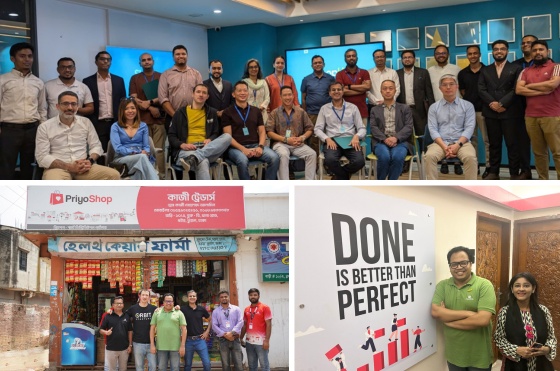
His April 2025 Bangladesh visit brings that local attention into another setting. He met founders, investors and other participants at Startup Bangladesh Connect, visited ShopUp and spent time with BonBillo alumnus PriyoShop. A photograph from the trip places the formal gathering alongside a retailer visit. The meetings have a useful change of scale: from a startup ecosystem to the shop where a business model has to function.
Making the first draft less lonely
By late 2025, Kripalani was trying another way to distribute expertise. On the November 25 episode of Prompted: Builder Stories, he discussed BonBillo’s AI work with Kyle James. The episode followed his move from BlackRock into founder support and explored tools that could help entrepreneurs work through business questions. The company’s December newsletter described a suite of more than 30 startup agents at that point.
His argument about creativity was practical: starting with something of quality can make it easier to refine an idea than facing a blank canvas. For a founder, the first useful draft might be a pitch narrative, a customer journey or a fundraising plan. A starting structure creates something to inspect. It also gives a mentor and a founder a shared object to argue over, which can be rather more productive than exchanging encouragement.
The same conversation, in a published excerpt, put emphasis on expertise in building the tools: “Subject matter experts bring their deep expertise into what an agent should be able to do.” That places responsibility with the people designing the guidance. They need to know what a useful result looks like and test whether the tool delivers it. Automating advice makes the quality of the advice consequential in a different way.
BonBillo now advertises more than 50 specialized agents across tasks including fundraising, sales, marketing, product and investor matching. Its homepage also reports 73 alumni teams and more than $103 million raised by those teams. Those figures describe the organization’s reported reach. They are alumni fundraising totals, rather than a measure of Kripalani’s personal wealth or a claim that his tools produced every result.
The human work continued alongside the software. In July 2026, he led a discussion on Objectives and Key Results following Turnbull’s session on investment readiness. The cohort was identifying its stage, setting milestones and interviewing customers. The new delivery method had brought him back to a familiar activity: helping people decide what to do next and how they would recognize progress.
Company-reported figures, checked October 2026. The fundraising total belongs to alumni teams.
Useful enough to leave the room
Across these episodes, the question of access keeps returning. An offline classroom resource reaches a teacher. A framework reaches a founder through a mentor. An AI agent makes a structured starting point available between meetings. The tools change; the distance between knowing something and being able to use it remains a practical problem.
That gives Kripalani’s career a more interesting shape than a simple departure from finance. He has repeatedly moved toward the point where expertise meets the person expected to act on it. The record contains plenty of institutions, but its most telling details are smaller: the offline software, the weekly mentoring hour, the customer interview and the visit to a retailer.
The test for this kind of work comes after the session ends. Can the teacher use the material? Can the founder make a decision? Does the draft help somebody see the business more clearly? For Suraj Kripalani, passing knowledge on has become a business of its own. Its useful moments are the ones that survive without him in the room.
Follow the work
- BonBillo: programs and founder tools ↗
- Suraj on LinkedIn ↗ · X ↗ · Medium ↗
- Listen: Prompted: Builder Stories, episode 27 ↗
- Watch: Suraj on selecting a target problem ↗
- July 2026: accelerator milestones and OKRs ↗
- The Bangladesh visit ↗ · NEIII advisor biography ↗
- Azra Mboweni’s Boston accelerator account ↗