Before Saskia Bruysten helped build a business with a Nobel Peace Prize winner, she made a file. It contained possible futures. After several years in management consulting, she was considering what to do with the rest of her working life, and she approached the question with the equipment she already owned: curiosity, contacts and a consultant's appetite for putting things in order. The trouble was that none of the options quite caught her imagination.
There is something endearing about attempting to spreadsheet a calling. It suggests a person willing to change direction, provided the change can survive a little scrutiny. Bruysten's eventual answer arrived in London in 2008, when she heard Muhammad Yunus speak. He described social business: companies organised around solving a problem, with profits reinvested in their purpose. Here was a use for the commercial skills she had spent years acquiring.
She followed up. The student in the audience became a collaborator, then a co-founder. Today, as Partner & Co-Founder International at Carbon Equity, she works on bringing more investors into private climate technology markets. Between that lecture and her present job lies a career spent examining the ordinary machinery of business: loans, suppliers, budgets, investment decisions. Bruysten keeps asking who else that machinery might serve.
The good student asks another question
Her early route was recognisable to anyone who has ever collected respectable qualifications. She studied business at the European Business School in Germany, graduating in 2003, and worked for Boston Consulting Group in Munich and New York. She later completed a master's at the London School of Economics, in the theory and history of international relations. The move placed a different set of questions alongside her business education.
The international outlook had older roots. Bruysten grew up near Frankfurt with a German father and a Canadian mother. Her mother had been a professional ballet dancer and studied at London's Royal Ballet School. In Bruysten's account of her upbringing, discipline and work mattered. So did the awareness that the world extended beyond Germany. Business school was one education; the family supplied another.
She has described her conventional early career with a little mischief. In an early career interview, she introduced her commercial background by saying, I come from the dark side.
The joke works because she knows the territory. Her later work would repeatedly draw on the people, habits and experience she acquired there. A change of purpose need not require throwing away every useful tool.
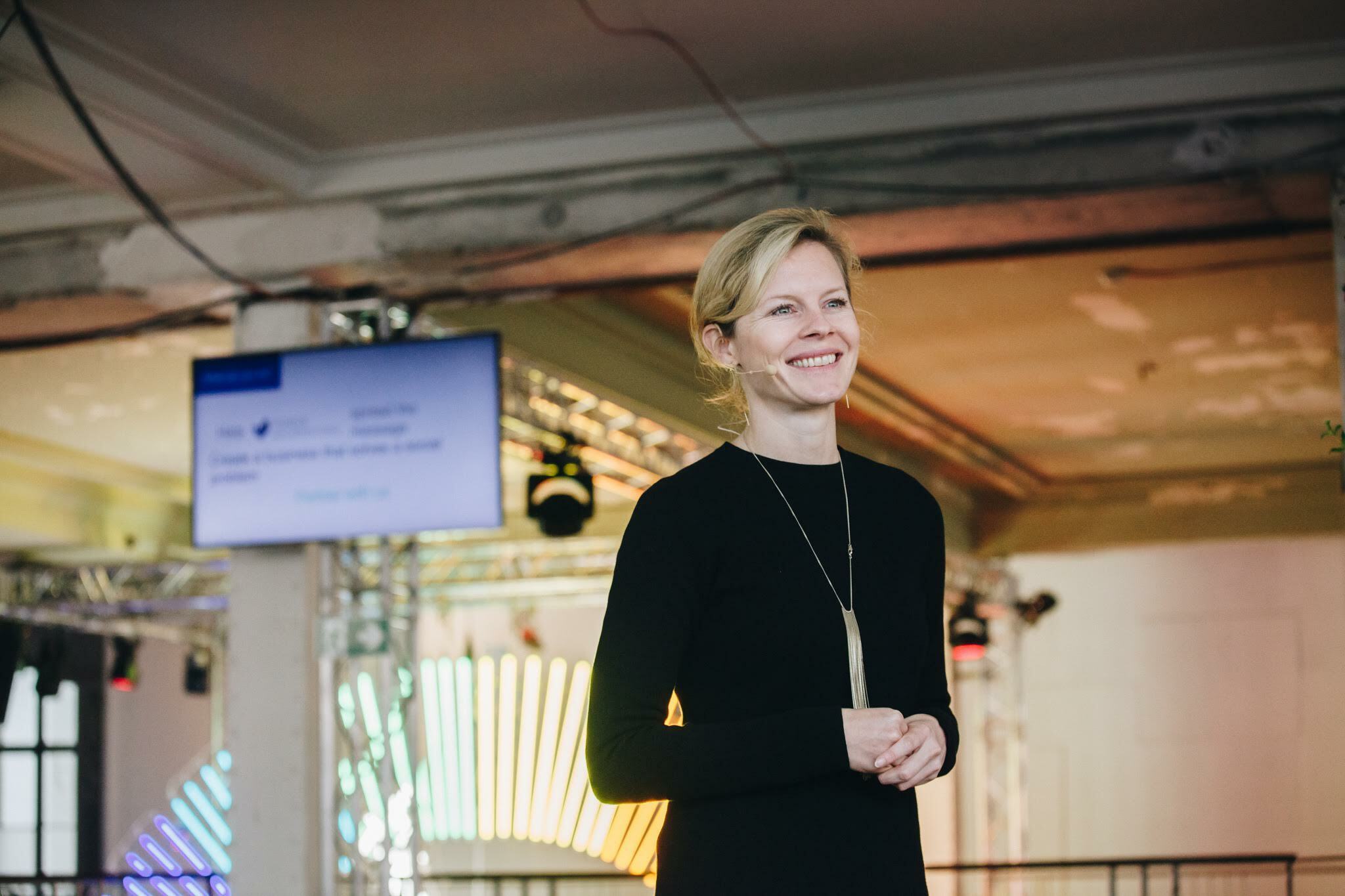
A lecture worth following up
Yunus's London appearance gave her a practical possibility. His work suggested that business methods could address problems that mattered to her while remaining business methods. In her recollection for her university's alumni publication, she handed him her business card and later met him to exchange ideas. Inspiration acquired an appointment.
By the end of 2008, she was helping establish the Grameen Creative Lab. Yunus Social Business followed in 2011, co-founded with Yunus and Sophie Eisenmann, another former consultant and EBS alumna. The sequence matters: a lecture, a conversation, work on an organisation, then a further organisation. The career change consisted of things she could actually do, one after another.
Bruysten later recalled approaching the experiment with a provisional commitment. She would try it for a year and see whether she could make it work. That is a refreshingly modest beginning for a long undertaking. There was room for uncertainty. She could test an idea without first declaring that every subsequent year of her life had been settled.
Business training
Grameen Creative Lab
Yunus Social Business
The money gets another turn
At Yunus Social Business, the financial mechanism offered its own small revision to habit. Donations could finance loans to social businesses. When a borrower repaid, the money returned to the fund and could support another enterprise. Alongside financing came help with running a company: checking finances, strengthening teams and keeping attention on the intended social result.
In 2019, Bruysten described an investment in a Ugandan chia producer working with small farmers. The example interested her because a commercially valuable crop could improve farmers' earnings. It made the argument tangible. An income, a buyer and a viable enterprise gave the discussion something firmer than a promise of benevolence.
There was still a great deal of unromantic work involved. Enterprises needed customers and capable management; repayments did not materialise because a mission sounded attractive. Her consulting background belonged in this work. Breaking a difficult problem into smaller pieces was useful when the pieces were a company's finances, its team and the practical requirements of growth.
- DonationCapital enters the fund
- Business loanAn enterprise gets financing
- RepaymentCapital can fund another business
Business support accompanies the financing. Diagram explains the model, rather than a guaranteed repayment outcome.
The Trojan horse has an office pass
Bruysten also wanted to work with people inside established corporations. She wrote about employees developing social businesses using their companies' resources and expertise. The name for them was social intrapreneurs. Her preferred image was a Trojan horse: a project could introduce a different way of thinking into an organisation that already had money, staff and reach.
The image has a pleasing corporate absurdity. Instead of warriors waiting inside a wooden animal, imagine colleagues with access to procurement and research departments. Yet her argument was specific. A project could teach a company to serve different customers, develop products under different constraints and reconsider how it defined a worthwhile result.
Her team's research identified more than 200 such initiatives and involved interviews with more than 50 social intrapreneurs. Many interviewees described internal obstacles. That finding gave her metaphor some bite. A company can possess considerable resources while making it difficult for its own employees to use them differently. Changing that requires decisions from the people who control the gates.
“Be a revolutionary if you can!”
Saskia Bruysten, advice to her younger self
Start with the things you already buy
Another opening was sitting in corporate purchasing budgets. Businesses already buy coffee, paper, cleaning and other services. Social procurement asks whether some of those purchases can go to enterprises with a social purpose. An existing expense becomes a possible route to a different outcome. It is an idea well suited to someone fluent in corporate budgets.
In a 2022 interview, Bruysten described matching corporate buyers with suitable social enterprises and training procurement teams. The work included finding suppliers that could meet buyers' criteria. Scale presented practical complications: a large order might require several enterprises. A commitment from senior management mattered, too, because purchasing departments needed permission and criteria to act.
This part of her career makes a useful corrective to the glamour surrounding founders. Sometimes the consequential conversation concerns a supplier list. The difficulty lies in getting an organisation to revise a routine, then repeat the revised routine when the initial enthusiasm has passed. Bruysten's interest in the machinery is what makes this chapter fit the others.
Keep the old address book
BCG remained part of the story. The firm began supporting Yunus and his network in 2012, with work spanning strategy and operations. Bruysten had become a client of the organisation where she began her career. More recently, she has spoken about encountering BCG alumni again through Carbon Equity, including people investing through the platform.
She has joked publicly about feeling like a BCG lifer. The recurring connection is revealing. She seems comfortable carrying a previous professional identity into new work. Former colleagues can become collaborators; the experience accumulated in one institution can be useful in another. Her story gives the career pivot a less theatrical shape than the customary clean break.
The same breadth appears outside her investment work. She co-founded the mentoring organisation Step up! Karrierewege, whose profile lists an engagement as a hip-hop trainer alongside interests in sailing and ballet. That is a better collection of particulars than a generic description of a busy executive. A person can know her way around both a business model and a dance floor.
A different destination for capital
Her current role brings the argument into climate investing. At Carbon Equity, Bruysten leads international expansion for a platform giving investors access to private climate technology funds. Her colleagues include co-founder and CEO Jacqueline van den Ende. Bruysten's job connects the platform with a broader pool of capital, rather than making her the inventor of each technology it finances.
She also remains connected to social innovation. Yunus Social Innovation lists her as a co-founder and shareholder, based in Berlin. The overlap makes sense: changing roles has left her with continuing relationships as well as new responsibilities. The earlier work has an institutional life beyond her tenure as CEO.
In March 2026, she discussed purpose, returns and her career in a NEXT LEVEL interview. Her recent public conversations have also examined the energy infrastructure needed for artificial intelligence. The subject fits her habit of looking beneath a fashionable conversation for the commercial decisions that make it possible. Power supply, efficiency and investment access provide plenty of work after the slogans have been printed.
Go back to that file of possible futures and the career looks less predetermined. She had a useful education, an established profession and a question she could not leave alone. Listening to Yunus supplied a direction. Following up supplied the work. The file, presumably, had served its purpose. There were businesses to build.
In her words, and in her work
- Carbon Equity - current work
- Yunus Social Business
- Yunus Social Innovation
- LinkedIn - Saskia Bruysten
- Twitter / X - historical public account
- Her writing: the corporate Trojan horse
- Interview: the route into social business
- Watch: That’s Smart Money (German)
- Watch: Power Couples, DLD Munich 2023
- Listen: The Purpose Playbook