At ten, Daniel Epstein had a business that required dirt under his fingernails. He mowed lawns, cut grass and landscaped. He liked being outside, and people were willing to pay a child to work on their property. Eventually, the arithmetic became interesting: he could charge more, hire friends and pay them to help. Before the international fellowship, before the investors, before the speeches, there was a patch of grass and a customer who wanted it shorter.
It is a pleasing beginning for someone whose adult work would involve so much talk of growth. The childhood enterprise also offers a practical way into Epstein’s story. He found something he liked doing, discovered that other people valued it, and brought more people into the job. His ambitions have changed considerably. That sequence remains recognizable.
Years later, a reporter noticed a blue wristband on his arm. It asked, “What Would MacGyver Do?” The television resourcefulness was an apt accessory for a founder who would help turn a ship into an accelerator. Some entrepreneurs advertise their taste in watches. Epstein had chosen a reminder to improvise.
A philosophy degree with commercial consequences
Epstein graduated from the University of Colorado Boulder in 2008 with a degree in philosophy. By the time he finished university, he had already started three companies. His academic subject and his appetite for business were traveling together. Philosophy supplied questions about what deserved his attention; entrepreneurship supplied a way to act on the answers.
There is something quietly comic about graduating in a discipline famous for questioning assumptions while already running businesses that must survive them. A seminar can leave a question open. A customer generally prefers a delivery date. Epstein’s career has carried both impulses forward: expansive questions about how the world should work, and a persistent interest in organizations that can pay their way.
His university’s alumni portrait describes an adventurer, contrarian and dog-lover living in Boulder. The location matters less as a fashionable startup address than as the place where the early work took shape. Unreasonable’s later international reach grew from a Colorado base, rather than requiring him to abandon it.
The name borrowed its provocation from George Bernard Shaw’s argument that progress depends on people who insist on changing the world around them. It gave Epstein and his colleagues a useful permission slip. It also created an obligation: an organization called Unreasonable would have to do something more interesting than issue sensible advice.
Twenty-five entrepreneurs, six weeks, one house of ideas
The Unreasonable Institute addressed a specific shortage: aspiring social entrepreneurs needed support, practical knowledge and connections. Epstein worked with co-founders Teju Ravilochan and Tyler Hartung. By 2012, their Boulder program brought together 25 entrepreneurs for six weeks of mentoring and business development. The businesses were international, and their work included recycling plastic bags in Delhi, supporting women through a Sri Lankan dairy operation, and improving cocoa production in Mexico.
The selection process had a peculiar twist. Candidates raised their own $10,000 tuition through an online marketplace, with limits on what any single donor could contribute each day. That made admission an exercise in persuading a crowd. A wealthy admirer could not simply settle the bill in one grand gesture.
The design was demanding, but it made the founders’ premise concrete. A venture had to explain itself to strangers before it could join a room full of advisers. Idealism had to acquire a business mechanism. In the early Institute, the organization supporting the entrepreneurs was a nonprofit; the enterprises it selected in 2012 were for-profit.
That distinction helps make sense of Epstein’s later work. His interest has consistently been in businesses whose useful effects can grow with their commercial activity. The practical question is what happens after a promising venture has learned to sell: who helps it reach the next market, find the next partner, or finance the next expansion?
The accelerator leaves the dock
In January 2013, Unreasonable at Sea set sail. Its completed program brought 11 ventures and 20 mentors onto one ship for 100 days across 13 countries. Stanford’s d.school and Semester at Sea were partners. Mentors included WordPress founder Matt Mullenweg, Megan Smith and Archbishop Desmond Tutu. A business program had acquired an itinerary.
The idea was to help technology businesses expand internationally while working on social and environmental problems. Rather than treating the world as a slide in a presentation, the program would move through it. Entrepreneurs lived, learned and received mentoring together as the voyage continued.
There was an appealing literalness to the arrangement. An accelerator is supposed to move a company forward. This one also moved everyone’s luggage. The format gave a familiar entrepreneurial promise - access to other markets - an unusually tangible setting.
It would be easy to describe the voyage as a solitary founder’s inspired gamble. Epstein’s own account makes that reading uncomfortable. Luke Jones, George Kembel and Taylor Rowe were co-founders of the project, and an operating team made it possible. A ship full of entrepreneurs requires the unglamorous work that every ambitious undertaking requires, with the added inconvenience of borders and an ocean.
One ship. Plenty of room for a change of perspective.
The talk that needed a correction
After speaking at the Do Lectures in Northern California in 2013, Epstein watched his performance again. In January 2014, he published a list of things he had got wrong. He had overstated a growth statistic and the number of completed applications. He corrected the time available to arrange visas. He even corrected which parent had questioned his decision to study philosophy: his mother, rather than his father.
The small family correction sat beside errors with larger consequences. The gesture is revealing because he resisted the easy option of allowing an enthusiastic speech to remain an enthusiastic speech. He attached the corrections to his own name.
“I feel strongly that I should hold myself to a higher standard,” he wrote.
He also acknowledged leaving his team out of the story. In particular, Shira Abramowitz had worked for months on the entrepreneurs’ visas. Giving that work its name changed the tale. What had sounded like an improbable escape became an achievement made possible by somebody doing a difficult job.
A founder can become the face of a collective project so thoroughly that the face starts taking up the whole frame. Epstein’s correction is an attempt to widen it. It is also a useful companion to the adventurous branding: the word unreasonable can excuse a bold premise, but a numerical claim still needs to be accurate.
A difficult problem is a design brief
In his writing about creativity, Epstein has argued for constraints. He once associated creative thinking with open space and freedom; experience led him toward demanding requirements. Restrict the money, the materials or the outcome, and the work has to become more inventive.
“At Unreasonable, our design constraints are always centered around our values,” he wrote in 2013.
That approach offers a bridge between the philosopher and the operator. Choosing a problem gives a venture direction. Choosing boundaries helps determine how it can pursue that problem. A company’s ethics then have a job to do before a product reaches the market, rather than appearing afterward as an attractive paragraph on a website.
Unreasonable’s present principles favor collaboration, long-term value and learning. Its shorthand “We > I” fits the lesson of the corrected talk. The organization says those beliefs affect hiring and promotion. It also has a plainly worded policy against arrogant behavior, which may be the least mysterious item in an otherwise philosophical manifesto.
The interesting tension is between the scale of Epstein’s ambition and the intimacy of the method. Global problems invite enormous language. A useful introduction, a candid conversation or a colleague receiving proper credit happens at a smaller scale. His organization tries to connect those two levels.
The invitation after the early struggle
Today’s Unreasonable Fellowship is built for growth-stage CEOs. It is invitation-only, has no application process and charges fellows nothing to participate. Its stated criteria include at least $5 million in annual revenue or $15 million in financing. These are businesses that have already passed important commercial tests and need help expanding.
The offer is continuing access to other entrepreneurs, mentors, investors and institutions. The fellowship describes more than 3,000 sources of capital and 1,200 mentors. Its structure turns the brief gathering into the beginning of a longer relationship.
For Epstein, that is a substantial evolution from the early Institute. Tuition fundraising once formed part of the doorway. Now the organization identifies ventures and extends private invitations. The emphasis has moved toward supporting companies with established activity, where a new relationship might help an existing solution reach more customers.
Unreasonable reports that its 587 fellowship ventures have collectively raised $24 billion in financing and generated $23 billion in revenue, with operations across more than 180 countries. These are aggregate venture figures reported by the company. They describe the businesses in its fellowship; they are not Epstein’s personal assets or money raised by Unreasonable itself.
Aggregate company-reported totals for fellowship ventures. Financing and revenue are different measures, shown on the same dollar scale.
The bank, the founder and the second conversation
One durable expression of that approach is Unreasonable Impact, launched with Barclays in 2016. The collaboration supports entrepreneurs through introductions, specialist advice and access to institutions. Its current account describes more than 421 ventures headquartered in 35 countries and supporting more than 35,000 full-time employees.
The institutional relationship matters because a growing venture may need more than another encouraging mentor. It may need a customer, a supplier relationship, investment expertise or somebody who understands how a large organization makes purchasing decisions. Unreasonable Impact describes relationships that continue through those different routes after the program ends.
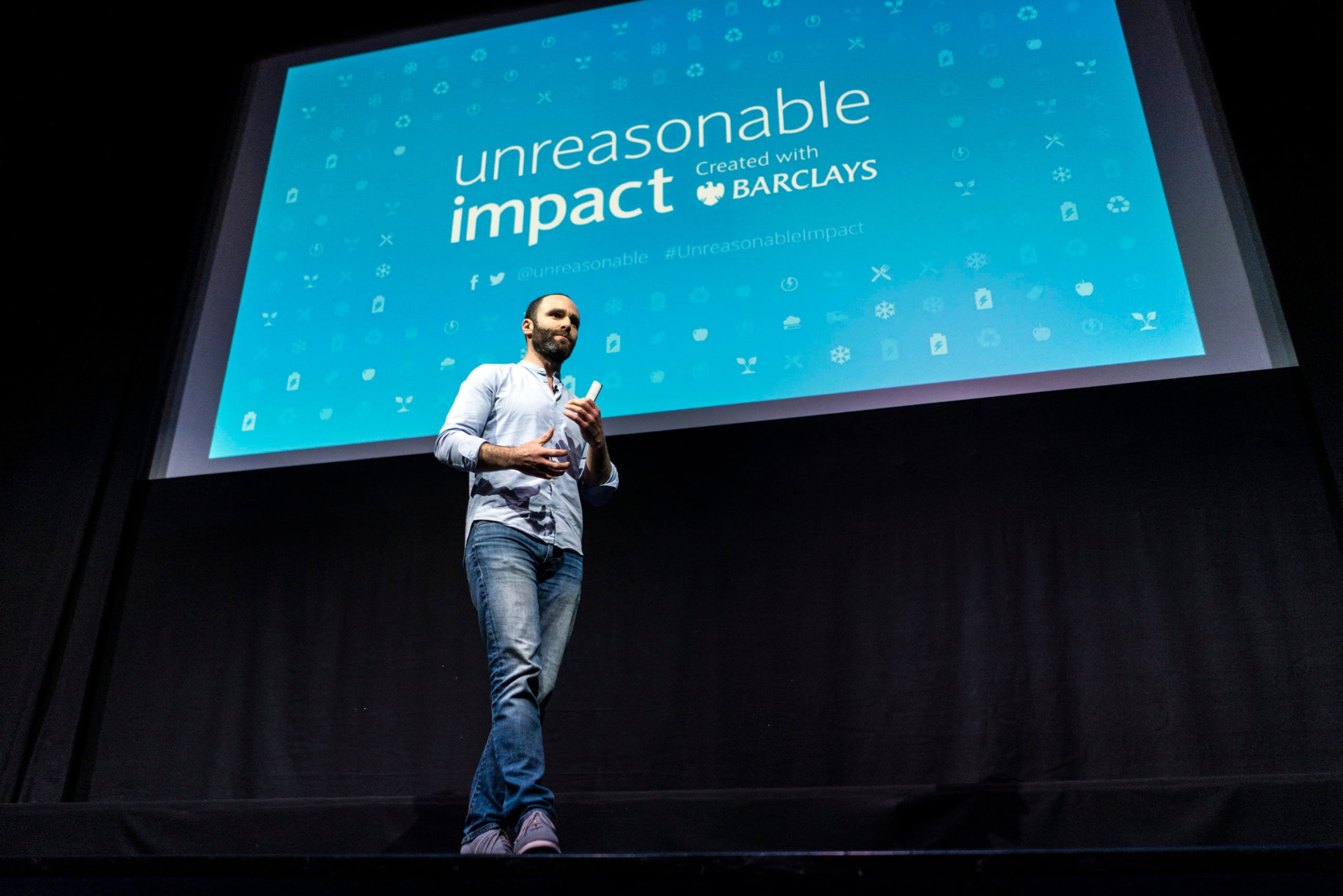
The stage photograph captures Epstein in front of the program’s name and the Barclays logo. The scene contains the negotiation at the center of his career: an entrepreneur arguing that existing institutions can help new businesses solve problems. The bank brings resources and reach. The entrepreneurs bring ventures that have something specific to sell.
His public life also includes speaking and interviewing. He has delivered keynotes in more than 30 countries and held conversations with Arianna Huffington, Tutu and Van Jones. In 2026, he hosts Unreasonable Stories, a podcast that turns attention toward the people building the businesses.
A September episode features Kresse Wesling of Elvis & Kresse, whose company makes luxury goods from retired fire hoses. Other conversations cover food sharing, solar energy, materials and space. The subjects are different; the recurring interest is how an individual arrives at a problem and decides to spend years on it.
Epstein once wanted a community for people prepared to act on their concern for the world. His work now provides several ways for those people to meet. The lawn has become an international landscape. Yet the old practical question survives every voyage, speech and partnership: who else can help do the work?