The relationship had started with an invitation. By 2023, it had become a liquidation dispute. Hilda Moraa’s Pezesha was owed money by Tesh Mbaabu’s MarketForce, and the two founders were struggling to speak directly. Both belonged to Harambeans, an alliance whose central promise is that African entrepreneurs will help one another. Here was a rather uncomfortable opportunity to find out what that meant.
In March 2024, a Harambeans gathering in Kenya brought them together. Conversations resumed; other members encouraged a resolution. An agreement followed that would use MarketForce’s intangible assets to settle the debt. The setting included a runway in the Masai Mara, which is an unusually cinematic place to untangle a balance-sheet problem. The work itself was ordinary and difficult: explain the pressure, apologize, find something the other party can use.
That episode gets closer to Harambeans’ purpose than a photograph of founders smiling beneath a conference banner. The organization brings African innovators into a continuing community, connects them with experienced operators and investors, and supplies selected ventures with capital. Its proposition depends on what members do when the introductions are over.

A declaration with a long memory
Founder and chairman Okendo Lewis-Gayle started the Harambe Entrepreneur Alliance in 2008. The name draws on harambee, the Swahili expression for working together toward a common purpose. On April 19 that year, its first class signed a declaration in the Gold Room of New Hampshire’s Mount Washington Hotel. The African venture network had acquired a distinctly New England starting line.
The location was deliberate institutional theater. Bretton Woods already carried the weight of the 1944 international monetary conference. Harambe gave young founders a ceremony of their own, with an annual signing that turned membership into an expressed obligation. Members identify themselves with an H and their induction year, rather like graduates who intend to keep attending the reunion.
Its famous associations include entrepreneurs behind Andela, Flutterwave, Yoco and Go1. Those companies belong to their founders and shareholders; affiliation should not be confused with ownership by the Alliance. The relevant achievement is assembling people whose experience can become useful to someone else. A 2021 Harvard Business School case, Harambe: Mobilizing Capital in Africa, made that organizational question a subject for classroom scrutiny.
The check comes with company
Harambeans occupies the space between founder community, philanthropic institution and early-stage investor. African entrepreneurs are its principal users. Corporate supporters, family offices, mentors and investors supply money, experience and introductions. The offer includes fellowships, founder and investor retreats, travel support and co-investment. A founder can use the network to find someone who has already handled an unfamiliar hiring decision or fundraising conversation.
The Prosperity Fund made the capital component concrete in 2019. Seeded by a multimillion-dollar Cisco gift, it announced two inaugural investments: $100,000 each for MAX and Releaf. Its stated design was to invest alongside other backers while building a durable source of support for the Alliance. Proceeds were intended to return to the fund and help finance later ventures.
This is conditional capital. The published approach ties access to the Alliance, its values and qualifying investment from a Harambean, angel or co-investment partner. Admission is therefore a beginning, not a funding commitment. The arrangement also means the network depends on investors outside its own balance sheet being willing to write checks.
By August 2025, Harambeans reported $1.5 million deployed across 15 startups. It also reported more than $189 million in follow-on funding for those companies. The second number measures subsequent fundraising, not investment profit, and cannot establish how much capital arrived because of Harambe. The useful comparison is one of roles: a relatively small fund participating in companies financed by a much larger group.
Reported August 2025. Portfolio fundraising is a separate measure.
When cash stopped arriving
MarketForce shows why the distinction matters. The Prosperity Fund backed it with $100,000, joining an investment coalition that included the Harambean-led funds Launch Africa and Future Africa. Connections could assemble support. They could not make a difficult business model inexpensive to operate.
In interviews with the Kenyan Wall Street, Mbaabu said some Series A equity commitments never arrived. Debt repayment became difficult in late 2022; by April 2023, a cash crunch prevented monthly payments. Moraa described the strain on Pezesha’s portfolio and the damage caused by indirect communication. The financing problem preceded the public rupture. Friendship then made the rupture more painful.
The summit reopened a conversation that had become stuck. Harambeans’ account names Sneha Shah, Maryanne Ochola and Muthoni Wachira among those helping the founders find common ground. An asset-based settlement gave them another option when a cash repayment was out of reach. It also illustrates the limits of the intervention: resolving a dispute does not repair every weakness in the underlying company.
In April 2024, MarketForce shut down its RejaReja business and turned toward social commerce through Chpter. Thin margins, price competition and a capital-intensive model were among the problems cited. For anyone copying the Harambeans approach, the lesson is specific: keep communication direct and involve trusted peers early. A network can help parties negotiate. It cannot supply healthy economics by force of goodwill.
What a rose and a thorn cost
Some of Harambe’s methods require very little money. At gatherings, its Rose, Thorn & Bud practice asks participants to share a victory, a difficulty and an emerging opportunity. The format gives the awkward subject a scheduled place at dinner. Nobody has to invent a graceful way to admit that something is going badly.
There are more ceremonial touches: a lapel pin called the Aegis, shared language and the yearly declaration. Pentagram designed the visual identity around an H that can stand alone or repeat into a pattern; the brand launched at the House of Lords in November 2018. Even the graphics make the organizational argument that an individual and a group can reinforce each other.
Keeping the institution running costs more than keeping a dinner conversation honest. Cisco’s decade-of-partnership account describes support for governance, financial discipline and operations. Member giving adds another layer. In 2021, Velani Mboweni supported travel for incoming members who could not afford induction attendance. The Founders Club contributed $29,000 toward the 2023 summit. These are practical expenses behind the photograph.
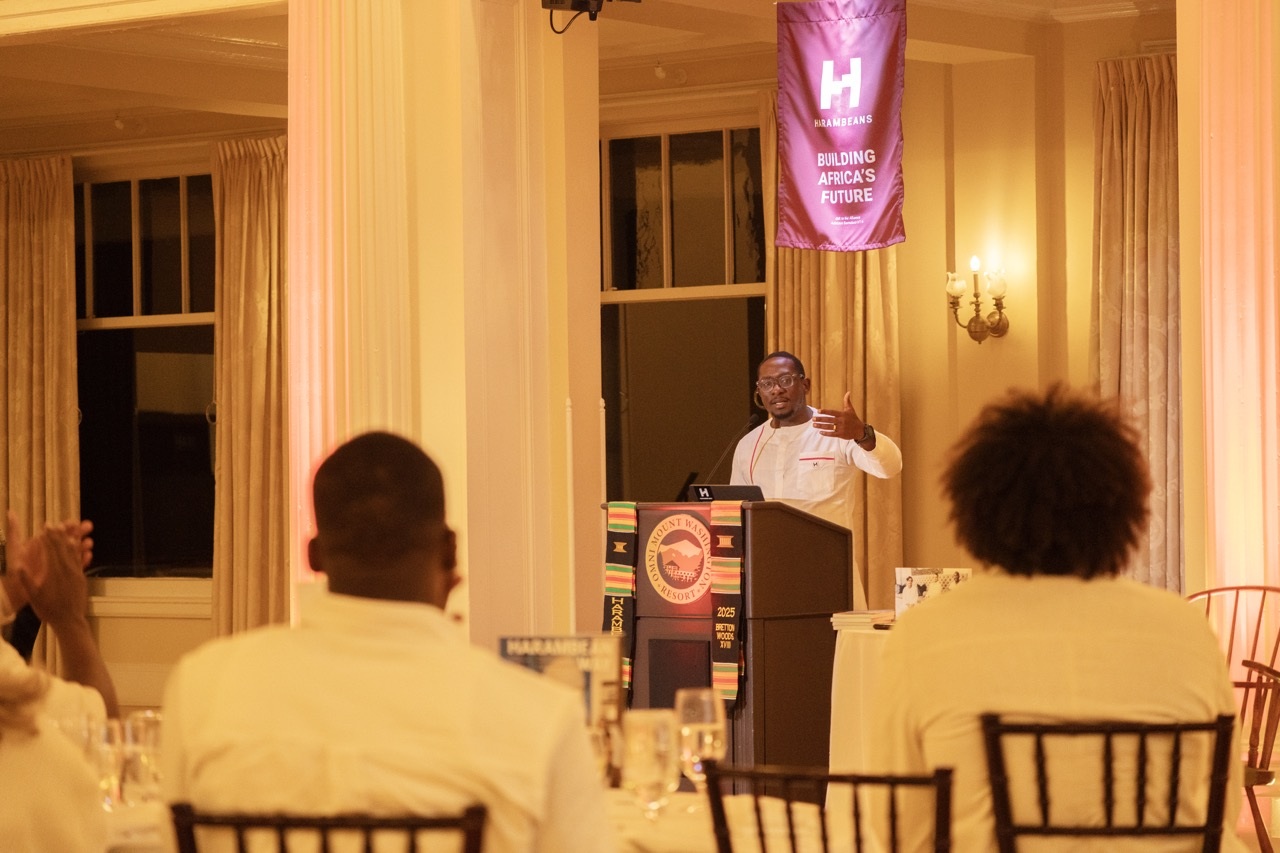
The 2025 class went further, pledging a $10 million donation by 2035. That is a future promise, dependent on the fortunes and choices of its members. It captures the ambition of a donor-backed model: successful founders eventually help support those who follow. The time between joining and being able to give substantially is part of the financial challenge.
A small room meets a large continent
Selectivity gives Harambeans its intimacy and creates its most obvious constraint. Its July 2025 account of Harambeans Lab described roughly 30 places against more than 5,000 annual applicants. That leaves a great deal of entrepreneurial ability outside the room. Jonathan Oppenheimer’s challenge was concise: “We need thousands.”
The response was Harambeans Lab, developed with Schmidt Futures, Cisco, and Allan & Gill Gray Philanthropy. By July 2025, the platform reported more than 202 short video interviews with 103 entrepreneurs, covering subjects such as fundraising, team-building and self-care. A Lab Prize also creates a route for selected entrepreneurs from partner communities to attend the Global Summit with expenses covered.
For a reader, the practical move is to start with a problem: a hiring decision, a capital question, a founder’s exhaustion. Recorded experience can travel more widely than invitations. It still requires judgment about which lessons fit the business and market at hand.
“We need thousands.”
Jonathan Oppenheimer
On extending the Alliance’s reach
Fifteen new names on the declaration
The 19th class signed on April 12, 2026. Announced in an August profile, it brought together 15 founders from six African countries whose ventures had already collectively raised more than $18 million. Their work spans satellite computing, carbon removal, healthcare finance, agricultural intelligence and logistics. Sector diversity is built into the selection.
Examples include Duncan Kariuki of Octavia Carbon, Soinato Leboo of Rhea and Ope Onaboye of Renda. These businesses face different customers and operational constraints, yet their founders can encounter related questions about hiring, financing and organizational growth. That is the case for a community organized around the entrepreneur, rather than a single technology.
Endeavor is a relevant alternative for someone seeking experienced mentors, investor access and a founder peer group. Harambeans’ particular combination adds a pan-African identity, small annual classes, formal rituals and donor-backed co-investment. The two worlds can overlap: Endeavor Kenya’s Maryanne Ochola participated in the conversations around the MarketForce dispute. Founders need useful relationships wherever they find them.
The next useful conversation
For applicants, the official site lists September 30 and October 31, 2026 as its early and regular admissions deadlines. Its published admissions guidance distinguishes between an early founder’s motivation, a pilot-stage entrepreneur’s ability to learn from evidence and the demands of scaling. The invitation asks for a person prepared to contribute to the community as well as benefit from it.
A founder outside the Alliance can borrow the dinner ritual, seek advice from someone with relevant operating experience and make difficult calls before silence becomes its own problem. Investors can examine the co-investment model while keeping diligence separate from social familiarity. Donors can see why an institution needs operational support alongside money earmarked for ventures.
Harambeans’ proposition works best when people share useful knowledge, have something to contribute and remain willing to engage through disappointment. It has less to offer someone seeking an automatic check or a substitute for customer demand. The revealing moment in its story is a conversation resumed after a breakdown. That is an outcome worth asking a founder network to deliver.