A business idea can survive quite comfortably among friends. Take it into a room of strangers who want to know who will pay, and the conversation gets more interesting. Entrepreneurs for Global Change, a New York nonprofit working with emerging founders, organizes versions of that encounter across borders. For its BOLD fellows from the Western Balkans, the trip comes with mentors, practical training and a return ticket.
The proposition has a useful specificity. Young people from Bosnia and Herzegovina, North Macedonia and Serbia can enter an entrepreneurship fellowship before they have a finished product. They prepare remotely, spend time in New York State and continue working on their ideas afterward. The program belongs to the U.S. Department of State; EGC implements it with embassy partners. International access is built into the education.
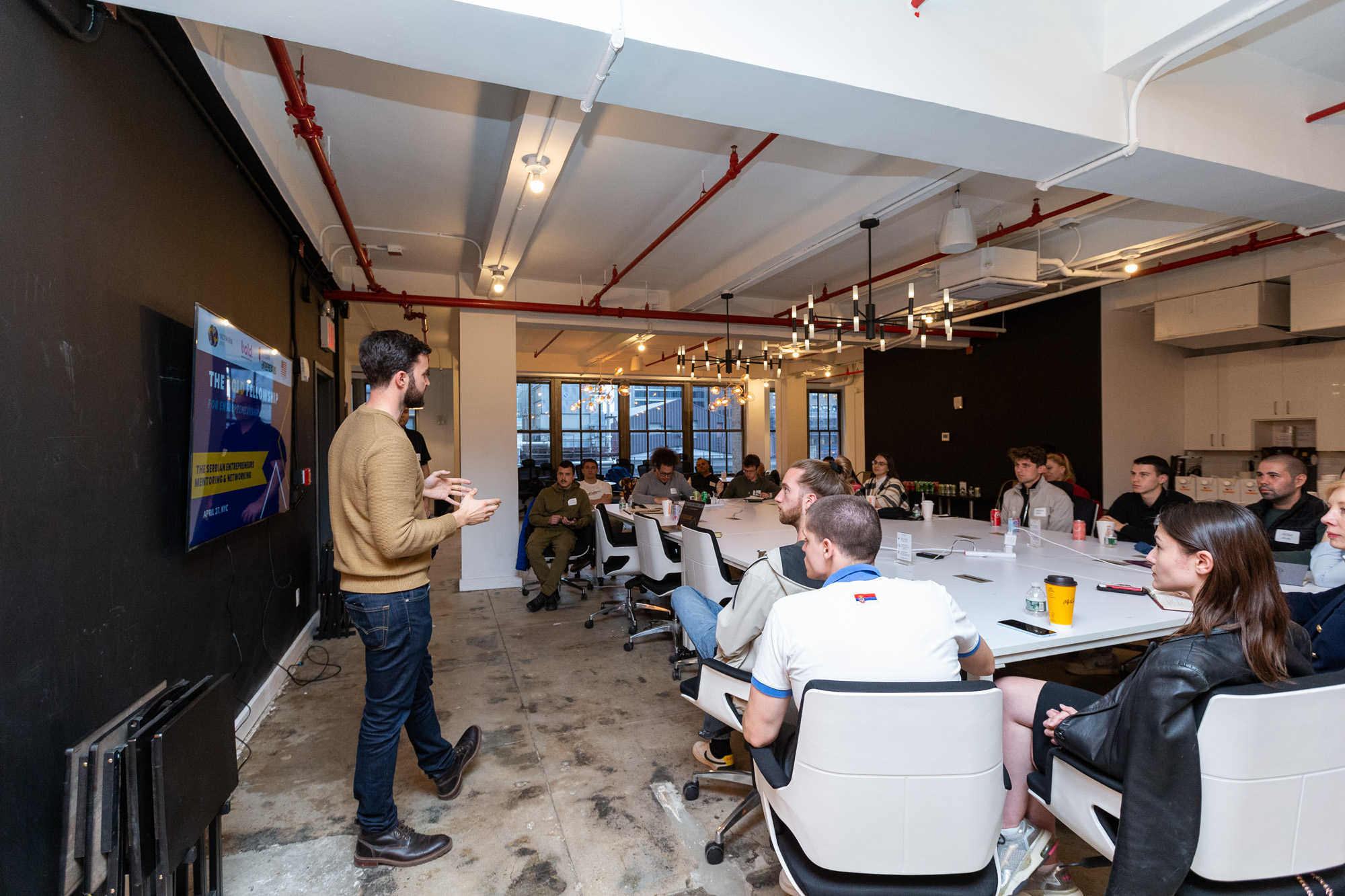
A startup for people starting startups
Founder and CEO Filip Sasic knows the administrative side of starting something. In his public announcement of EGC, he described juggling finance, strategy, human resources, branding and development, then asked his network for practical tools and advice. Behind the organization’s outward-facing mission sat a familiar founder problem: too many jobs for one person.
Established in 2023, EGC occupies the space between entrepreneurship education, an incubator and international exchange. Its users include aspiring founders and small startup teams; its institutional relationships help make the programs possible. Someone buying software expects a tool. An EGC participant is looking for instruction, useful introductions and a setting in which to test a business proposition.
Sasic’s team brings experience from several directions. CFO Ruth Ku has held executive positions at early and mid-stage startups, including ShopKeep, Ellevest and Buffer. The mentor network extends beyond employees: author and business teacher Matthew Lee Sawyer publicly lists EGC among the organizations whose entrepreneurs he mentors. That combination gives the programs access to operating and market-entry experience.
The ticket is funded. The work is yours.
BOLD’s published offer covers travel, accommodation, meals and program activities, with no equity taken. Its expense FAQ also includes the U.S. visa and jokes that fellows must pay for their own “I love NYC” T-shirt. The distinction matters for a young applicant: participating does not require selling a slice of an unformed company.
There is still a substantial commitment. The general fellowship targets people aged 18 to 25 with ideas at the ideation-to-pre-MVP stage. Serbia’s program information also specifies current students or recent university graduates and willingness to cooperate across the region. Applicants need time for preparation and an intensive stay abroad. A funded place cannot manufacture that availability.
The economics follow from the purpose. Public descriptions identify State Department grant support for BOLD. EGC delivers an educational and exchange program whose beneficiaries are founders, while government and institutional partners support its operation. A covered fellowship place should therefore be understood as access to a program, rather than a promise of investment in the participant’s venture.
Travel + accommodation + meals + program activities covered
A fellowship benefit, not startup investment.Syracuse puts the syllabus on the street
The April 2025 Syracuse itinerary shows what experiential education means in practice. Fellows visited the Couri Hatchery incubator and Blackstone LaunchPad, joined business-model and negotiation sessions, and received an introduction to the resources at Bird Library. A library visit may sound less glamorous than a pitch stage. For someone investigating a market, knowing where to look is part of the job.
Other sessions included customer discovery and market research with professor Ken Walsleben, a visit to the Technology Garden, and exposure to the Dolphin Tank business-plan competition at Le Moyne College. At Salt City Market, participants examined social entrepreneurship through a working food-business setting. Business models became something they could walk through.
Syracuse’s entrepreneurship credential describes learning outcomes spanning customer identification, market research, planning, networking and pitching. That makes the intended progression legible: investigate a need, organize the business around it, then explain the proposition. A polished presentation is one deliverable inside a larger process. For an applicant, the useful question is what work a program will require between its speaker sessions.
Canva before code
One of EGC’s alumni accounts supplies an unusually copyable example. Solarise founder Tamara Ilic says her team began with simple Canva visuals and showed them to solar-panel companies and installers. The startup, which works on software for initial solar-installation quotes, could explain its idea before committing to a finished system. The first object in the conversation was a drawing.
Ilic also described the difficulty of coordinating four founders in different locations. That is a less photogenic problem than a demo day, and a recognizable one: scheduling meetings and agreeing on features can become obstacles of their own. In her account, a €50,000 Smart Start Innovation Grant helped fund the venture. That money belonged to Solarise’s story, not EGC’s balance sheet.
Another alumnus, ZedNova Studio founder Zlatko Marjanovic, described a self-funded, self-sustaining service business and the strain of taking on more than five projects at once. His next challenge involved better procedures and a more standardized offering. The two accounts illustrate different needs: one team tests a software concept; another has enough work to expose the limits of its delivery process.
“Don't build something nobody cares about or wants to use.”
Zlatko Marjanovic / EGC alumni spotlight
A reader can borrow the sequence without borrowing either business. Make the proposition easy to see, put it in front of someone who might use it, and listen for what remains confusing or unnecessary. Once customers arrive, examine the work required to serve them. More demand is helpful only if the operation can carry it.
The cohort needed more attention
In his April 2026 retrospective, Sasic identified selection as something EGC underestimated early on. He also described founders arriving convinced that fundraising was their next task, then discovering through mentor conversations that their positioning or customer focus needed work first. The organization’s own lesson concerns who enters the room; the founder’s lesson concerns what to ask once there.
The same retrospective reported more than 450 entrepreneurs supported and acknowledged that some participants stop building their startups. Those are different kinds of information. Reach measures how many people the organization has worked with. A participant’s decision to continue, change direction or seek another role says something about the individual journey. Attendance alone cannot establish a business outcome.
Croatia gets a different itinerary
EGC’s Scale 2.0 serves a later starting point. Its published criteria call for Croatian teams with a developed minimum viable product, early traction, at least two founders and one team member. The program brings participants to Infobip’s campus in Vodnjan, New York City and the Shift conference in Zadar. It is designed around a business already taking shape.
The offer is fully funded and takes no equity. Its work includes testing the product and market-entry strategy with experienced people, then practicing the explanation in international settings. Someone still choosing a first idea should notice the eligibility difference. Applying to a program built for traction before having a product means arriving with a different assignment from the rest of the cohort.
The wider program list includes LeapX, aimed at technology and AI founders. Its published format combines four weeks of online building with an optional Canary Islands residency. Expected work includes shipping a functioning prototype, interviewing potential customers and running validation experiments. For all the attraction of faster development tools, the customer still gets a vote.
The teachers take a turn
EGC also works further upstream. From October 6 to 10, 2025, ten doctoral students from the University of Belgrade’s Faculty of Organizational Sciences visited Syracuse through the University Partnership Program. The faculty’s account identifies EGC as organizer and the U.S. Embassy in Belgrade as a supporter. Participants explored entrepreneurship teaching and research with their American counterparts.
This expands the audience beyond people launching companies. Faculty and researchers can bring methods back to future classrooms, potentially reaching students who never travel themselves. The program’s stated purpose includes sharing teaching approaches and developing academic collaboration. Its value depends on what participants subsequently use, which makes the return journey as relevant as the visit.
Regional relationships serve a related purpose. Young Ambassadors announced a memorandum with EGC in January 2025 to connect youth with skills, programs and mentoring opportunities. EGC’s seven-day regional workshops bring practical exercises and peer contact closer to home. Together, these formats give the organization several ways to reach people whose needs do not all fit a New York fellowship.
What travels home
EGC’s place in the market becomes clearer beside the alternatives: a university entrepreneurship center, a local founder group, an online course or a commercial accelerator. Its distinctive combination is geographic access, structured practice and continued relationships, delivered through programs with different entry requirements. Regional organizations can also be partners; founders need not choose one community forever.
The method asks something of the participant. Someone unwilling to revise an idea will get less from customer discovery. A team unable to attend intensive sessions cannot use the full format. And an international introduction is useful only when the founder follows through with a relevant question, a clearer offer or the next piece of work.
That is the homework in EGC’s itinerary. A founder may return with a smaller target market, a simpler prototype or a better way to handle five projects. Each is more concrete than the ambition they boarded with. The next test happens wherever their customers live.
Explore EGC
Programs, founder accounts and a look inside the fellowship.