The first thing to go wrong at Atlanta Tech Village was the arithmetic. In December 2012, David Cummings thought renovating his newly purchased Buckhead office building would cost $4.5 million. By January 2014, his published budget was $11.5 million. Architects, elevators, furniture and wireless infrastructure had acquired the tiresome habit of costing money. A startup community, it turned out, required rather more than putting entrepreneurs in a room.
- Flexible workspace bundles a desk with access to founders, advisors and events.
- Buckhead membership starts at $300 a month; a private office starts at $630.
- The useful lesson: repeated encounters need both a calendar and a viable building.
Cummings had sold Pardot, his marketing automation business, before buying the property. With co-founder David Lightburn, he set about making a place where entrepreneurs could find one another. The proposition was unusually concrete: shorten the distance between a person with a problem and someone who had already solved it. The 103,000-square-foot building was the apparatus.

01 / The budget was not the only assumption to break
The original plan called for renovating in stages over five years. During the beta opening, demand for entrepreneur space exceeded expectations, while existing traditional tenants disliked the changing demographic. Cummings described arranging their departures and switching to a full-building renovation over twelve months. Customers had effectively redrawn the construction schedule.
There is a useful distinction here. Demand did not rescue the first budget; it made the project more ambitious. The founder’s account of the renovation describes a twenty-year horizon. Anyone copying the model should notice that patience alongside the glass walls. A community needs time to become useful, and someone must pay for the interval.

02 / What the monthly bill buys
Today, ATV serves solo founders, early technology teams and companies growing toward larger offices. At Buckhead, published starting prices are $300 monthly for shared community space, $446 for a reserved desk and $630 for a private office. These are October 2026 starting prices, with office size and arrangements affecting the bill. The workspace business earns its keep through paid memberships and rentals; event hosting and sponsorship support the wider offering.
The Buckhead offer includes round-the-clock access, furnished space, conference rooms and month-to-month arrangements. There are also nap rooms and a lactation lounge. These details suggest founders are expected to arrive with bodies, families and inconveniently human needs. More than half the building, the operator says, is dedicated to community space.
That is an economic choice. Shared areas occupy square footage that could otherwise become another private office. They also give people somewhere to cross paths. ATV’s distinction from a conventional lease lies in this combination of flexible space and an organized startup network. For a founder comparing options, the question is whether those nearby people can help with the work at hand.
03 / An introduction needs a job to do
The advisor directory makes the promise specific. Aaron Hurst lists go-to-market planning, fundraising preparation and managing a growing team. Arthur Tyson offers help with financial models, unit economics and runway. Brian Culler focuses on engineering hiring and leadership. A founder can arrive with a defined problem rather than a vague wish to network.
The programming gives those encounters a rhythm. Atlanta Startup Village now describes a quarterly pitch night: four minutes on stage, followed by questions and feedback. Startup Summer School covers market validation, finding early customers and preparing to raise money. Women + Tech creates another route into the community. These are different doors for different stages of the same awkward activity: asking for help.
It Takes A Village adds selection and accountability. The pre-accelerator targets underrepresented technology founders who have product traction and have raised less than $300,000. It combines workshops, weekly mentoring, grants and scheduled venture-firm meetings. Participants must be available onsite one or two days a week. Its published fall calendar starts programming October 2, 2026, with demo day scheduled for January 27, 2027.
Partners contribute expertise as well as recognizable names. AVL Growth Partners advertises finance office hours; Google is listed as supporting Women + Tech. The practical value is the question an expert can answer. A sponsor logo cannot fix a cash-flow model, but a conversation with the right finance operator might.
04 / The second building that was never supposed to happen
For years, another Village seemed financially implausible. Property prices had outrun what startups could pay in rent. Cummings recalled his answer in a July 2024 essay: “no new locations because the math didn’t make sense”. South Downtown changed the calculation. Property acquisitions through foreclosure and related arrangements offered the chance to build a wider entrepreneurial neighborhood.
A startup community needs a property bill its members can afford.
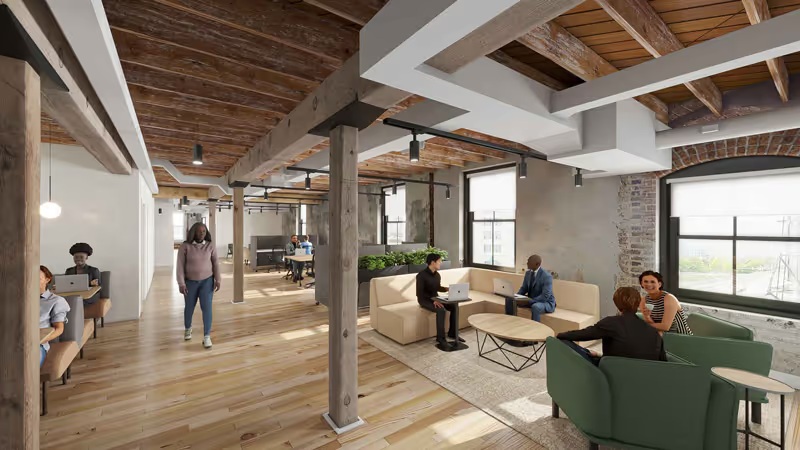
Sylvan opened in January 2025 inside a hotel dating to 1909. Gensler describes approximately 30,000 square feet of suites, focus rooms and shared gathering areas. Even the entrance became a small experiment. Cummings initially preferred one retail space for the lobby, then accepted that the space across from Spiller Park Coffee made a more natural front door. Hospitality had won a minor argument with geometry.
05 / Bring a problem, then come back
ATV’s graduate list includes Calendly, Salesloft and BitPay. The operator also reports more than $3.2 billion raised through its startup community. That figure describes an ecosystem’s capital, and those graduates illustrate its reach; neither establishes how much success the building caused. Founders, products and markets still do their own considerable work.
The copyable part is smaller than a real-estate portfolio: make encounters recurring, give people specific questions to answer, and reserve space for conversations. For a prospective member, attend an event, inspect the advisor list and bring a current obstacle. Return often enough to become recognizable. The model suits people who can participate in Atlanta; it offers less to a remote team seeking only a mailing address. And a roomful of helpful people cannot make customers want an unwanted product.
Step into the room
Visit ATV · Explore the pre-accelerator · Meet the advisors · Village news
LinkedIn · X · Instagram · Facebook
Watch ATV’s YouTube events · Watch the Village introduction · David Cummings interview on Techrides