The awkward thing about helping startups survive is that your own organisation still has to pay the rent. Fishburners, the Sydney community that brought founders together for 15 years, entered voluntary administration in May 2026. Within weeks, it had a buyer. The business of making introductions had acquired a rather urgent need for one of its own.
On June 2, Scalare Partners acquired the Fishburners brand, programs, intellectual property and community assets. Employees and liabilities were excluded. That distinction gives this story its shape: a name and a network could continue, while the organisation that built them faced the consequences of its financial troubles.
For founders, the appeal remains easy to grasp. Building a company means confronting unfamiliar problems in quick succession. Fishburners offers access to people who may have confronted them already, alongside workspace, events and education. Its rescue exposes the more difficult question underneath: who pays to keep those useful people meeting?
A community’s next chapter, negotiated in less than a month.
A network worth saving
Fishburners’ website puts its historical community at more than 35,000 entrepreneurs. That is a measure of reach across its history, not a count of people currently paying for desks. The distinction matters in a sector where membership, attendance and alumni can easily end up in the same impressive-looking sentence.
Its featured founders include Koala’s Dany Milham, v2food’s Nick Hazell and Hyper Anna’s Natalie Nguyen. The range is revealing: mattresses, food and business analytics can all involve founders wrestling with hiring, sales and raising money. Fishburners’ expertise sits in that shared work of company-building, rather than in one narrow technology.
Those names also require some editorial restraint. Participation in a community does not establish that the community caused a company’s success. What the alumni list does demonstrate is the sort of room Fishburners has assembled: founders working on different products, with experiences that could be useful to their neighbours.
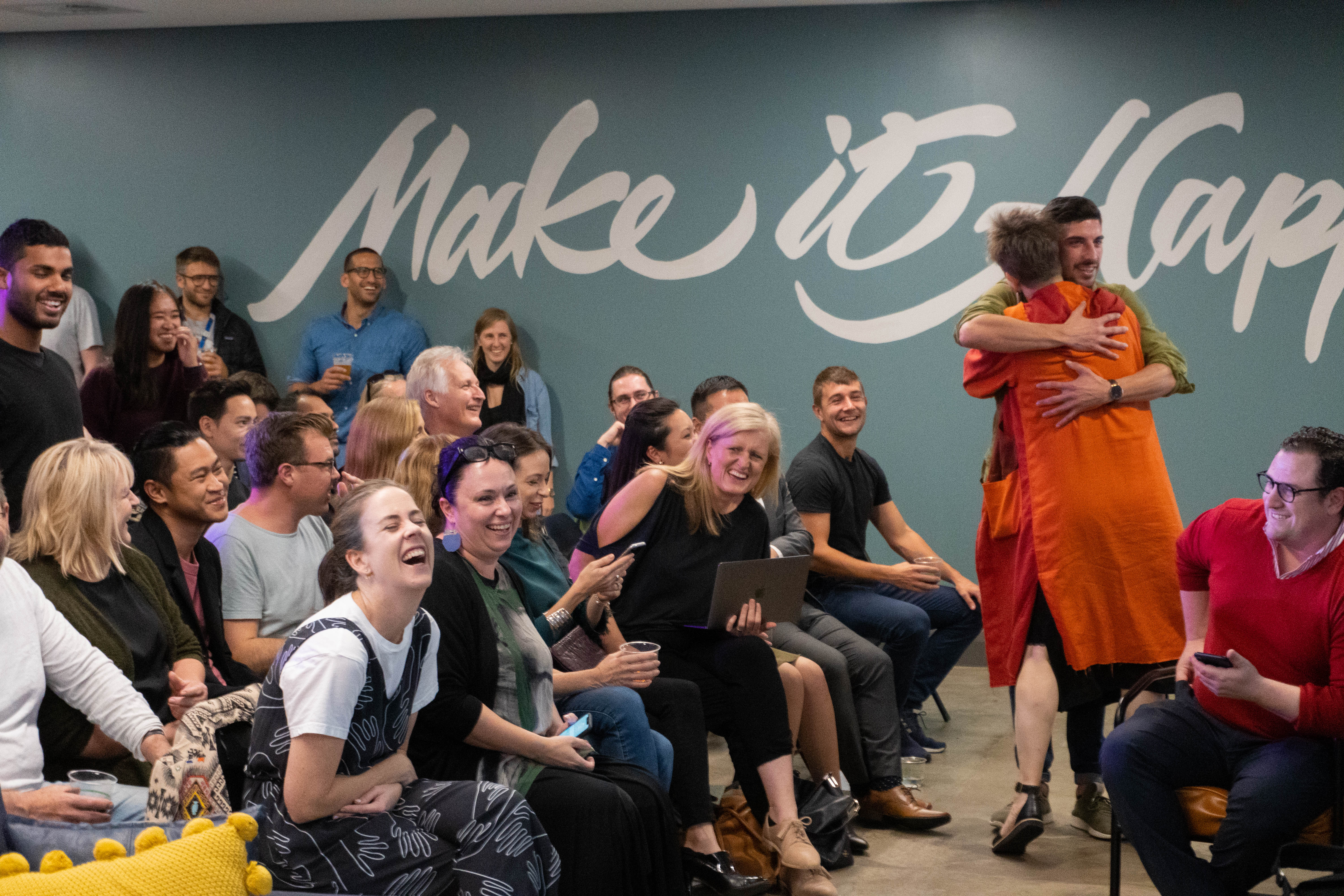
Before the Passport, Project Hollywood
The official origin story starts with Project Hollywood, a coworking experiment associated with GradConnection and a group of 15 startup founders. Mike Casey persuaded early PayPal investor Peter Davison to establish a not-for-profit space. Fishburners followed in 2011, with shared experience at the centre of its purpose.
The original Ultimo operation grew to 50 desks and, within four years, occupied its Harris Street building. Paid members and corporate sponsors supported the model. Its basic proposition was tangible: put people starting businesses near one another, and give them ways to learn together.
Google for Entrepreneurs became a partner in 2014. Google’s announcement connected its support to expanded facilities, mentoring, training and programs for female entrepreneurs. Fishburners joined an international network of more than 30 startup hubs. A local room was gaining connections well beyond the people who could walk through its door.
This history helps explain Fishburners’ place in the market. A general coworking operator can sell a convenient address and meeting rooms. Fishburners adds a deliberate concentration of early-stage founders and organised support. Stone & Chalk occupies overlapping territory; it has also been a partner. In this market, the organisation across the competitive fence may be helping host your next program.
The membership that tried to travel
By 2025, Fishburners was questioning how much support should depend on occupying a particular desk. Then-CEO Majella Campbell explained the problem in an interview: events and programs brought founders together, but those connections were difficult to extend once people left. Meeting a handful of people at a time was a slow way to navigate a much larger network.
The Founder Passport was the response. Membership would give founders access to people, events and opportunities without making a full-time desk the price of admission. The announced model also included Passport Hubs, a residency and a planned digital tool called Ecosystem Navigator. These addressed different parts of the same problem: finding useful support and keeping it within reach.
The timing was hardly leisurely. The NSW government was closing the Sydney Startup Hub in York Street in August 2025. Fishburners announced a new CBD Passport Hub at 64 York Street, scheduled to open on September 1. A change in premises coincided with a change in what membership was supposed to mean.
The website’s advertised starting price. It also lists A$54.92 per month when billed annually. These are published offers, not a guarantee of post-acquisition terms or unlimited desk access.
The published offer groups together mentoring, community events and provider discounts. Those benefits have different kinds of value. Advice can save a founder time; an introduction may lead to a customer; a discount saves money only when it applies to something the company needs. A large perks total should never be mistaken for cash in the bank.
Fishburners’ advertised residency asks for a more deliberate commitment. It is application-based and equity-free, with stage-relevant groups and weekly check-ins. The language gets pleasantly less corporate at the edges: the check-ins are called Rumble in the Jungle, and Founders Court puts basketball on the schedule. Accountability apparently comes with trainers.

The rent bill arrives
The public account of the financial failure is considerably less playful. Fishburners’ board cited unresolved rental debt accumulated under the state-led Sydney Startup Hub program, followed by operating losses. KPMG administrators were appointed on May 6, 2026. The board had already been discussing consolidation and investment; administration put an accelerated sale process in motion.
Startup Daily reported an annual rent bill above A$1.5 million and rental arrears exceeding A$2 million. It also reported that relocation costs and uncertainty around the hub’s closure contributed to further losses. Moving to another address had not removed the older obligations.
The available account therefore points first to the organisation’s financial burden. It does not establish that founders had stopped valuing the community. Both can be true: a service can matter to its users, and the operator can be unable to sustain the cost of providing it.
For anyone copying Fishburners’ approach, that is the uncomfortable part to copy into the spreadsheet. Community-building creates recurring work as well as recurring encounters. The people arranging introductions, maintaining programs and running the premises need a viable operating model. Enthusiasm can fill a room without covering its overheads.
What survives a change of owner
Scalare’s acquisition shifts Fishburners into a commercial group containing workspace operator Tank Stream Labs and several founder-service businesses. Its June plans offered members a home through Tank Stream Labs, including a dedicated Fishburners Hub at the Kent Street campus in Sydney. The Passport Hub proposal included hot-desking one, two or three days a week across the network.
The buyer also outlined a return for Fishburners Pitch Nights and founder showcases, with national expansion intended. A proposed Fishburners investment vehicle would invest in selected startups emerging from the pitch program. The announcement made that vehicle subject to regulatory and commercial considerations. An intended fund is not an available cheque, and membership is not an investment commitment.
“Founder communities remain critically important despite advances in technology and remote work.”
Bradley Delamare, Tank Stream Labs CEO
Acquisition announcement / June 2026
Delamare subsequently wrote that the two brands had explored ways to align over the preceding decade without completing a combination. His stated ambition under corporate ownership was to reduce reliance on government. That supplies a concrete answer to what changed: a long-considered relationship became an asset acquisition after administration forced the issue.
Scalare’s wider network adds potential connections to services such as Planet Startup’s finance support and The Founders Union’s programs. The owner presents the combination as a way to generate service revenue and investment opportunities. That commercial incentive deserves to be understood alongside the continuing promise of founder support.
- 01Find your peopleCommunity and founder events
- 02Work on the businessWorkspace, mentoring and advice
- 03Make the introductionCustomers, partners and investors
Selected investment is a proposed next step, not an automatic progression.
How to use the room
A founder considering Fishburners should begin with a specific problem. An early team might need feedback on its first sales approach. A more established business might need introductions or advice on hiring. The practical test is whether the community can connect that problem to relevant experience, at a price and level of access that fit the company.
The most portable lesson is repetition. Fishburners’ published schedule includes coffee gatherings, founder sessions and pro bono mentors. A recurring encounter gives a conversation a second act: someone can hear what happened after the advice, then adjust it. A useful community makes that follow-through easier.
There are limits. A founder who needs specialist laboratory equipment will need more than a peer network. A team seeking immediate capital cannot treat a showcase as financing. A remote member needs to assess which relationships can actually be maintained remotely. Even a well-matched membership needs time and participation to become useful.
Fishburners’ next test is practical too. The brand has a new owner and a route into other workspaces. Its value to the next founder will be measured in smaller units: the person who answers a question, the introduction that happens, the meeting worth returning for. Those are the encounters the business now has to sustain.
Step into the conversation
Explore the membership, meet the community online, or watch the new owner discuss its plans.