Eoin Kearns drove trains out of Dublin’s Heuston Station. Then he joined a programme that asked him to do something rather different: develop an idea and pitch it to the people running the railway. His new working environment was Dogpatch Labs, a startup hub inside a former warehouse. The distance between a train cab and a pitch stage looks considerable. Dogpatch’s business depends on making such distances shorter.
- For founders: workspace, mentors, investor connections and accelerator support.
- For would-be founders: a programme that begins with finding a complementary co-founder.
- For established organisations: startup methods applied to problems their own employees understand.
Kearns was one of 22 Irish Rail employees in the inaugural Future Track cohort. Over 12 weeks, they worked towards five project pitches to senior leadership. They interviewed customers, received mentoring and learned how to present a business proposition. In Dogpatch’s December 2024 account, Kearns called the advice from internal champions “invaluable.” The modest word is useful. A room full of encouragement is pleasant; access to someone who can help an idea progress is consequential.
A room with a second career
Dogpatch’s address supplies an agreeable irony. CHQ was built in 1820 to store wine and tobacco. The hub’s current chapter began there in March 2015, in space previously occupied by a furniture store. Former vaults became meeting and event rooms. A mezzanine added the Urban Garden. The building had already learned how to accommodate several kinds of stock before anyone arrived with a laptop.
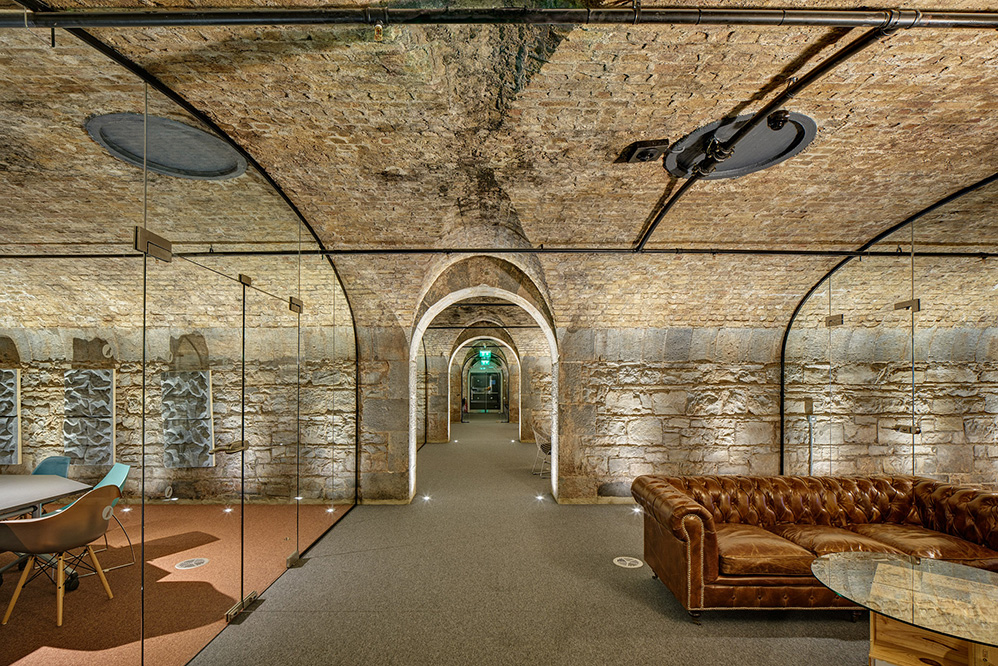
The history requires a little care. Dogpatch’s company profile lists 2009, while its Dublin doors opened in 2011. Instagram’s association belongs to the original American Dogpatch network. It would be charming to give Dublin credit for every famous alumnus; geography objects. The more relevant local story is the evolution from shared space into an operator of programmes.
Founder and CEO Patrick Walsh’s team now serves several overlapping groups: startups, scale-ups, remote workers, prospective entrepreneurs and corporate staff. That range gives the place its character. An employee with operational knowledge and a founder with technical ambition may each possess something the other lacks. Dogpatch arranges occasions for those assets to become visible.
Before the company, the colleague
Founders takes that idea further than a conventional accelerator. It recruits individuals who may have neither an idea nor a team. Engineers, domain specialists and commercial people meet, test possible partnerships and try to form companies. The programme’s premise is that Ireland has capable people whose comfortable career paths have never required them to find an entrepreneurial counterpart.
Its 2025 formation phase advertised a €2,000 monthly grant. Selected teams could then receive €100,000 for a 10% equity stake. Those are separate steps, with selection between them. The grant buys a little breathing room; the investment buys a share of the company. Describing the arrangement simply as free support would obscure the bargain.
“We believe strong co-founder teams are one of the most critical determinants of startup success.”
Patrick Walsh / Founders programme
NDRC, which Dogpatch operates with regional partners, offers a different route for startups. Its advertised €100,000 investment uses an uncapped SAFE, an agreement for future equity. The same headline amount does not mean the same terms. Anyone comparing accelerators should begin with the instrument, the commitment required and the people they will actually work with.
Selected teams
10% equity stake
Selected startups
Uncapped SAFE
The desk is the entrance fee
For someone who needs a working base, the prices are more ordinary. Hotdesking Lite is listed at €200 a month excluding VAT, with eight on-site days. Full hotdesking is €350; dedicated desks start at €500; private offices at €2,500. Membership applications are curated. Buying space means applying to enter a particular community, rather than merely choosing a chair.
That is Dogpatch’s positioning in a crowded workspace market. Its paid memberships sit alongside corporate innovation services and publicly funded accelerator delivery. Mentoring, workshops and investor introductions make the workspace relevant to company-building. The practical test for a member is whether those encounters save time or improve decisions. Attractive brickwork cannot answer that question.
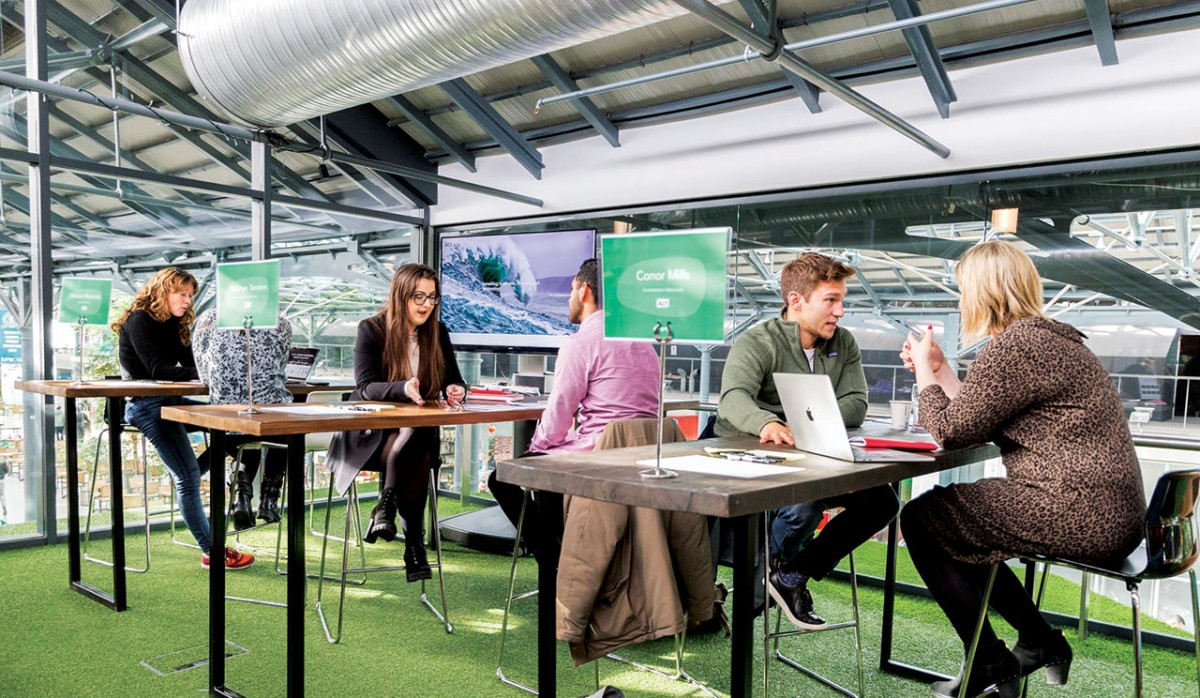
Its mentoring operation also offers an instructive adaptation. When COVID-19 interrupted physical gatherings, First Fridays moved online. Dogpatch’s account describes entrepreneurs joining from 15 Irish counties. Removing the journey widened the catchment. The national accelerator network gives that principle a physical form through PorterShed in Galway, Republic of Work in Cork and RDI Hub in Kerry.
Five pitches are a beginning
Future Track shows how this expertise travels into established organisations. Teams discover a problem, design possible solutions and propose a pilot. Irish Rail supplies operational context and access to senior decision-makers; Dogpatch supplies coaching, facilitation and startup methods. The combination matters because an outsider can challenge assumptions while an insider knows which constraints are real.
The five pitches from 2024 should be read as five proposals. They do not establish five deployed improvements. Corporate programmes need leaders willing to sponsor the next step, staff who can make time for discovery and customers who can be consulted. Without those conditions, a polished presentation may simply acquire a very distinguished audience.
The lesson a reader can copy is quite practical: bring together complementary people, ask them to investigate an actual problem, and schedule access to someone able to authorise a test. For an individual founder, bring a specific question to a mentor. A conversation about a rejected customer proposal will usually travel further than a request for general inspiration.
Make room earlier
Dogpatch also hosts Patch, the youth accelerator whose first summer cohort in 2019 gathered 12 builders. Its August 2025 report counted more than 200 alumni and 34 startups, with over $26 million raised by those businesses. These are programme-reported outcomes, rather than proof that the room caused every success. Still, they explain the interest in starting before a career becomes settled.

The wider operation remains tied to public choices. In June 2025, the government approved continued NDRC services with Dogpatch through the end of 2026 while announcing a planned successor platform. Continuity helps founders; the programme’s future also depends on what the state commissions next.
Dogpatch’s proposition is most convincing at human scale: a person with useful knowledge gains a colleague, a mentor or a hearing. Kearns already knew the railway. The programme gave him a route to present ideas about its future. For all the talk of ecosystems, that is a service a reader can recognise.
Go into the room
Explore membership and prices, Founders, NDRC or Future Track.
Keep up with Dogpatch Labs and its blog: LinkedIn / X / Instagram / Facebook.
Watch Patrick Walsh in conversation with Tim Rowe, or see the Inside the Raise event.