The notice arrived on April 16, 2021. Imaguru, the startup hub that had occupied a building in Minsk since 2013, was told its lease would end on April 30. Two weeks to leave. For a business built around getting people into the same room, this was a particularly direct way to interrupt operations.
The closure came during Belarus’s crackdown on dissent. Imaguru had supported people protesting the authorities; its own account describes masked men entering the premises the previous month and attendees being taken to a police station. The immediate point of failure was brutally mundane: access to the building. The relationships assembled inside it would prove harder to dismantle.
Today, Imaguru promotes physical hubs in Warsaw and Madrid, alongside online programs. It sells places to work, helps founders prepare for investors and organizes the encounters from which companies sometimes emerge. Its history gives that familiar startup vocabulary a different weight. Here, finding a new market has also meant finding a place where the community could keep meeting.
A room with consequences
Tania Marinich and Anastasiya Khamiankova launched Imaguru in Minsk in November 2013. Its proposition joined engineering talent with the things engineering alone cannot supply: business judgment, potential co-founders and people prepared to finance an experiment. Hackathons, courses and investor gatherings gave those groups reasons to encounter one another repeatedly.
One meeting became an unusually memorable calling card. Imaguru’s historical account dates the formation of MSQRD’s core team to a November 2015 hackathon. The face-swapping app was acquired by Facebook in March 2016. A weekend gathering had helped assemble a team whose product reached a much larger stage within months.
It is an appealing origin story, but its usefulness lies in the mechanics. A hackathon sets a deadline, puts complementary skills within reach and asks people to make something they can demonstrate. That creates a better test of a possible working relationship than swapping business cards. MSQRD supplies the famous outcome; the repeatable part is the structured encounter.
MSQRD’s core team gathers at an Imaguru hackathon. Four months later, Facebook acquires the app.
The community packs its bags
The 2021 closure changed the geography of Imaguru’s work. Its historical timeline records a Vilnius opening that year and the start of Warsaw activities in 2022. In a February 2023 interview, Marinich described operating in Vilnius and Madrid, with a new Warsaw location expected that spring. The dates distinguish beginning work in a city from opening a particular space.
“Imaguru is a community, not necessarily a physical space.”Tania Marinich · February 2023
Marinich told EU-Startups that people who had relied on Imaguru wanted to keep connecting somewhere safer. Lithuania’s finance ministry had invited the organization to work there. That demand, and the opportunity to establish elsewhere, supplied a reason to carry on. After Russia’s full-scale invasion of Ukraine, she said the team also helped people fleeing the war and provided services to Ukrainians free of charge.
The costs extended beyond replacing an office. Imaguru’s account describes property seizures and prison sentences handed to its founders in absentia: 12 years for Marinich and 11 for Khamiankova, with combined penalties of about $160,000. The organization characterizes the prosecution as political repression. Those are personal and political consequences, not a relocation budget. They explain why its public commitment to entrepreneurial freedom is unusually concrete.

The 49-zł front door
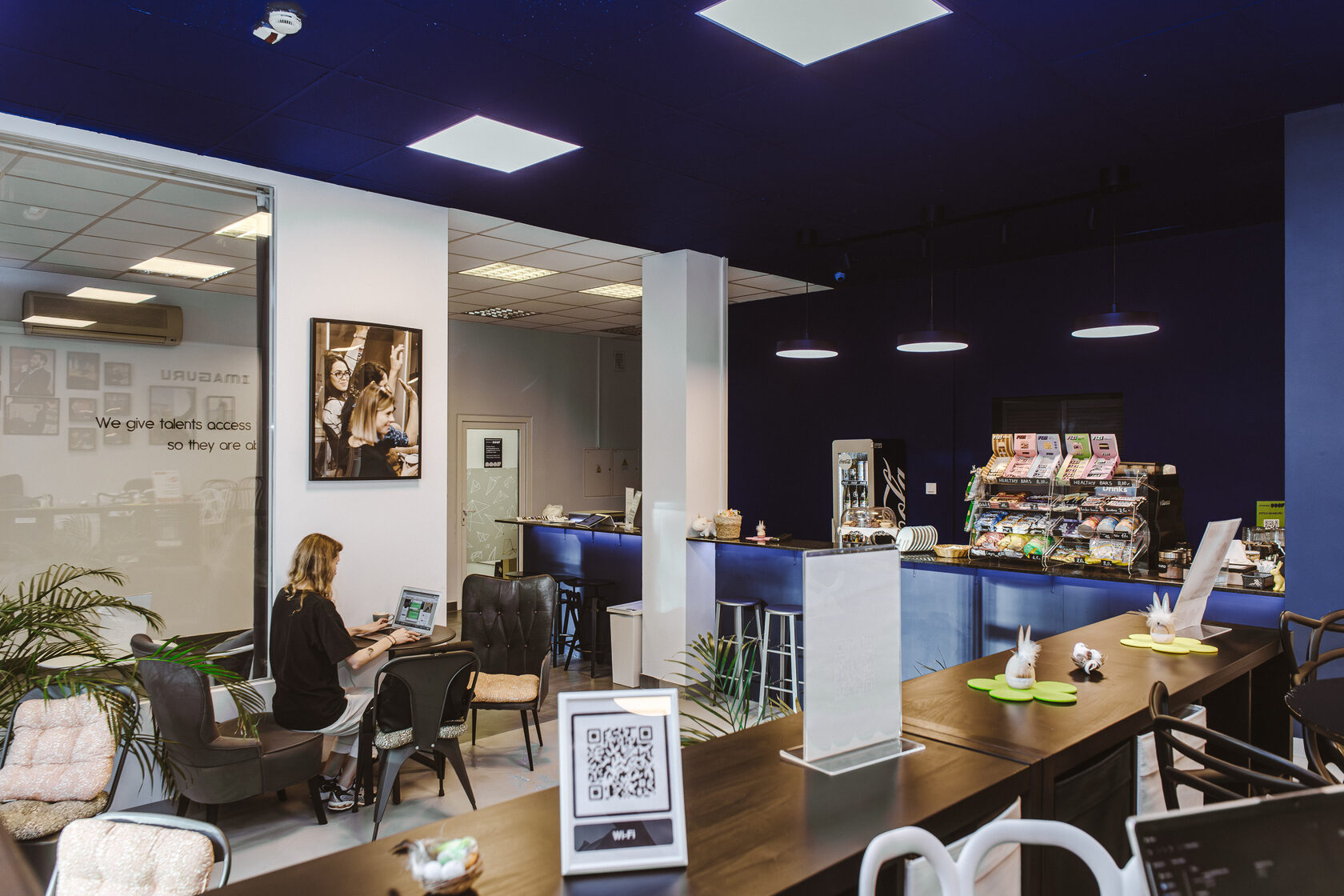
In Warsaw, the service begins with something straightforward: a desk. Imaguru’s published coworking rates list 49 zł for a flexible day, 199 zł for a week and 699 zł for a flexible month. An assigned desk costs 899 zł a month. The plans include Wi-Fi, meeting-room access, coffee and cookies. Startup life still requires somewhere to put the laptop.
The wider Warsaw offering includes offices, an event space and a recording studio for podcasts, interviews, webinars and video. That makes the customer base broader than founders seeking venture money. Freelancers need desks; teams need rooms; organizers need venues; creators need recording facilities. These are usable services even when nobody in the room is preparing a funding round.
The commercial logic has several parts. Space and facility rentals are paid offerings. Corporate projects and founder services add other activities, while partnerships support particular programs. Investment sits alongside this work. A founder should judge each offer by its own deliverables: renting a desk, attending an event and being selected for an accelerator are different purchases or commitments.
Bring a problem to the mentor
Imaguru’s tailored mentoring is described as a prepared, facilitated 30-minute meeting, available individually or in a series in Warsaw, Madrid or online. Its topics include sales, fundraising, growth and strategy. The format starts with identifying a need and matching an adviser to it, with communication and follow-up built into the description.
That suggests a practical way to use the service. Bring a question that can change a decision: which customer segment to pursue, why a sales conversation stalls, or what an investor is likely to challenge in the numbers. A short meeting becomes more useful when both people know what must be resolved. “Help us grow” gives even a capable adviser very little to work with.
Imaguru also advertises investment-readiness work, fundraising support, retreats and acceleration. Its stated expertise is concentrated around forming companies, finding customers, preparing pitches and connecting founders with relevant experience. For a technically strong team, this is the missing commercial layer: the work between a functioning product and a business that someone will pay to use.
- DefineOne decision you need to make.
- MatchAn adviser with relevant experience.
- TestA change with customers.
- ReturnResults for the next conversation.
Spain, with a reason to go
The published Spain accelerator makes market choice explicit. Its preferred applicant already has traction at home and a reason to expand. An idea-stage company can apply, but needs a strong case for the target market. The offer includes an investability report, a two-week trip and three arranged in-person meetings with investors, prospective customers or other relevant contacts.
The terms say selected companies receive a scholarship covering flights and accommodation for at least one co-founder. Participation itself does not take equity; a later investment would involve equity and a valuation discussion. The posted schedule placed acceleration in February-April 2026, ending with a Warsaw Demo Day. Those are published program terms and dates, rather than a claim that every promised outcome occurred.
The fit test is sensible. A company without a plausible customer in Spain may have more urgent work at home. Travel and introductions can shorten the search for a market; they cannot establish demand by themselves. For an applicant, the useful preparation is a clear account of who should buy, why they would buy and which meeting could test that belief.
The other side of the pitch
Investors are customers of the network too. Imaguru offers startup scouting, introductions and co-investment opportunities, describing its contact with founders through coworking, accelerators and events. Its investment pages feature businesses including Zeely and Filmustage. These relationships need careful reading: a company presented by a hub is not automatically a company wholly financed or created by that hub.
A December 11, 2025 Demo Day listing gives the model a useful scale: 10 selected early-stage startups and 10 early-stage investors, with free registration and limited capacity. Organized with Startup Grind, the Warsaw evening advertised questions about market fit, scalability and fundraising readiness. A founder could leave with criticism and a useful introduction. Neither is the same thing as a cheque.
Established businesses enter through a different door. Imaguru describes a 2021 Vilnius fintech hackathon with ROCKIT and sponsorship from Swedbank, along with work involving Visa, EBRD and EPAM. Its corporate menu includes problem-led hackathons, innovation labs and startup scouting. The buyer is seeking ideas, talent or a possible pilot, which gives the founder a potential commercial conversation beyond fundraising.
What travels with the founders
Imaguru sits where coworking, startup education and early-stage investment networks overlap. Alternatives exist for every individual service: rent an office, hire an adviser, join an accelerator or approach investors directly. Its distinctive offer is the combination, shaped by a community with first-hand experience of displacement. That history matters most to founders who need relationships in a new country as much as premises.
The approach still depends on participation. A corporate hackathon needs a worthwhile problem and someone willing to act on the result. A mentoring session needs preparation. An international program needs a reason to enter its chosen market. The parts a reader can copy are modest: organize repeated encounters, make the brief specific and keep the next conversation connected to actual work.
Imaguru’s story began with a place people could gather. Losing that place revealed how much of the business existed in the people who had met there. The practical promise today is recognizable in Warsaw’s desks and Madrid’s programs: somewhere to work, someone useful to ask, and a chance to build the next relationship before it becomes urgent.