A business can disappear faster than its founder’s identity. The invoices stop; the awkward introductions continue. In Belgium, PULSE Foundation has built an unusually practical response to that interval. Revival, its second-chance programme, pairs entrepreneurs after a forced closure with a coach, a mentor and people who understand the experience. The interesting detail is what counts as success: a new business, certainly, but also a job or qualifying training. The entrepreneur is allowed to choose a different ending.
- BEyond helps established Belgian tech companies scale internationally without taking equity.
- Revival offers free support after forced closure, for up to eighteen months.
- PULSE funds ten social-profit organisations over three to six years, with leadership support alongside.
Growth has a waiting room
For a foundation devoted to entrepreneurship, that broad definition of recovery matters. It suggests that entrepreneurship is a skill a person carries, rather than a title a company confers. PULSE was established in 2012 by roughly twenty entrepreneurial families and entrepreneurs, drawing inspiration from France’s Fondation Entreprendre. Its stated values are initiative, collaboration and paying it forward. Under CEO Emmanuelle Ghislain, the work stretches from young people encountering enterprise to founders navigating expansion or closure.
The foundation’s growth programme, BEyond, began in 2018. It addresses the moment when a tech business has customers and traction, and the next decisions become awkwardly expensive. Who should be hired? How should the next funding round work? Which foreign market deserves the founder’s attention? PULSE positions the programme around companies past their first million in revenue. An idea on a napkin belongs elsewhere; this is support for a working company facing a larger stage.
10-12 companies per annual cohort · No equity taken
BEyond puts those companies among experienced mentors, specialist experts, investors and other founders. Its alumni list includes Moonbird, Intigriti, Kazidomi and Spentys. The foundation reports more than eighty scale-ups accelerated, with 95% of alumni still active or acquired. Those are programme-reported outcomes, not proof that the accelerator caused each success. What a founder can actually use is more concrete: advice on a difficult decision, an introduction, and peers whose difficulties need little translation.
The company closes. The calendar continues.
In December 2020, PULSE opened another door. Revival drew on the French programme 60.000 Rebonds, offering entrepreneurs something closer to the outplacement support an employee might receive. It accepts people whose activity ended involuntarily within the previous twenty-four months, across sectors and business sizes. Bankruptcy is one route in; liquidation, forced cessation and a sale at a loss also appear in its description. The trigger is a business ending, rather than a particular entrepreneurial pedigree.

A certified volunteer coach and a mentor work with the participant individually. Experts answer specialist questions; workshops and co-development sessions bring participants together. The standard twelve months can extend by six. It costs the entrepreneur nothing, with Xerius supporting the programme. Free does not mean casual: participants commit to individual and collective sessions. PULSE reports more than three hundred people accompanied and a 78% rebound rate, using that deliberately roomy definition of work, business or training.
The design addresses something that can fail before the next venture even begins: the person’s ability to see a way forward. It also creates space to reconsider whether another company is the right answer. There is no virtue in hurrying back into the same difficulties. The practical lesson is to separate the entrepreneur’s recovery from the pressure to produce another startup. A coach, a mentor and a peer group serve different purposes; putting all three within reach is the programme’s useful architecture.
One door for the scattered paperwork
First Lights tackles the administrative side. Its Lumi assistant offers free, round-the-clock orientation on bankruptcy procedures, social rights and paperwork; trained volunteers take complex cases. PULSE reports supporting 320 entrepreneurs during a pilot year. The distinction between the programmes is sensible: someone may need an answer about the next administrative step before they can think about their professional future. First Lights supplies orientation, with Revival providing the longer accompaniment. Legal advice and therapy remain outside the assistant’s remit.
Buy the organisation some time
PULSE also recognises that other organisations already know their communities. Its funded portfolio includes youth-enterprise organisation LJE, incubators VentureLab and StartLab.Brussels, and #SheDIDIT, which supports women entrepreneurs from diverse cultural backgrounds. MyMachine adds an appealing wrinkle: children imagine dream machines, then older students design and build them. There is room here for enterprise before anyone is old enough to be impressed by a valuation.
The foundation offers structural funding over three to six years, with annual reviews and a decision at year three. RISE adds three years of leadership work, expert support and peer sessions. The business model is philanthropic: mainly donor money, alongside programme sponsors and some public funding. PULSE reports deploying €1.8 million annually. Its funding practice gives readers something straightforward to copy: agree objectives, fund enough time to pursue them, and support the people responsible for the work.
“I feel less alone in my position.”Eléonore van der Loos · StartLab.Brussels, on RISE
The FDT Health Impact Grant adds a different funding experiment. With Financière de Tubize, PULSE offers up to €50,000 for Belgian healthcare-access pilots with a validated proof of concept. Repayment depends on success and the venture’s capacity to pay. The idea is to let one successful pilot finance the next innovator, rather than spend each donation only once.
Failure gets a microphone
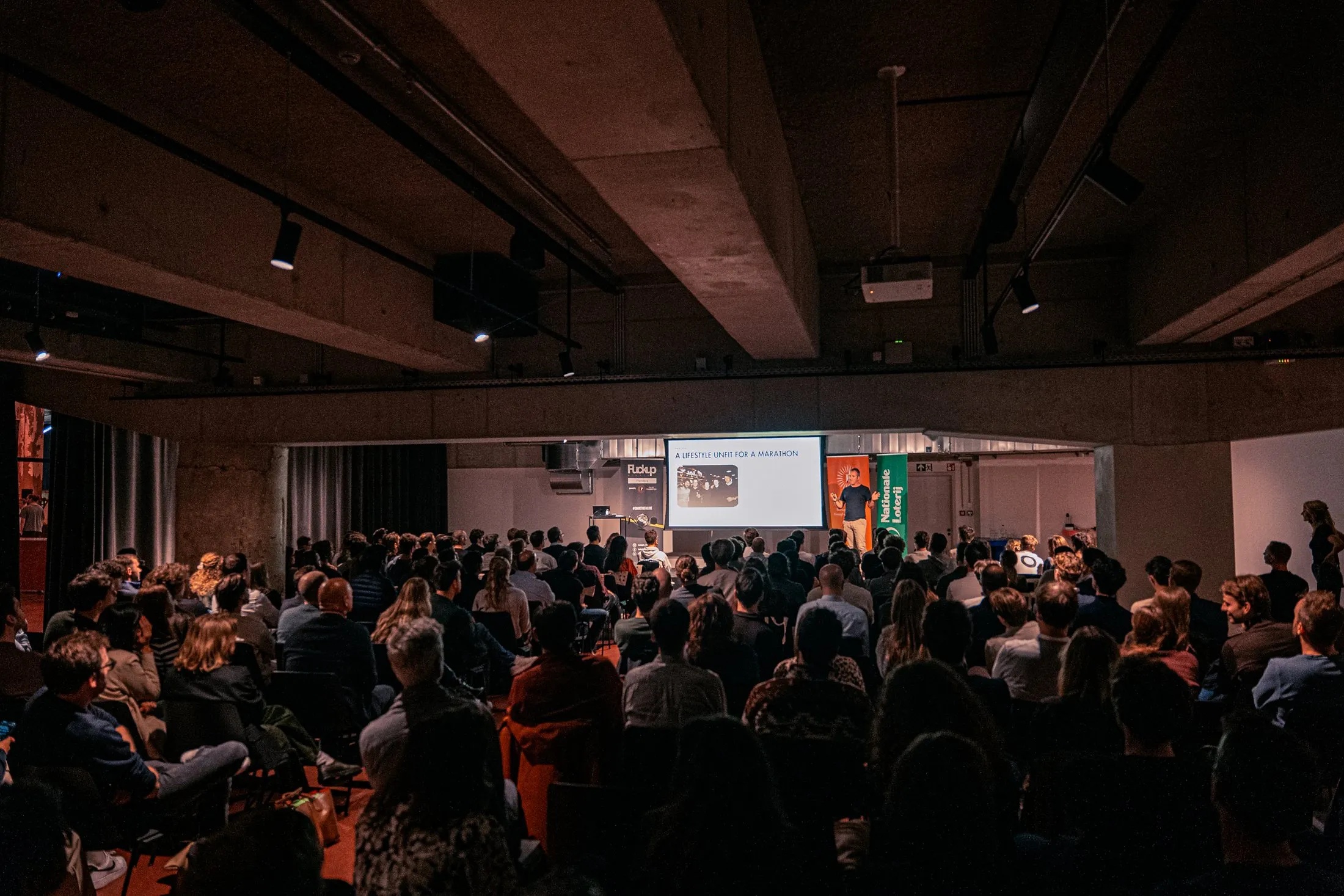
Some obstacles require a public conversation. PULSE runs licensed Fuckup Nights, where founders discuss failures before an audience. BE.Entrepreneur takes a more institutional route: its 2024 work produced twenty-five policy recommendations, and an April 2026 gathering returned to review progress. Wallons-y!, launched in June 2026 with AKT, L’Echo and Wallonie Entreprendre, extends the cultural work in Wallonia. These sit beside the accelerators, giving the foundation a role beyond any single cohort.
For someone considering PULSE, the choice starts with their situation. A tech scale-up seeking international growth can explore BEyond. A founder after forced closure can approach Revival. A funded social-profit organisation receives RISE alongside its financing. None substitutes for a market, a committed participant or specialist advice where needed. The distinctive proposition is the continuity between those stages. PULSE makes the successful founder and the struggling one neighbours. They may, after all, be the same person at different dates.
PULSE Foundation ↗ · LinkedIn ↗ · Explore BEyond ↗ · Explore Revival ↗ · First Lights ↗ · Reports & updates ↗
Watch the programmesBEyond in two minutes ↗ · Revival in their words ↗ · The RISE bootcamp ↗