Before Seedstars had a global competition, it had twenty non-refundable tickets. Alisée de Tonnac recalled the purchase in a 2018 interview: the tickets were booked before the team knew whether its first world tour would work. Booking them was an expensive way to remove a committee meeting from the future. The entrepreneurs would go. What they would find was still an open question.
- Seedstars connects emerging-market founders with investment and practical business support.
- Its customers also include institutions commissioning entrepreneurship programmes.
- Funds and programmes have separate eligibility rules. A place in one does not promise a cheque from another.
01 / The journey became the business
Founded in Switzerland in 2012, Seedstars initially built companies. Its early projects included a wine subscription and a recruitment website for startups. Pierre-Alain Masson, Michael Weber and Adrien de Loës were the original founders; de Tonnac joined subsequently and became a co-founder. By 2013, Masson and de Tonnac were taking a pitch competition around the world, organising events in twenty cities.
There was a practical advantage to travelling: they could meet entrepreneurs outside the familiar investment circuits. Early summit editions attached themselves to Geneva’s Lift conference. The Sandbox network helped make introductions abroad. For organisers starting without a full address book, borrowing established relationships was considerably more useful than announcing a grand vision.
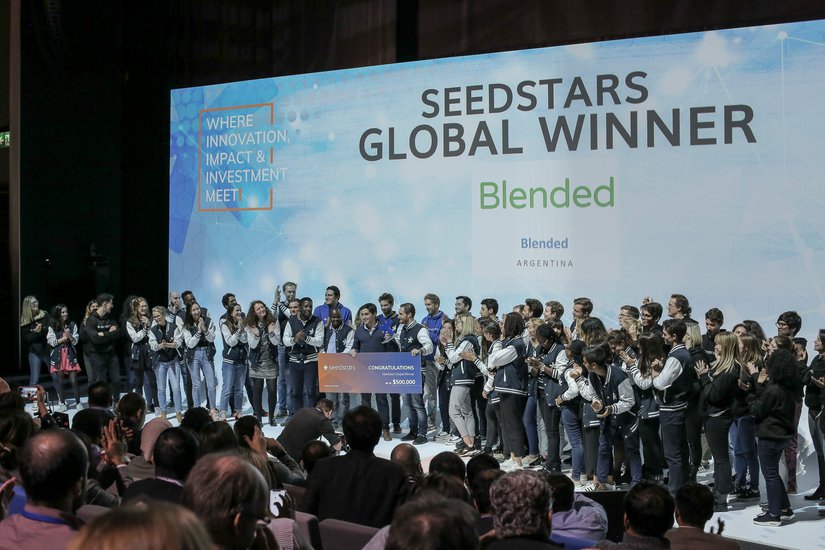
The competition also revealed a limitation. In 2018, then-COO Katarina Szulenyiova described having too little time in each city to understand founders’ different needs. Hubs and digital connections offered a way to stay longer. The useful lesson was almost embarrassingly ordinary: meeting somebody and helping them are different amounts of work.
“Find your Unique Selling Proposition and stick to it.”
Alisée de Tonnac · 2018
02 / What happens after the pitch
Today, Seedstars operates across investment and education. Its programme catalogue separates acceleration from investment readiness. Acceleration works on functional prototypes, first paying customers and product-market fit. Investment readiness examines what a business must improve before approaching investors. The latter can run for two to six months, giving founders time to apply the work while continuing to operate.
The mechanics are concrete: workshops, assignments, mentoring and reviews of business indicators. An Entrepreneur in Residence coaches acceleration participants through weekly KPI meetings. Seedstars’ Control Tower workbook tracks goals and progress. Its Investment Readiness Score helps identify weaknesses so support can address the company in front of the mentor, rather than an imaginary average startup.
Portfolio support extends the relationship further. International Ventures has described growth training, fundraising preparation, recruitment assistance and introductions between founders. Its three-month Growth Track involves the team, not only the chief executive. That matters because the person who pitches the strategy may not be the person who must implement it on Monday morning.
03 / The cheque comes with conditions
Seedstars International Ventures now advertises first investments of $150,000-$350,000, follow-ons up to $500,000 and target ownership of 3-5%. It concentrates on pre-seed and seed B2B businesses in emerging markets, spanning financial services, market enablement and productivity. The proposition is specific enough for a founder to assess before writing a flattering introductory email.
Africa Ventures follows a different brief. Anchored by and part of LBO France, the partner fund advertises initial investments of $250,000-$2 million. It looks for post-revenue companies with demonstrated growth and scalable innovation, including offline models. Completing a Seedstars accelerator is explicitly not required. The shared name should not obscure the separate investment decisions.
There is no single financial transaction called “joining Seedstars.” Programme participation, an equity investment and an institutional mandate are different arrangements. Its acceleration page discusses programme fees and charges for additional investment-vehicle services. Founders should read the individual offer, especially the equity, fees and time commitment, before deciding whether the support fits.
04 / The customer behind the founder
Entrepreneurs are only one side of the business. Governments, development agencies, foundations and corporations also work with Seedstars to build programmes and reach promising companies. Fund investors supply investment capital. Seedstars therefore sits between a venture manager, an entrepreneurship educator and a programme operator, with different customers paying for different forms of access and execution.
Two 2025 announcements make that position tangible. With iGravity, it took on management of the SECO Startup Fund, a Swiss Confederation credit instrument. In Mexico, a partnership with Círculo de Crédito supported the Trust-Tech Fund’s investment and acceleration efforts around identity, fraud prevention and credit-related technology. Institutions bring mandates and specialist knowledge; Seedstars brings founder networks and programme delivery.

05 / Networks have a gatekeeping problem
A 2023 International Ventures review supplied a revealing pair of figures: referrals represented 45% of its pipeline and 82% of its investments. Those historical numbers do not prove referred founders were better businesses. They show how strongly relationships shaped selection. A company trying to widen access must still wrestle with the advantages of already knowing somebody.
The same review described replacing cumbersome investor administration with digital onboarding. It also distinguished satisfaction with portfolio support from measurable business outcomes. That is a useful restraint: enjoying a mentor is not evidence that mentoring caused revenue growth. Seedstars’ practical advantage over a standalone competition is continuity; against other accelerators and seed funds, its emerging-market network is the proposition to examine.
06 / Copy the follow-through
The capital has become substantial. International Ventures II announced a $20 million first close in 2022; Africa Ventures I announced $42 million in December 2024. These were fund milestones, not Seedstars corporate revenue. Africa’s portfolio includes broadband provider Poa! Internet and agricultural retail network Shamba Pride, reminders that an investable problem can be thoroughly unglamorous.
Founders can copy the smaller practices: diagnose the weak point, review progress regularly, ask for a relevant introduction and keep the relationship alive after the event. This approach needs a business capable of using the help. Mentoring cannot manufacture customer demand, and venture funds require stage, geography and growth potential to align. Twenty tickets can get you into the room. The interesting work begins when everybody goes home.
Keep exploring
Find a suitable call through Seedstars programmes, explore International Ventures or Africa Ventures, and meet the disability-focused initiative SEED Inclusivity.