A company that makes hardware for the Moon and a company that turns discarded wind turbine blades into building materials have something in common. In October 2026, both joined Sting. Their products could hardly be more different. Their immediate predicament is familiar: a technical achievement must become something a customer wants, a team can deliver and an investor can understand.
- Sting backs early-stage tech teams with coaching, commercial help and investor access.
- Core runs for 6-18 months; equity warrants pay for the support.
- Selected companies can separately receive SEK 600,000 from Propel Capital.
That gap between an invention and a business is Sting’s territory. Founded in Stockholm in 2002, it has supported more than 500 startups, including Yubico, Sellpy, Airmee and Volumental. The interesting part is how it organizes the less glamorous work: deciding whom to sell to, hiring someone who can sell, and paying for the months before anybody does.
The crash came first
Pär Hedberg founded Sting in the aftermath of the 2001 IT crash. He had run technology companies, with experience in sales, electronics production and logistics. His biography also contains an unexpected qualification: Swedish freestyle skiing champion, 1978. He now makes ice cream. The combination is reassuringly specific for someone whose later work involved helping founders attempt difficult things.
Sting grew into an incubator, accelerator and connector of early capital. Its non-profit structure matters to that story. Owned by the Electrum Foundation, it finances its activities through a mixture of public support, private partnerships and its own resources. Returns go back into startup support. A successful company can therefore help pay for a founder who arrives years later.
Vinnova, the City of Stockholm and Region Stockholm are among its main partners. This places Sting between public innovation policy and private company building. Its users are founders, especially those working in climate, health, AI and deep tech. Its job is to help them reach the point where customers and investors can judge a business.
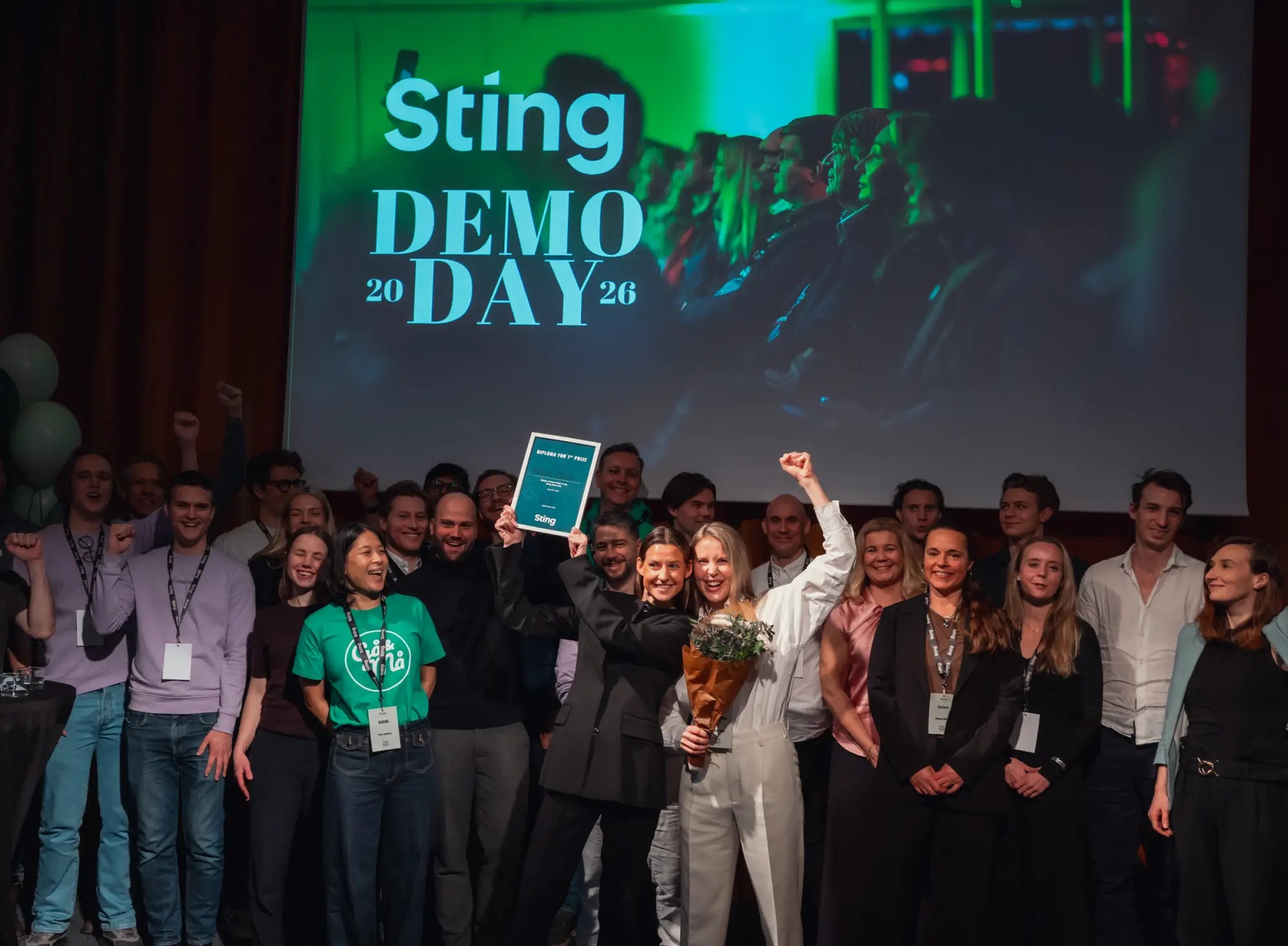
Give the company a longer clock
In October 2025, Sting brought its separate Incubate and Accelerate programs together under Sting Core. The first intake comprised 15 startups. CEO Karin Ruiz described the change as giving founders “one strong, streamlined path to growth.”
Core now allows six, twelve or eighteen months of support, organized in six-month periods. A dedicated coach helps with the business. Other support covers recruitment, product development, intellectual property, sales, fundraising and workspace at A house. The flexible duration is particularly relevant to science-based ventures, where demonstrating that technology works and preparing it for commercial use can require different timetables.
The distinction from buying occasional advice is the bundle: an operating rhythm, specialist help and access to investors around the same company. Compared with approaching mentors, recruiters and angels separately, that can reduce the founder’s coordination burden. The practical value depends on whether those people understand the particular business and its next obstacle.
Three six-month periods. A longer runway for company building.
The coaching team also shows how experience circulates. In autumn 2026, Siam Choudhury returned as a coach after building regtech company Pliance at Sting. Verified acquired Pliance in 2023. He comes back with a founder’s experience of the process that new entrants are beginning. That is a concrete form of institutional memory: a former participant can now help another team work through its decisions.
The price has two parts
Sting’s fee FAQ lists a SEK 5,000 start fee and 2% equity per six-month period, using warrants that convert into shares when the company leaves Core. Over three periods, those stated percentages add to 6%. Founders should treat that as a meaningful ownership decision. The same FAQ gives Sting a right to sell its shares back for SEK 75,000 during its first two years as a shareholder.
Propel Capital is a separate decision. Selected Core companies may receive an optional SEK 600,000 convertible investment: SEK 400,000 up front and SEK 200,000 as follow-on. That financing sits alongside the program warrants. Joining a program does not make an investment automatic.
Propel pools business angels around Sting companies. Its seventh vehicle launched in 2025 with SEK 27 million committed, including matched funding from Saminvest. The mechanism gives founders a route into an investor community as well as an initial cheque. For an angel, it offers shared selection and a portfolio of early-stage bets.
A patent is also a bill
Science to Business gets unusually concrete about the obstacles facing researchers. It offers potential convertible loans of up to SEK 100,000 for patent applications and SEK 250,000 for key personnel, alongside help finding a commercial co-founder. These are loans with terms, rather than free grants. They address costs that can arrive before a research spinout has dependable sales.
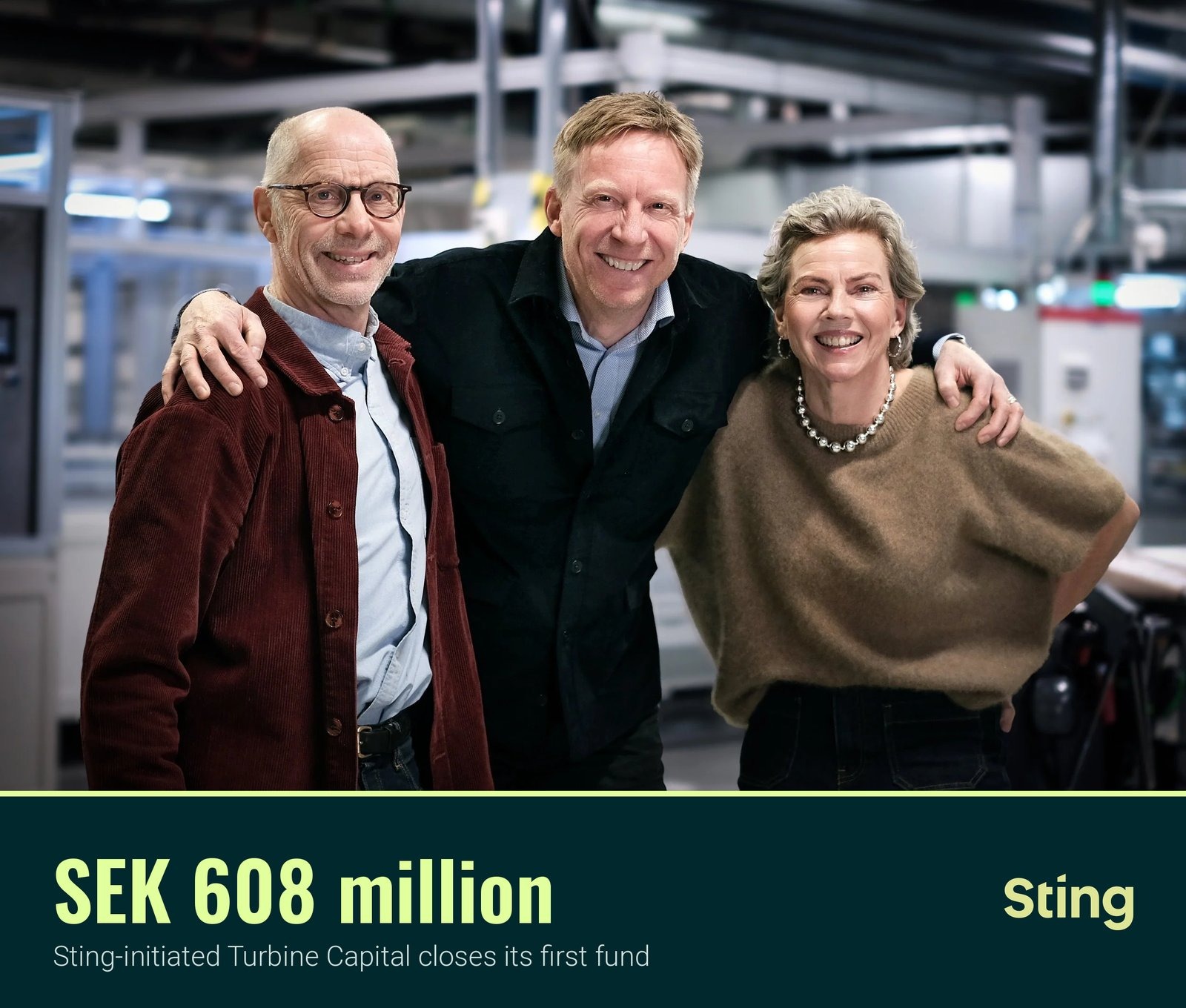
The larger financing story is Turbine Capital, initiated by Hedberg and co-founded with Karin Edström and Anders Ösund. Its first fund closed at SEK 608 million in October 2026. Industrial investors include Mycronic, Saab, Scania, Volvo Cars and Stena; institutional backers include Saminvest and the European Investment Fund.
A patent, a first hire, a first customer: the sequence matters as much as the invention.Editorial observation
Sting is a founding partner, sponsor and investor in Turbine, which has a 15-year horizon. For hardware and research-heavy companies, the implication is straightforward: funding needs to tolerate development time, while industrial relationships can help connect the technology to its eventual market.
Start with the next question
Founders in Stockholm have alternatives, including SSE Business Lab and university-linked KTH Innovation. The useful comparison is practical: eligibility, sector expertise, the time a coach can commit and the ownership cost. Sting belongs in that comparison as an organization combining sustained company-building support with connected investment vehicles. The right choice depends on which of those resources a team actually needs.
There is a smaller entry point. Open Coaching offers a free 20-minute conversation. Startup Academy provides free, self-paced online courses, including a researcher track. A prospective founder can use those resources to sharpen the question before committing equity or applying to Core.
The habit worth copying is to separate technical proof, customer proof and financing readiness. Ask who buys, what evidence they need and which expense comes next. Core requires a team and Swedish registration; a solo founder or overseas company needs a different starting point. A local service business without a scalable technology proposition has different needs again. Sting’s offer makes most sense when the invention is promising, the commercial work is still substantial, and the founders are ready to do it.