BREAKING  Forbes 30 Under 30 names Factorem's Alexandra Zhang +++ Lead times slashed from 3 months to 12 days +++ Singapore HQ → Colorado expansion underway 300% year-over-year growth reported 11 nations. One manufacturing network. No minimum orders. BREAKING  Forbes 30 Under 30 names Factorem's Alexandra Zhang +++ Lead times slashed from 3 months to 12 days +++ Singapore HQ → Colorado expansion underway 300% year-over-year growth reported 11 nations. One manufacturing network. No minimum orders.
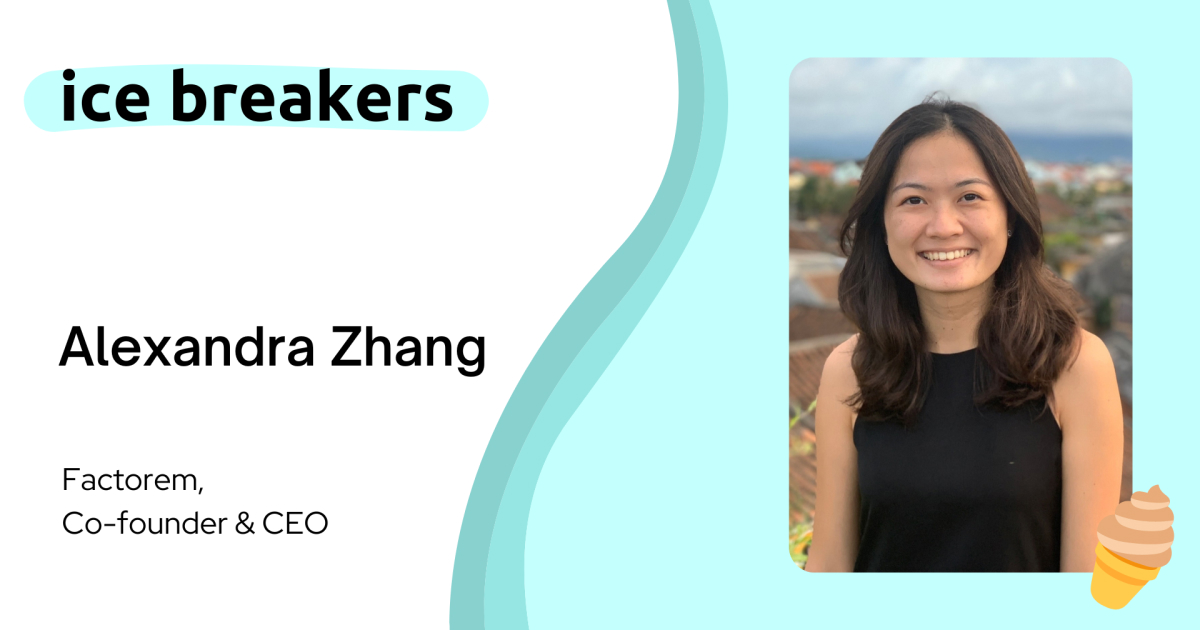
Alexandra Zhang, co-founder and CEO of Factorem
Alexandra Zhang — she studied buildings, then learned to make the parts inside them. The maker, mid-pivot.
The Profile

Alexandra Zhang

She needed one prototype machined. The world made it impossible. So she built the network that makes it easy — for everyone after her.

Co-Founder & CEO, Factorem · Singapore ↔ Colorado

12
Day avg lead time
150+
Vetted factories
30K+
Parts manufactured
98%
Quality acceptance
Who she is now

A factory floor you can reach from a browser tab

Type a part number into Factorem and something quietly radical happens. An AI reads your CAD file, flags the defects that would have ruined the batch, prices the job in minutes, and routes it to one of more than 150 pre-vetted factories scattered across eleven Asian nations. No minimum order. No three-month wait. No cold-calling machine shops who never call back. That is the company Alexandra Zhang runs as co-founder and CEO, and it is the company she once desperately needed and could not find.

Factorem - Latin for "maker" - is, in her own framing, not a marketplace that matches you to a stranger and wishes you luck. It is an engineering-led service: a person on the other end who answers within a business day, a quality team in Singapore that inspects before anything ships, and an ISO 9001-certified promise that 98% of every batch comes back right. The platform handles CNC machining to within two microns, 3D printing across twenty-plus materials, sheet metal, injection molding, surface treatment, and the unglamorous miracle of re-engineering a legacy part nobody has the drawings for anymore.

The customers are the people who keep the physical world running and can least afford a bad batch: aerospace teams, robotics startups, defense contractors, biotech labs, semiconductor shops. For all of them, Zhang sells the same thing - time. The old answer was three months. Her answer is twelve days.

The pitch, condensed

"Only one or two things are truly critical to the survival of the business."

"I chose NOC because I've always wanted to build something from zero to one."
— On joining the first NUS Overseas Colleges cohort to Toronto, 2018
The frustration that started it

A transmission, a dead end, and an idea

Here is the strange specific: Zhang studied real estate. Buildings, leases, square footage. Then she flew to Toronto in 2018 as part of the very first NUS Overseas Colleges batch sent to the city, took an internship at an automotive startup, and found herself working on transmissions for electric vehicles. An engineer's job, in everything but the diploma.

That is where she hit the wall that would define the next chapter. She needed prototypes. She needed reliable manufacturers. And the process of finding either was a slow, opaque, soul-testing slog - emails into the void, quotes that took weeks, minimum order quantities that made small runs absurd. Her co-founder, Hardik Dobariya, was running into the same brick wall from the product side. Two people, the same maddening problem, the same instinct: someone should fix this.

So they did. Factorem was incubated at The Furnace, the NUS School of Computing's startup workshop, and earned a VIP grant from NUS Enterprise along the way. The logo carries eleven panels, one for each Southeast Asian nation in the network - a small piece of design that quietly tells you the founder thinks in maps, not just margins.
How the machine runs

Three decisions that made it different

Kill the minimum order

Traditional factories want thousands of units or they want you gone. Factorem took the MOQ to zero, which means a robotics startup can order one bracket the same way Boeing orders ten thousand.

Let the AI quote, let a human check

Software reads the CAD, spots the defects, and prices the job in minutes to 24 hours. Then a real engineer reviews it. Speed without abandoning you to an algorithm.

Own the quality, not just the match

A Singapore-based team inspects with optical and laser tools before anything leaves. The promise is 98% acceptance, every batch - a number you only quote if you intend to keep it.

The big move

From the tropics to the Rockies

Most founders expand into America by hiring a sales rep and hoping. Zhang packed a bag. She left Singapore for Colorado to build out the U.S. operation herself, planting an office in Colorado Springs while basing in Boulder. It was a bet that the American hardware market - hungry for supply chains that do not run through a single fragile geography - would pay for speed and resilience.

The bet is paying. Inside roughly ten months, the U.S. grew to nearly half of all sales. Revenue went from about $400,000 in 2023 to somewhere between $800,000 and a million the year after, with 300% year-over-year growth on the books. In 2025 Factorem was picked for the gBETA Greeley accelerator, the kind of local stamp that says a Singapore company has genuinely become a Colorado one too.

The throughline is the same as the day she couldn't get a transmission part machined in Toronto: she goes to where the problem is and stands in it. The harder version of expansion, chosen on purpose.

The arc

Zero to one, year by year

2018
First NUS Overseas Colleges cohort to Toronto. Interns at an automotive startup building EV transmissions, and runs straight into the sourcing wall that becomes the business.
2020
Co-founds Factorem with Hardik Dobariya. Incubated at The Furnace, NUS School of Computing. The maker is born.
2023
Named to Forbes 30 Under 30. Packs up Singapore and moves to Colorado to open the U.S. market. Posts ~$400K in revenue.
2024
Revenue climbs toward $1M. U.S. sales surge to nearly half the company.
2025
Joins gBETA Greeley. ~$755K in sales, 300% year-over-year growth, and a U.S. office firmly planted in Colorado Springs.
In her words

The operating philosophy

"Never stop showing up. Especially on the harder days. Trust in the process and the unfolding of life."

"One of the valuable lessons I've taken is to laser focus. Only one or two things are truly critical to the survival of the business."

"Note down why you embarked on your startup journey. The 'why' is important and may change as you hit each milestone."

Off the clock

Ten silent days, and a soft spot for Biscoff

For someone whose product is speed, Zhang's idea of a reset is the opposite. She once walked into a 10-day silent Vipassana retreat with zero prior experience - more than ten hours of meditation a day, no phone, no conversation, not even a journal to hide behind. Ten days alone with the loudest thing in any founder's life: their own head. She came out, and kept building.

She talks about her biggest wins arriving disguised as setbacks - the funding round that came after the no, the marquee client who showed up by accident. Obstacles, in her telling, are not endings. They are plot twists. It is a useful belief for a person who picked one of the least forgiving industries on earth and decided it was full of untapped potential, alongside the other unglamorous giants she admires: agriculture and construction.

And the small human stuff that makes a profile worth reading: she treats movement and fitness as an energy-giver, not a chore. She travels every chance she gets. And her go-to ice cream flavor is Biscoff - the spiced cookie one, for the record. A maker with a sweet tooth and a meditation streak. The combination is more coherent than it looks.

Field notes

Real estate grad. Transmission tinkerer. Forbes lister. Silent-retreat survivor. Biscoff loyalist.

Share this profile