The curious thing about a startup accelerator is its ending. A founder walks out with a sharper pitch, new contacts and, perhaps, applause. The following Monday, the customers still need persuading. Ministry of Awesome came to regard that Monday as a problem worth redesigning around. For an organisation with such a cheerful name, it has developed a rather unsentimental view of what founders need.
- A Christchurch recovery project became a national startup support organisation.
- Founder Catalyst pairs founders with experienced operators for seven months, without a participation fee.
- The emphasis is customers, commercial progress and accountability; investment follows its own timetable.
01 / A city needed a conversation
In 2012, after the Canterbury earthquakes, Kaila Colbin, Sam Johnson, Vicki Buck and Sacha McMeeking helped establish Ministry of Awesome. The initial question was civic: what could Christchurch become? Coffee & Jam gave people somewhere to exchange ideas. The name sounded like a department invented by someone who had suffered enough departments.
The infrastructure became more formal. A partnership with Ara Institute of Canterbury began in 2018; Te Ōhaka, their centre for growth and innovation, followed in 2019. ChristchurchNZ joined in 2020, enabling Founder Catalyst. Today, Coffee & Jam remains a monthly lunchtime gathering. Around that modest social ritual grew a way to help people turn possibilities into companies.
02 / The trouble started after graduation
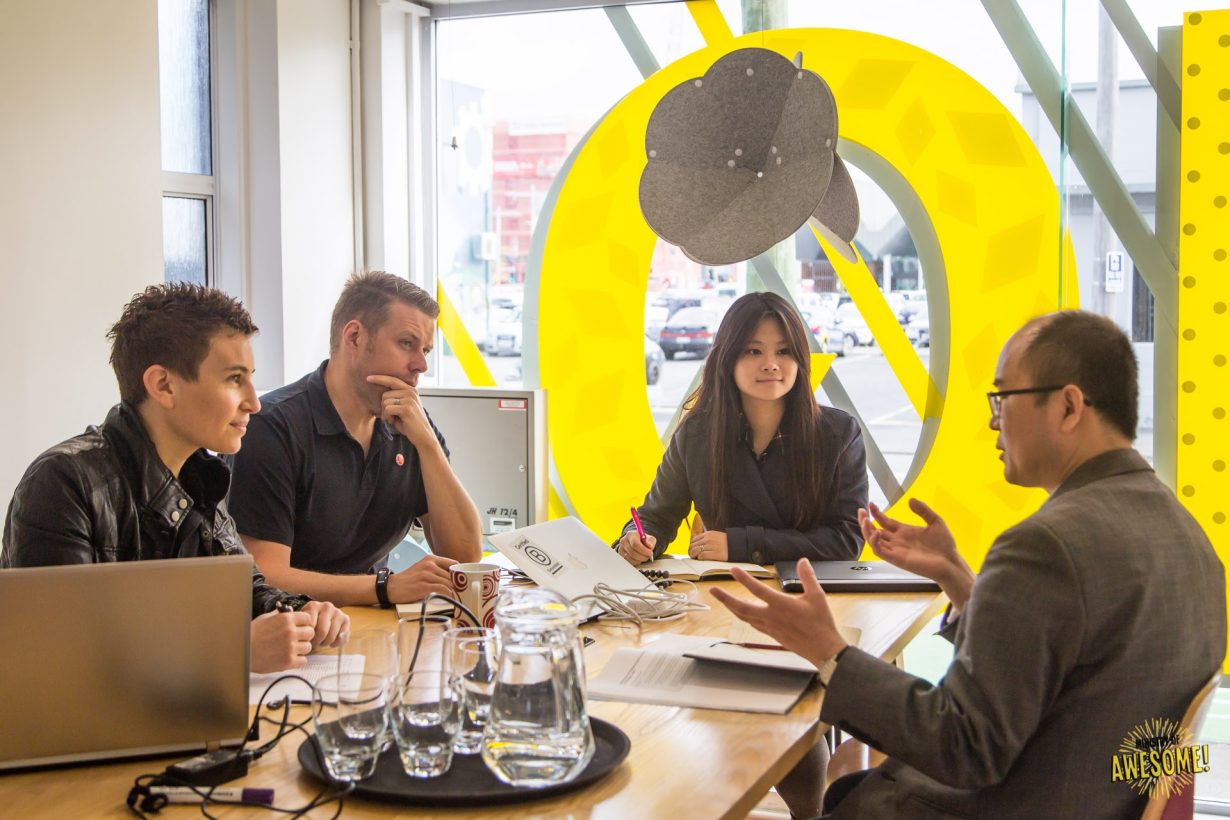
In a March 2025 interview, then interim chief executive James Burnes explained the change. Feedback gathered in 2021-22 suggested three-month programmes ended too soon. Founders lost their structured support just as the next difficulties arrived. MoA extended incubation and stopped staging expensive demo days. “For us, it was not a good use of money,” Burnes said.
That interview described a nine-month programme. Current Founder Catalyst materials specify seven months. The principle survives the change in duration: sustained advice, recurring work and introductions when a company needs them. Raising capital became a means of growing the business rather than a ceremonial finish line. An investor meeting need not wait for a stage to become available.
“For us, it was not a good use of money.”
JAMES BURNES / ON HIGH-PRODUCTION DEMO DAYS, 2025
03 / First the customer. Then the code.
For a founder, the entry point depends on the question. Startup Aotearoa offers free one-to-one coaching through MoA, Creative HQ and regional partners. Request a session, meet a coach, leave with actions, return when ready. Its website reports 1,800 early-stage entrepreneurs supported across the network. This is help for discovering whether an idea deserves more of your life.
MoA also distinguishes customer discovery from market growth. Pre-Founder Catalyst helps founders understand buyers. Founder Catalyst works with teams pursuing traction and scale. Its toolkit covers business models, sales, recruiting, pitches and overseas expansion. The startup fundamentals list gets wonderfully earthbound: finances, contracts, tax, employment obligations and insurance. A global ambition still requires someone to read the paperwork.
Is this worth testing?
Who needs it?
How does it grow?
Backkr provides a concrete example. Founder Kate Radcliffe-Reid had seen small service businesses priced out of agency marketing. Through Founder Catalyst, she met Damon Ross, now her technical co-founder. She credits entrepreneur-in-residence Marie-Claire Andrews with turning problems into next steps. Of Ross, she says: “He won’t build anything until people really want it.” A useful temperamental difference, especially when software is involved.

The same commercial lesson appears elsewhere in MoA’s founder stories. Airie founder Annie Kim describes mentor Dan Khan shifting her attention from polishing a product toward building a business. Traft AI’s Jackie Huo and Claudia Feng worked with Irina Miller while developing Inoscope for construction and insurance workflows. MoA supplies business guidance across sectors; the founders bring their specialist knowledge.
04 / An honorary co-founder, minus the shares
Founder Catalyst assigns each startup a dedicated entrepreneur-in-residence, described as an honorary co-founder without an equity stake. Founders also gain access to the wider group. That arrangement matters: recurring contact can turn a vague intention into something a founder must explain, measure and revisit. The promise is practical company building through a relationship.
Le Velo Studio co-founder Alex Guichard joined after previous ventures, including a painful failure. In his account, accountability helped restore confidence: reporting results, forecasts and explanations to a mentor. MoA’s culture names integrity, collaboration, accountability, respect and excellence under the mnemonic I CARE. Its community code also spells out acceptable behaviour. The friendliness has terms.
MoA’s current programme figures are self-reported outcomes. They describe the portfolio; they do not establish how much success the programme caused.
05 / No fee does not mean no cost
Founder Catalyst charges no participation fee, but requires a collaboration agreement and roughly two to four hours a week for programme activities. The company-building work comes on top. Public and corporate partners support the organisation: the current homepage identifies ChristchurchNZ, MBIE and Kiwibank. In 2022, reporting put the backing for the separate Electrify Accelerator at NZ$140,000.
Electrify addresses another constraint: access. Its conference connects women founders with investors and supporters. A 2026 seed opportunity with Foggy Valley Aotearoa and NZGCP offered up to NZ$100,000 for one eligible technology startup through a SAFE, an agreement for future equity. It had ownership conditions and investor discretion. Separately, Kiwibank’s StartUp+ partnership offers progress-based borrowing. Coaching, investment and debt each come with different obligations.
06 / Borrow the habit of asking better questions
MoA occupies the space between having an idea and operating a company ready to grow. Creative HQ, Soda, The Factory and other hubs provide alternative routes, while sometimes collaborating on delivery. Founder Catalyst seeks a strong New Zealand connection and globally scalable ambition. Ordinary service businesses, consultancies and casual side projects fall outside its stated remit.
For someone comparing programmes, this suggests a useful interview of the interviewer. Who will work with you? How often? What happens when customer feedback contradicts the plan? Ask whether the programme fits your present bottleneck: finding customers, developing a product, hiring or financing growth. A sector-specific accelerator may offer more relevant technical contacts; a generalist mentor may help expose assumptions your own industry takes for granted. The important distinction is the work you can accomplish together. A crowded events calendar tells you remarkably little about whether anyone will help examine your next disappointing sales result.
The transferable lesson is straightforward: build support around the difficult work that follows an event. Find a buyer before adding features. Give a mentor specific results to challenge. Make introductions when they are useful. A programme cannot supply motivation or manufacture demand. But it can make the next decision less lonely, and considerably harder to evade.