A working prototype can be a very persuasive object. It does something. You can point at it. You can give a demonstration and collect encouraging nods. Then somebody asks who will buy it, how much they will pay, and whether the business will still exist next year. HIVE COLAB occupies that awkward stretch of ground. The Ugandan innovation hub helps founders do the work that enthusiasm tends to skip: assemble a team, understand a market, keep accounts and make the next version worth paying for.
Its story began with shared space and internet access in 2010. Today, the organisation’s activities range from business incubation to circular agriculture and an education technology fellowship. The connective tissue is practical: people who understand a local problem often need help turning that understanding into a viable enterprise.
A room with a condition attached
The July 2010 launch announcement was admirably specific about membership. Applicants needed to be working on projects; keeping their place meant demonstrating progress. A community board included Teddy Ruge, Daniel Stern, Solomon King and Jon Gosier. Appfrica, Project Diaspora, UConnect and Node Six were involved in the announcement. The proposed workspace would give developers computing resources, bandwidth, professional surroundings and contact with one another.
Creators would retain ownership of their projects. Investors could enter the picture through a wider network. That arrangement put collaboration and independence in the same room, with an expectation that people would actually build something. Even the earliest description understood the danger of a workplace becoming a comfortable waiting room.
Barbara Birungi Mutabazi, a co-founder and the organisation’s executive director, brought a particular interest in who gets to participate. Her first job involved researching whether putting craftswomen’s products online could improve their earnings. Technology’s value, in that account, had to show up somewhere more useful than a screen.
“There is power in collaboration when creating.”
Barbara Birungi · 2016 interview
The rent was part of the innovation
For all the language surrounding startup hubs, one of HIVE COLAB’s clearest early financial records concerns ordinary bills. In March 2012, Indigo Trust announced an £18,000 grant. That September, it announced another £15,078 to cover six months of rent, salaries and internet. The premises, the people running them and the connection to the outside world all needed paying for.
These were operating grants to the hub. Keeping that distinction clear matters when reading about an organisation that both receives support and helps other businesses obtain it. A funded workspace creates room to experiment; it does not automatically put investment capital into every member’s bank account.
One grant. Six months of rent, salaries and internet.
Jon Gosier described an earlier source of backing in a TED interview: Appfrica used profits from its client work to support initiatives including HIVE COLAB. The present model has accumulated development partnerships and programme funding alongside workspace services. Its expertise includes business development and research, with market surveys, focus groups and ICT-for-development work among the services it advertises. Founders use the support; institutional partners help make programmes possible.
One year became three
The early difficulties were more stubborn than finding desks. In a 2016 interview, Birungi described graduates with technical skills but little preparation for creating businesses. Some founders abandoned their ventures when progress disappointed them or a job opportunity appeared. She put the hub’s historical success-failure balance at roughly 50-50, an unusually plain admission in an industry fond of graduation photographs.
She also described a concrete change: incubation had been extended from one year to three. That is a useful measure of what the organisation learned to accommodate. The clock for developing a company did not fit the original timetable. At the time, support included grace periods for workspace payments and help refining business models, forming teams and developing prototypes.
A later account exposed another design problem. Visiting business trainer Alison Gray wrote in 2017 that women had been dropping out of technology courses faster than men. Women-only courses reportedly reduced that attrition. The observation makes a better lesson than a slogan about inclusion: notice who stops coming back, then examine the conditions under which you expect them to learn.
Women at Hive now describes dedicated founder cohorts covering leadership, products, customers and finance. Its business-development emphasis makes participation more substantial than an invitation to a networking evening.
Twenty places. Four investments.
The Hive Accelerator, developed with the Argidius Foundation, shows how specific the offer has become. Its published plan targets 80 locally led startups across four cohorts in 2023-2026. Applicants need Ugandan incorporation and founders, at least two team members, one full-time founder, annual revenue of at least $10,000, and management accounts or audited books.
The programme promises three weeks of workshops spread across three months, followed by six months of mentoring. Founders practise due diligence, financial storytelling, pitching and milestone planning. Four startups per cohort can receive $15,000 each through competitive peer selection, in the form of equity or debt.
Yellow marks the competitive investment allocation. Joining a cohort does not guarantee funding.
The distinction has consequences. A founder must budget time away from daily operations, prepare records and understand the proposed financing instrument. This particular accelerator suits businesses with evidence of sales. Someone with only an idea should look at the hub’s earlier-stage support and its separate eligibility requirements.
The market is bigger than the room
HIVE COLAB’s reach also depends on removing geography from the application process. Hive Virtual is designed for rural entrepreneurs, combining online business and technology training, mentoring and progress reviews with possible physical meetings. Its description puts unusual emphasis on finding tenders and freelance work so participants can test demand and begin earning.
Remote participation can reduce travel and the need to occupy a city workspace. It still requires usable connectivity, time and a willingness to complete assignments. Moving support online changes the route into the programme; it does not remove the work. Alongside Kampala, the organisation lists a physical location in Mbarara.
The Youth Startup Academy Uganda adds another route to opportunity. Financed by Korea’s SMEs and Startups Agency, its original design aimed to incubate 1,000 entrepreneurs by 2024 through training, mentoring and consulting. The ambition included connecting Ugandan businesses to international markets.
In November 2024, Mutabazi described taking 12 Ugandan businesses to Korea the previous year. Seeing Korean startups pitch, she said, broadened the visitors’ ambitions. She pointed to Yunga’s Korean investment and Boringo Fresh’s work in Kenya as examples of progress. Her argument was that founders need exposure to larger possibilities as well as encouragement to pursue them.
There is a business in those banana peels
O-Farms makes the hub’s sector range tangible. HIVE COLAB implemented the programme in Uganda with Bopinc, Village Capital and IKEA Foundation support, helping enterprises bring agricultural losses and by-products back into productive use. Its examples include rejected tomatoes becoming ketchup and banana peels becoming food packaging.
The selection criteria focus on businesses with customers and revenue. The offer combines training, technical assistance, coaching and investor connections. The environmental benefit must sit inside a workable commercial model: somebody still has to want the finished product at a price that supports its production.
Bopinc’s wider O-Farms work captures the less photogenic obstacles: access to finance, certification and market development. A clever reuse for waste can stall at any of those points. That is why the business advice matters alongside the technical idea. Bopinc also publishes a circular toolkit, giving entrepreneurs outside a cohort practical ways to examine their products and processes.
The next test is in the classroom
In April 2026, HIVE COLAB launched Uganda’s first Mastercard Foundation EdTech Fellowship cohort, bringing together 12 ventures. The announced group included Shule.tv, Yiya Engineering Solutions, Yaaka Digital Network and Mindset Coders. They address different educational needs, from digital content to skills development and ways of reaching learners with limited connectivity.
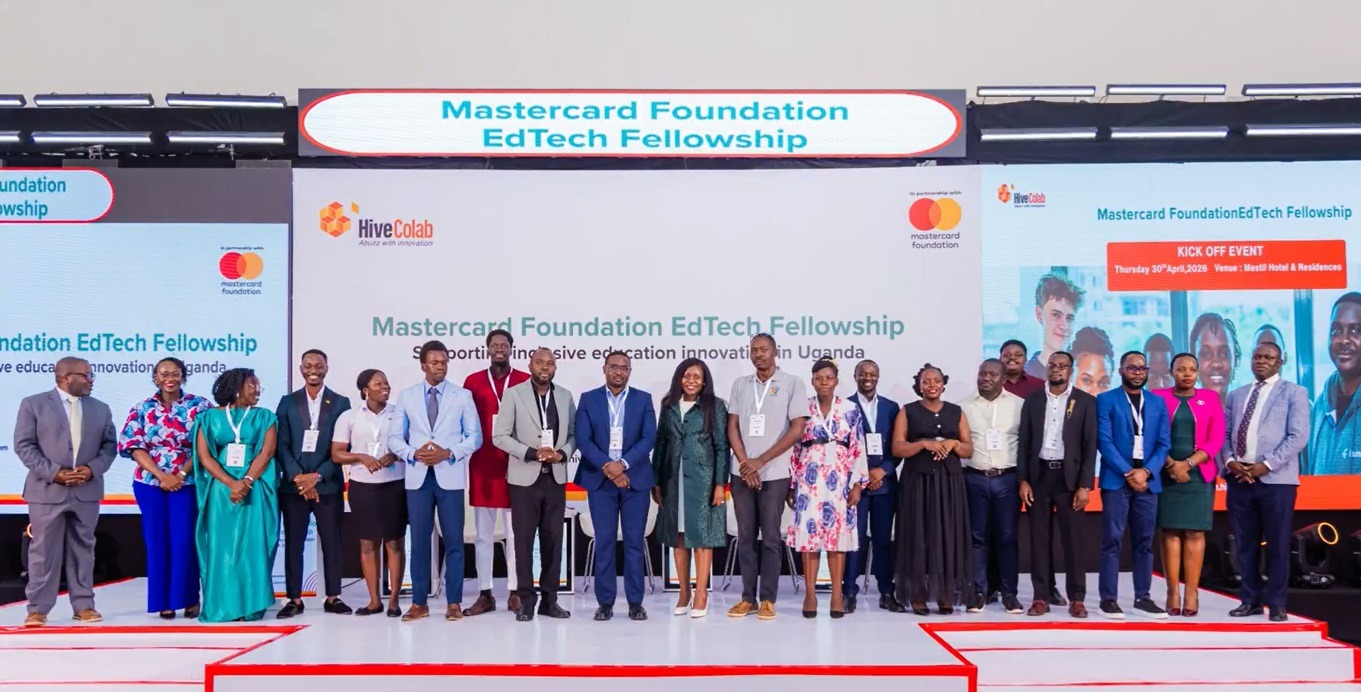
The fellowship’s own description prioritises locally founded, locally led businesses with working products and demonstrated traction. Support covers learning science, accessibility, teacher and learner engagement, business resilience and measurement of educational outcomes. Those requirements put pressure on a familiar shortcut: counting distribution as proof that a product works.
For an education venture, reaching a school is only part of delivery. The fellowship asks founders to consider what teachers can use, what underserved learners can access and what evidence will show improvement. Its emphasis on low-income communities, refugees and learners with disabilities gives those questions a defined audience.
What survives the demo
Ugandan founders have alternatives, including Outbox, Innovation Village and Makerere Innovation and Incubation Center. HIVE COLAB’s particular combination is a long-running founder community, several sector programmes, regional and remote participation, and development partnerships. The useful comparison is which organisation can help with a venture’s next constraint.
The same connecting role explains Swarm Summit, whose 2025 agenda focused on AI and platform technologies in Uganda’s development. Bringing policymakers, investors and founders together can expose practical questions about talent, markets and governance that a technical demonstration leaves unanswered.
Readers can copy several habits without joining a cohort: make progress a condition of participation, test a financial narrative with peers, examine dropout patterns and seek customers beyond familiar circles. Each depends on honest feedback and the capacity to act on it. HIVE COLAB’s most useful proposition is the work implied by those habits: give a promising builder enough structure, contact and scrutiny to become a business owner.