An investor can have money and still have homework. On June 4, 2026, the Okanagan Angel Summit reached its finale in Kelowna with C$407,000 committed across three Canadian startups. The evening looked like a pitch competition. Behind it sat eight weeks of preparation for the people seeking capital and the people deciding where it should go. Accelerate Okanagan had arranged an education with consequences.
- Teach both sides. The Angel Summit prepares founders and accredited investors together.
- Match support to the problem. Mentorship, IP resources and project funding serve different needs.
- Check the small print. Geography, business stage and available funding determine access.
The other half of the funding table
The tempting assumption is that a startup region needs more polished pitches. Accelerate Okanagan’s approach suggests another question: who is ready to listen? Its Summit builds experience in investor meetings and due diligence as well as presentation. The organisation works on the judgement around a company, alongside the company itself.
In 2026, applications opened across Canada for the first time. Investors also adopted a model that allowed them to spread capital among several companies and add investments on finale night. Drawbridge received C$74,000; shuriii received C$188,000. Bullfinch Earth received C$120,000 from the Summit fund and another C$25,000 personally from keynote speaker Ben Yoskovitz. A regional room had become a national meeting place.
Bullfinch Earth includes C$25,000 invested personally by Ben Yoskovitz. Total: C$407,000.
That change is instructive without being a universal recipe. Wider eligibility gives investors more ventures to examine; flexible allocations give them more ways to act. The results show what happened after those changes. They do not establish which change mattered most. Even a pleasing number deserves a little interrogation.
A region learns to share its address book
Accelerate Okanagan began on December 31, 2010, through the combination of Penticton’s Okanagan Research and Innovation Centre and Kelowna’s Okanagan Science and Technology Council. Its purpose was straightforward: help more technology companies start and grow in the Okanagan. Combining regional organisations put previously separate support under one roof.
The money arrived through public development channels. In November 2011, federal and provincial governments announced C$2.1 million over three years for its work. By 2025, PacifiCan had announced a C$1,980,500 contribution for Ascend BC, supporting businesses in the province’s North and Southern Interior. These are program contributions to a nonprofit, distinct from investors buying stakes in startups.
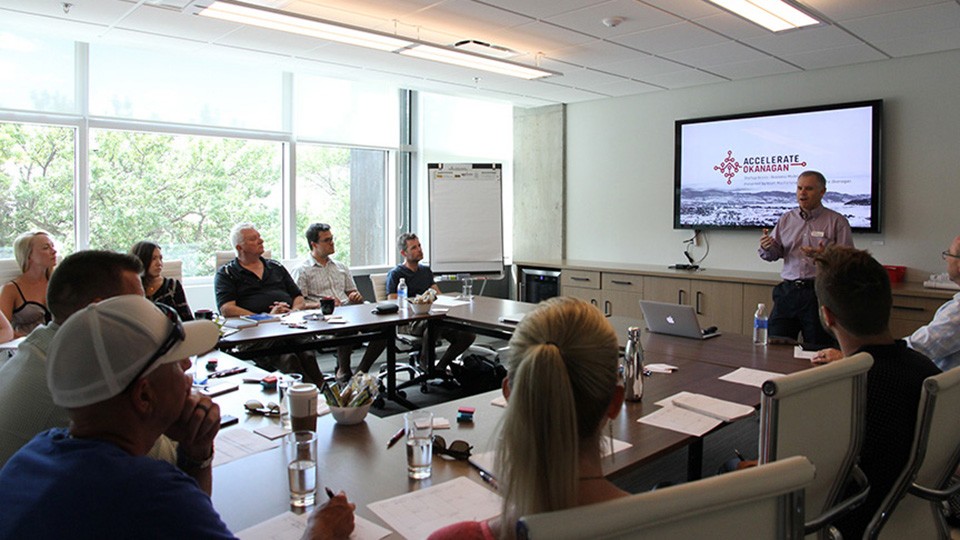
Its model brings together public support, corporate relationships and participant or membership fees. The service is largely human: experienced executives, specialists and peers who help founders make decisions. Workspaces add a physical setting. The Kelowna Innovation Centre opened in 2017; The VIEW followed in Vernon in 2020. A useful introduction becomes easier when people have somewhere to meet.
The next bottleneck has a name
Accelerate Okanagan’s customers are not all at the same point. An aspiring entrepreneur, a founder with early customers and a chief executive preparing to expand need different conversations. The program names are a menu of those conversations. Choosing well starts with identifying the expensive uncertainty in front of you.
Fundable tackles investment preparation. Its Fall 2026 cohort runs for eight weeks, beginning October 6. The published listing puts the fee at C$900 plus tax, or C$700 for AO Tech Members. Participants work toward a pitch deck and funding strategy. Preparation can improve a conversation; it cannot make an investor agree.
Eight weeks of investment preparation. Financing depends on investor decisions.
ThreeSixty addresses companies with validated products and early adopters, typically at C$100,000 in annual recurring revenue or moving toward it. The regional delivery description pairs an Executive-in-Residence with a tailored plan and quarterly milestone reviews. Its initial engagement lasts six months. Northern Innovation Network currently lists its funded round as finished and takes inquiries for a waitlist.
Delta adds project support: up to C$45,000 in non-dilutive co-investment for defined growth initiatives, with project budgets up to C$150,000. Market expansion, operational improvements and leadership hiring are examples. The partner description says no equity is taken and no repayment is required. The founder still needs a project precise enough to fund.
The useful unit of ambition is a project someone can actually execute.An editorial lesson from Delta’s design
A grant is a tool with a handle
Market Diversification reaches beyond technology startups to eligible small and medium businesses in the Southern Interior. Funded by the Economic Trust of the Southern Interior, it matches up to C$10,000 for entry into new markets. Its first year supported 60 companies, with an estimated C$1.6 million in revenue reported in subsequent coverage. That estimate is a program outcome, not Accelerate Okanagan’s turnover.
GreenStep, the sustainability business, participated in 2025. Its CEO, Angela Nagy, described the experience plainly: “The application was easy, the process was smooth”. VO2 Master offers another example. The Vernon company makes a portable metabolic analyser; Accelerate Okanagan says matching support helped it attend international events and meet distributors in the EU, Asia Pacific and Oceania.

The homework worth borrowing
The distinctive offer is the combination. A founder can seek advice, investigate IP support through AccelerateIP, prepare for investors and find community within a connected regional network. Alternatives include New Ventures BC, SFU VentureLabs, specialist accelerators and private advisers. Some of these organisations also collaborate. In this market, an alternative provider may be the next introduction.
What can another region copy? Train investors alongside founders. Give mentors specific milestones to revisit. Turn an expansion wish into a scoped project. None of this removes eligibility rules, funding limits or the need for paying customers. A pre-launch idea will not automatically fit a scale-up initiative; a company without matching resources may struggle to use co-investment. The transferable habit is asking what needs to happen next, then finding the people equipped to help it happen.
Enter the conversation
Explore programs and community events, or watch Alex Reid explain the organisation’s work in a 2017 Shaw TV interview.