Blanka’s first encounter with the judging did not suggest a podium finish. In the 2023 New Ventures BC Competition, the beauty-brand platform missed the automatic route through its early written round. It had to pitch its way into Round 3. By the end, it had taken third place. A competition can measure the polish of an answer on Tuesday and still leave room for a better answer on Friday. That is a useful arrangement for anyone attempting to build a company.
- C$200 to enter: the 2026 competition combines business-plan reviews, education and networking.
- Mentorship is selective: a team of mentors works with ventures reaching the Top 25.
- More than a contest: IP education, sales coaching and investor visibility address different founder problems.
The cheque has homework attached
New Ventures BC is a nonprofit serving technology entrepreneurs. Its annual competition, presented by Innovate BC, is the conspicuous front door. Behind it sits an education and support operation. The product is practical help with the awkward passage from invention to enterprise: identifying customers, finding a route to market, protecting an idea and explaining how the money will work.
The 2026 rules give that passage a shape. Founders begin with an outline, then submit a five-page feasibility case. Those who reach Round 3 expand their work into an eight-page condensed venture plan with mentor support. The final jury gets a pitch and time for questions. Anyone can put “huge market” on a slide. A page limit and an attentive reader make the adjective considerably less comfortable.
- 01Outline
Describe the venture - 025 pages
Test feasibility - 03Top 25
Mentors + 8-page plan - 04Top 10
Pitch + questions
This is business development with an audience and a deadline. Free seminars cover pricing, product-market fit, fundraising, hiring and intellectual property. Recordings let founders return to a topic after the initial optimism has worn off. The materials are useful even when a venture never reaches the final judging room.
People are the portable prize
Browse AI founder Ardy Naghshineh described his original aim plainly: “We weren’t thinking about winning.” During the competition, a judge introduced the company to the person who became its COO. That is a wonderfully specific answer to the question of what networking accomplishes. Blanka, meanwhile, reported leaving with a business plan and pitch deck it continued to use. Both are benefits a company can carry away.
“We weren’t thinking about winning.”
Ardy Naghshineh · Browse AI · 2024 interview
NVBC’s volunteer page counts more than 200 mentors and jurors. Their work includes examining plans, discussing milestones, making introductions and rehearsing presentations. It also sets a revealing boundary: volunteers primarily interested in finding an investment or buying equity are asked not to participate. Confidentiality and conflicts of interest have explicit rules. Advice is easier to weigh when the adviser’s incentives are visible.
Craver, a restaurant-ordering technology business, used both the competition and sales support. Its founder Amin Yazdani credited the contest with helping refine the idea and business model, while reminding founders that “you decide what direction to take your company.” Listening, in other words, need not mean surrendering the steering wheel.
A trophy for a manufacturing problem
The 2026 first-prize winner, Dream Photonics, makes the breadth of the competition concrete. The Vancouver venture works on connecting optical components in advanced computing hardware. Adaptive, 3D-printed micro-lenses help compensate for tiny placement differences, reducing painstaking alignment work. It received the C$110,000 first-prize package at the September 21 ceremony.
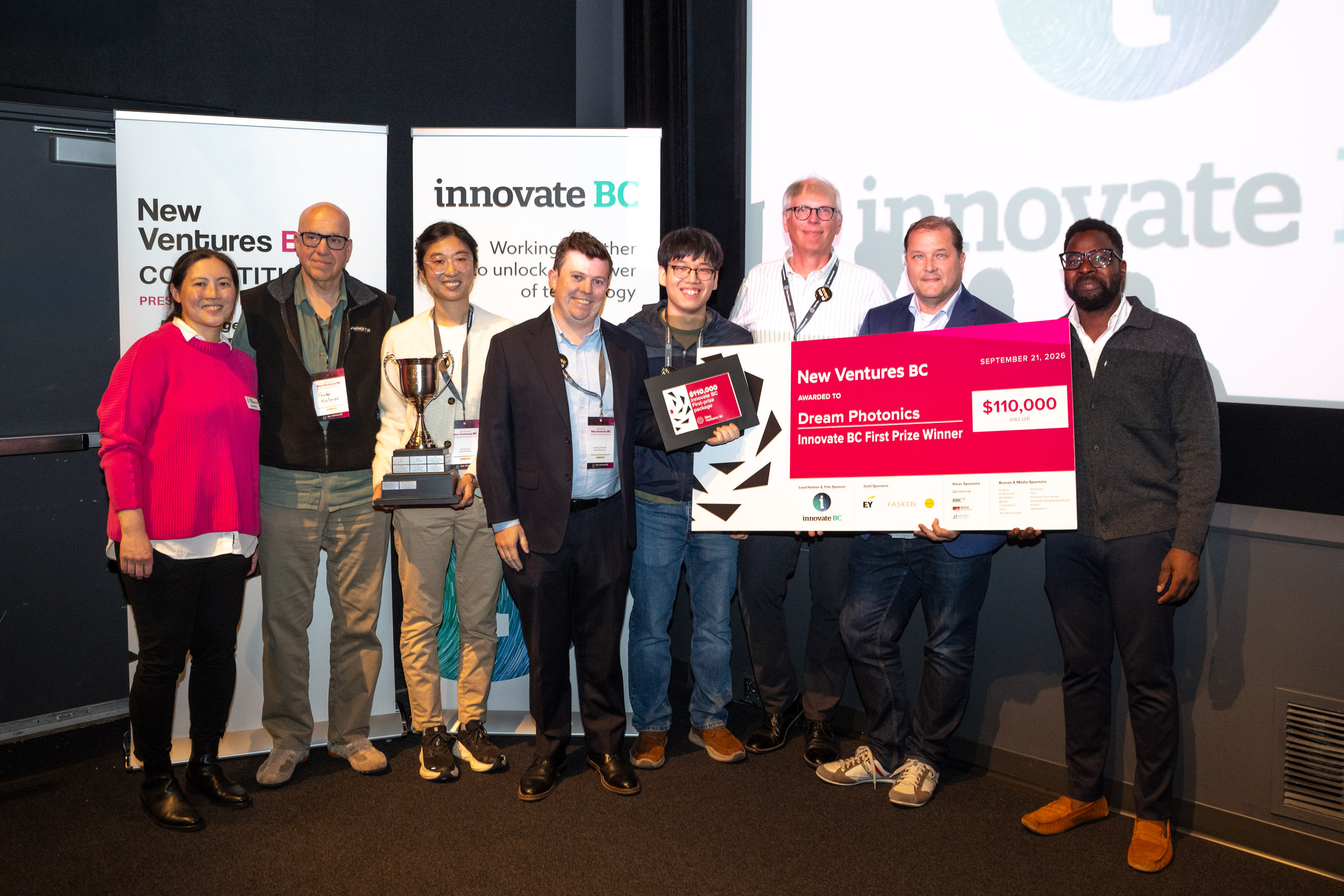
That last word deserves attention. Packages combine cash with services; their headline value is not entirely money available for payroll. Across the competition, sponsors provide accounting, legal and video support alongside cash awards. Founders should price the benefit against what their business actually needs.
Dream Photonics also acknowledged Innovation UBC and HATCH Venture Builder. That places NVBC sensibly in the market: one part of a founder’s support network. SFU VentureLabs and Launch Academy are other routes worth examining. A company can use more than one institution, and different stages call for different help.
The institution has had time to accumulate those connections. Venture capitalist Wal van Lierop initiated NVBC in 2000; its impact-report timeline dates the first competition to 2001. Familiar alumni include Jane Software, AbCellera and Aspect Biosystems. NVBC now reports more than 4,200 participating startups, whose subsequent financing exceeds C$3.4 billion and whose job creation exceeds 15,000. Those totals describe the participants’ later achievements. They cannot tell a new entrant how much success the competition itself caused. The attraction is access to people and a process; the founders still have to find demand, deliver a product and survive their own decisions.
The legal bill before the legal bill
AccelerateIP extends NVBC’s work into British Columbia and the three Northern Territories. It separates IP education, strategy and implementation. The advertised ceilings include up to C$25,000 for eligible strategy costs and up to C$60,000 for implementation. Those are conditional supports. As of October 8, 2026, the dedicated program website lists both funding intakes as closed pending renewal.
Free IP Pathways education remains another starting point. Patent agent Susan Tees teaches fundamentals and business alignment through sessions, case studies and assessment. AirFrameIP offers a free workspace for documenting an evolving strategy. The sequence makes practical sense: understand what needs protection before ordering expensive protection.

The person behind the program mix. Executive Director Angie Schick leads an organization whose offerings extend beyond the annual awards night.
C$200 is only part of the cost
The business model rests on public support, sponsors, volunteer time and modest fees. The federal ElevateIP contribution agreement was amended in April 2026 to C$15.29 million. That is a multi-year program agreement, distinct from the billions raised by competition alumni. Sponsors and donated services help make the participant prices possible.
The less visible cost is founder attention. Written plans, meetings and revisions take time. The sales mentorship program charges C$200 for eight weeks, requires an IRAP adviser referral and targets businesses with paying customers. The AI accelerator’s growth stream charges a subsidized C$250 and requires senior participation. Both have closed application windows for their current cohorts. A good program still needs the right timing.
Copy the questions, then do the work
The transferable method is straightforward: name the buyer, quantify the benefit, explain distribution and show financial assumptions. Seek criticism while changing the plan is still affordable. Use fellow founders as people to exchange introductions with. Blanka’s recovery shows why an early score need not end that work.
There are boundaries. The competition requires a BC connection, an eligible technology venture and generally less than C$1 million in non-grant funding. Conventional consulting businesses do not qualify unless commercializing new IP through a product model. A founder seeking guaranteed financing will find a contest an unreliable budget line. The useful outcome is a more defensible business case, with people who have taken the trouble to examine it.