At the launch of Egypt’s second semi-annual entrepreneurship report in August 2024, the guest list included the planning minister, the financial regulator’s chairman and the head of the investment authority. Entlaq Holding had arranged an occasion in which a startup report could be discussed by people with the power to alter startup conditions. The distinction matters. A founder can rehearse a pitch. Rehearsal does remarkably little to shorten a licensing process.
- The work: research, strategy, government affairs and startup programs.
- The customers: institutions shaping markets and companies trying to enter them.
- The useful idea: investigate the obstacle outside the business before prescribing another workshop inside it.
Entlaq occupies that awkward space between a business and the environment in which it must operate. Its customers include governments, investors, development partners and founders. They arrive with different questions, but frequently need each other’s answers. What does the market permit? Who can finance the next step? Which institution needs persuading? A beautiful business plan can remain beautifully stranded.
The accelerator acquired a wider field of view
Forbes described Entlaq’s January 2023 program launch as an early-stage accelerator offering two annual cohorts, four to six months of support and investment tickets of up to $50,000 per startup. That was an announced ceiling, rather than evidence that every participant received a cheque of that size. The same profile named Rabbit, Rasmal and Ninjacart among its consultancy customers.
The company now lists four co-founders: Mohamed Ehab, Omar Rezk, Aya Ismail and Menna Zaghloul. Their roles span executive leadership, management, programs and public affairs. The combination helps explain the firm’s range. Someone must understand the founder’s commercial problem; someone must understand how an institution hears it.

Ehab’s biography supplies an illuminating detail. He trained in mechatronics engineering and worked in robotics and mobility operations. It is tempting to read the consultancy as another exercise in making components cooperate. That is an interpretation, but a useful one: founders, capital and regulators can each function separately while the business between them goes nowhere.
A report with somewhere to go
Entlaq’s research library makes its interests unusually visible. There are reports on fintech, agricultural technology, clean energy, tourism and women in entrepreneurship. The subjects stretch across industries; the recurring concern is what prevents promising activity from becoming a functioning market.
Its 2024 agricultural technology study draws on farmers, startups and development partners. Its 2025 clean-energy report examines problems including fragmented regulation, financing and adoption. These are different briefs with a common discipline: speak to the people encountering the obstruction before announcing the cure.
For the 2026 entrepreneurship diagnostic, Entlaq described collecting separate perspectives from founders, investors, policymakers and ecosystem builders. Its readiness scorecard uses eight dimensions and a one-to-five scale, with responses anonymized and checked against secondary evidence. The September pocketbook covers 12 priority sectors. A perception survey is useful evidence about experience; it still needs interpretation beside actual deals, rules and operating conditions.
- 01DiagnoseResearch the constraint
- 02ConnectMap decision-makers
- 03OperateBuild a program or route
- 04CheckMeasure what changes
One June 2026 publication tackles the distance between scientific research and commercial results. Entlaq says its commercialization assessment covered 55 benchmark institutions, more than 300 stakeholders and 29 technology-related subsectors. It proposes 15 reforms. Its argument puts institutional incentives and connections under scrutiny, rather than treating another institution as an automatic solution.
Then the map became part of the job
On February 12, 2026, ITIDA announced the revamped Egypt Innovate platform. Entlaq leads its development and operating consortium; Robusta supplies the technological infrastructure, while Kamelizer handles digital marketing and identity. The public agency owns the platform. The division of labour is essential to understanding what Entlaq actually does.
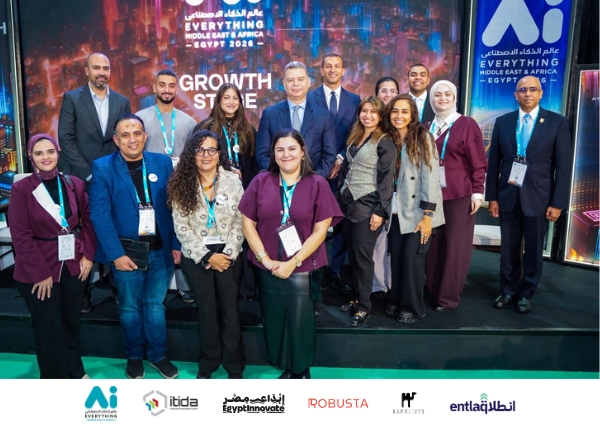
The announcement described a pilot-phase base of 780 entities and more than 81,536 registered users. Those figures measure the platform, not Entlaq’s customer list. Its features include a startup gallery, an ecosystem map, learning resources and matching tools. In principle, a founder can become visible to an investor without first acquiring the correct acquaintance at the correct reception.
entities in the platform’s pilot-phase database
Startups, investors, incubators and research centres. A platform count, not an impact score.A directory’s usefulness depends on the freshness of its entries and the quality of the encounters it produces. ITIDA describes a model in which organizations update their own information. Operating such a system means attending to that mundane maintenance. Connections look elegant in a diagram. Somebody still has to keep the telephone book current.
Who pays, who benefits, who gets a decision?
Entlaq’s business is a mixture of commissioned advice, research and program delivery. An institutional sponsor can buy a program; founders can benefit from it. Its advisory menu includes private market studies, regulatory analysis, stakeholder mapping and evaluation design. The purchase begins with a brief and a scoped proposal, making the question more specific than “How much does consulting cost?”
“Decisions, not decks.”Entlaq’s stated operating principle
The firm also invests. In September 2024 it announced a minority stake in foodtech business Brotinni, for an undisclosed amount. Separately, the Huawei partnership promised free cloud and technology access to portfolio startups. Capital, services and an avoided technology bill are different forms of support, with different conditions attached.
Women in Tech Egypt offers another practical route. Entlaq works with Standard Chartered and Village Capital on the accelerator. Its published criteria focus on operating, technology-enabled businesses with a woman founder; the program offers training, networks and competitive equity-free funding. A grant opportunity should be read as a competition, rather than money that accompanies admission.
The part another company can borrow
Entlaq’s market position combines jobs often purchased separately: understanding a sector, navigating its institutions and preparing ventures to grow within it. A specialist accelerator, a research shop or an internal government-affairs team can each cover part of that brief. Combining them is useful when the commercial and institutional questions cannot sensibly be separated.
The copyable habit is to ask which decision is blocked, who controls it and what evidence would help them act. It requires reachable decision-makers, credible data and a business worth supporting. If customers simply do not want the product, another roundtable will offer excellent seating and very little relief.