Cheryl Sew Hoy was in fourth grade when she encountered a familiar business problem: too much inventory, insufficient transport. Her mother let her sell leftover wares from a catalogue business. Cheryl recruited a second-grader to help carry them. She would handle the talking. It is an unusually compact introduction to a future founder: a product to sell, a customer to persuade, and someone younger already in operations.
The story has survived several changes of company, country and surname. Known professionally as Cheryl Yeoh during her earlier ventures, Sew Hoy has since sold a startup team to Walmart Labs, returned to Malaysia to lead an entrepreneurship agency, and helped create a public directory of venture firms’ conduct policies. She now runs Tiny Health from Austin. The businesses differ; the practical question keeps returning. How do you get the people, knowledge and resources into the same place?
There is a temptation to tell a career like this as a sequence of polished introductions. Cornell. Silicon Valley. Government chief executive. Founder again. The childhood episode offers something more revealing. Long before any of those introductions, she understood that doing all the work herself would limit what she could sell. The second-grader may have had the less glamorous assignment, but he had a job description.
A company at the kitchen-table scale
Her first model of entrepreneurship was close enough to watch every day. Her mother ran a marketing business from home in Malaysia. As a teenager, Cheryl sold catalogue inventory to local corporations and organised flea markets during school holidays. These were small enterprises with immediate feedback. People either bought something or they did not. An elaborate slide deck would have been an inconvenient substitute for a sale.
“My mom always encouraged me to be entrepreneurial,” she has said. She credits those early experiences with teaching her sales and negotiation. That training travels well. Hiring asks someone to believe in a company’s future. Fundraising asks someone to pay for it before it exists. Selling asks a customer to care about the part that has finally been built. The audience changes, and persuasion remains part of the work.
A full Malaysian government scholarship took her to Cornell University. She earned a bachelor’s degree in operations research and industrial engineering, followed by a master’s in engineering management. The combination suits a career spent arranging complicated things: products, teams, programmes and partnerships. Engineering also gave her a way into technology before she had decided what kind of business she wanted to run.
After university, she worked in management consulting. New York’s emerging startup community eventually offered a different possibility. She left consulting and started CityPockets in 2010. The distance from selling surplus catalogue stock to running a software company was considerable. The impulse to organise a messy commercial problem was already familiar.
- CornellEngineering training
- 2010CityPockets
- 2013Walmart Labs acquisition
- 2014Founding CEO, MaGIC
- 2018#MovingForward
- 2020Founds Tiny Health
The coupon drawer goes digital
CityPockets belonged to the daily-deal era, when a bargain could arrive faster than a person could remember buying it. The company helped users keep track of vouchers from different services and offered a marketplace for unused deals. It addressed a mildly absurd consequence of online convenience: buying something had become so easy that remembering what you owned required another product.
The business attracted attention while its founders were running short of money. Sew Hoy slept on a colleague’s couch in New York, with a small curtain providing privacy, and kept her weekly food budget to $35. There is little romance in a ceiling-mounted curtain. It does, however, put a useful limit on the glamour usually attached to the word founder.
The daily-deal market changed. CityPockets gave way to Reclip.It, a personalised shopping-list product that matched shoppers with coupons and weekly offers. The team moved to Silicon Valley and received backing from investors including 500 Startups. The change matters because it makes the eventual acquisition less tidy than a success story can sound. The first product had to be reconsidered before there was a company someone wanted to acquire.
In 2013, Walmart Labs acquired the Reclip.It team. Sew Hoy’s announcement thanked the people who had stayed through the difficult stretches and described her next assignment: product work on Walmart’s personalisation team. Her small company’s interest in helping shoppers find relevant deals could now be applied inside a much larger retailer. An exit also became an entrance into a different scale of work.
A return ticket with a public mandate
A year later, Malaysia asked her to return. Sew Hoy became the founding chief executive of the Malaysian Global Innovation and Creativity Centre, or MaGIC. The agency was launched in April 2014 by Barack Obama and Malaysian prime minister Najib Razak. For someone whose education had been funded by Malaysia, the invitation carried a personal reason to say yes.
She had sold a company. Now she was being asked to help other people build theirs. That changed the unit of attention from one team and its customers to a network of founders, educators, investors and institutions. The desired result was regional as well as national: Malaysia as a place from which Southeast Asian startups could expand.
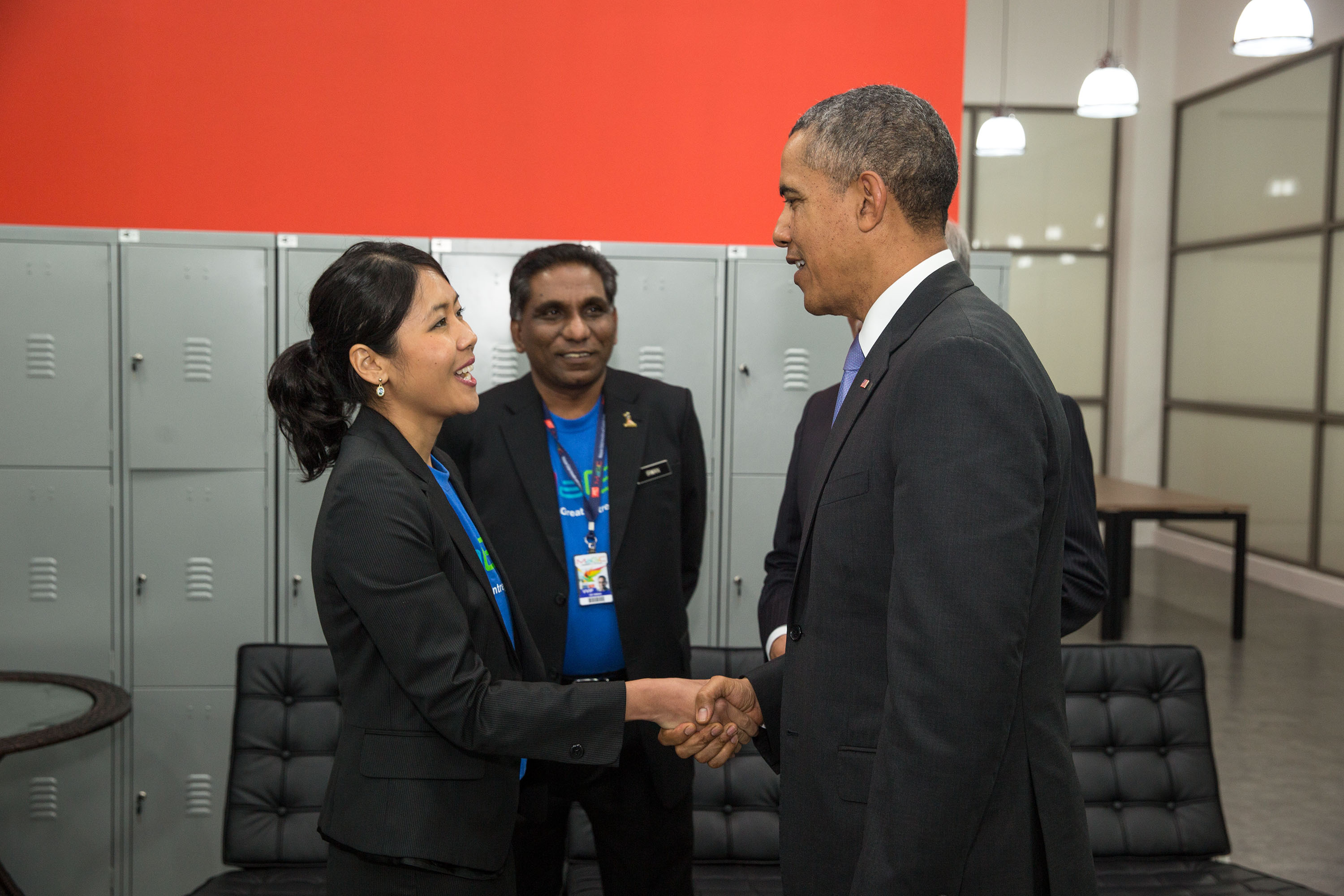
Her stated ambition was direct: “I will put Malaysia on the global map.” At MaGIC, that meant building programmes rather than relying on the sentence. The organisation developed MaGIC Academy, its accelerator programme and partnerships that exposed founders to other markets. A three-year relationship with Stanford University was part of the effort to connect local entrepreneurs with experience beyond Malaysia.
In her January 2016 reflection, she described education, exposure and acceleration as the agency’s initial priorities. She also pointed to a November 2015 investor demo day that brought more than 150 investors to hear 50 startups pitch. Those are useful numbers because they describe a meeting between people who needed each other. An entrepreneurial community becomes more concrete when someone actually turns up to hear the pitch.
The work between the programmes
MaGIC also required a leader to move between two working cultures. Government brings formal authority, procedures and public obligations. Startups bring short deadlines and a willingness to change direction. Sew Hoy had to operate within both. A founder accustomed to adjusting a product quickly now had stakeholders whose responsibilities extended beyond a single business.
Her account of building the community gives New York an unexpected role. She drew on its knowledge-sharing sessions, founder gatherings, coworking spaces and office hours. Silicon Valley supplied part of her experience, but she did not treat it as a place Malaysia could simply reproduce. That is a useful distinction for anyone tempted to order an entrepreneurial culture as though it were office furniture.
She also emphasised listening to entrepreneurs and recruiting people who understood the work. A programme could sound convincing at its launch and still fail to earn trust. Her response was to deliver visible progress early. In this view, community building involves an accumulation of practical encounters: a question answered, a useful introduction, a team that does what it said it would do.
Her tenure ended in January 2016. Back in the Bay Area, she took on further operating and advisory work, including marketing leadership at Hack Reactor, a directorship at Flexiroam and an entrepreneur-in-residence role at Silicon Valley Bank. Her own professional profiles also describe advising and investing in startups. She had begun to work on several sides of the founder’s table.
A directory with consequences
In 2018, Sew Hoy helped launch #MovingForward, an initiative asking venture firms to make their anti-harassment and anti-discrimination commitments public. Its format was deliberately practical: a directory of policies and reporting contacts. It addressed a problem in the relationship between investors and founders, where the people seeking funding often fall outside ordinary employee protections.
The initiative followed her decision to speak publicly about misconduct she had experienced. Working with collaborators including Andrea Coravos, Ginny Fahs and Tracy Chou, she helped turn a conversation about accountability into information founders could consult. A published policy gave someone a place to begin and a commitment to point to.
Uncork Capital publicly credited Sew Hoy and Coravos for encouraging firms to disclose their positions and reporting mechanisms. The project subsequently expanded into Europe. Its appeal lay partly in how ordinary its demands were. State the rules. Publish the contact. Make the commitment available to the people expected to trust you. In venture capital, even that required organising.
“I prefer ‘repeat entrepreneur.’”
Cheryl Sew Hoy, August 2026
The repeat entrepreneur returns to the garage
Sew Hoy founded Tiny Health in 2020. By September 2026, she was announcing a $33 million Series B led by B Capital, bringing the company’s total funding to $46 million. In the same announcement, she recalled an earlier arrangement: her mother hand-packed the first kits in her garage. The family connection runs through the career with remarkable persistence. The parent who supplied her first inventory eventually helped ship her later company’s orders.
She has become particular about how this career is described. In an August 2026 interview, she preferred “repeat entrepreneur” to “serial entrepreneur,” explaining that the latter made starting companies sound like an end in itself. The wording fits a record in which different assignments have demanded different kinds of work. A shopping tool, a public agency and a venture-policy directory do not reward precisely the same skills.
The latest funding makes a convenient milestone, though it cannot explain the whole person. A financing announcement measures capital committed at a particular moment. Her longer story includes learning to sell, changing a product, leaving a corporate role, returning home and asking an industry to publish its rules. Each chapter has involved persuading other people to participate.
Look back to the catalogue business and the connection becomes easier to see. Her mother offered a chance to try. Cheryl found help with the carrying. Years later, the garage required another pair of hands, and her mother supplied them. Amid the institutional names and investment rounds, there is still a family doing the work needed to get something out the door.