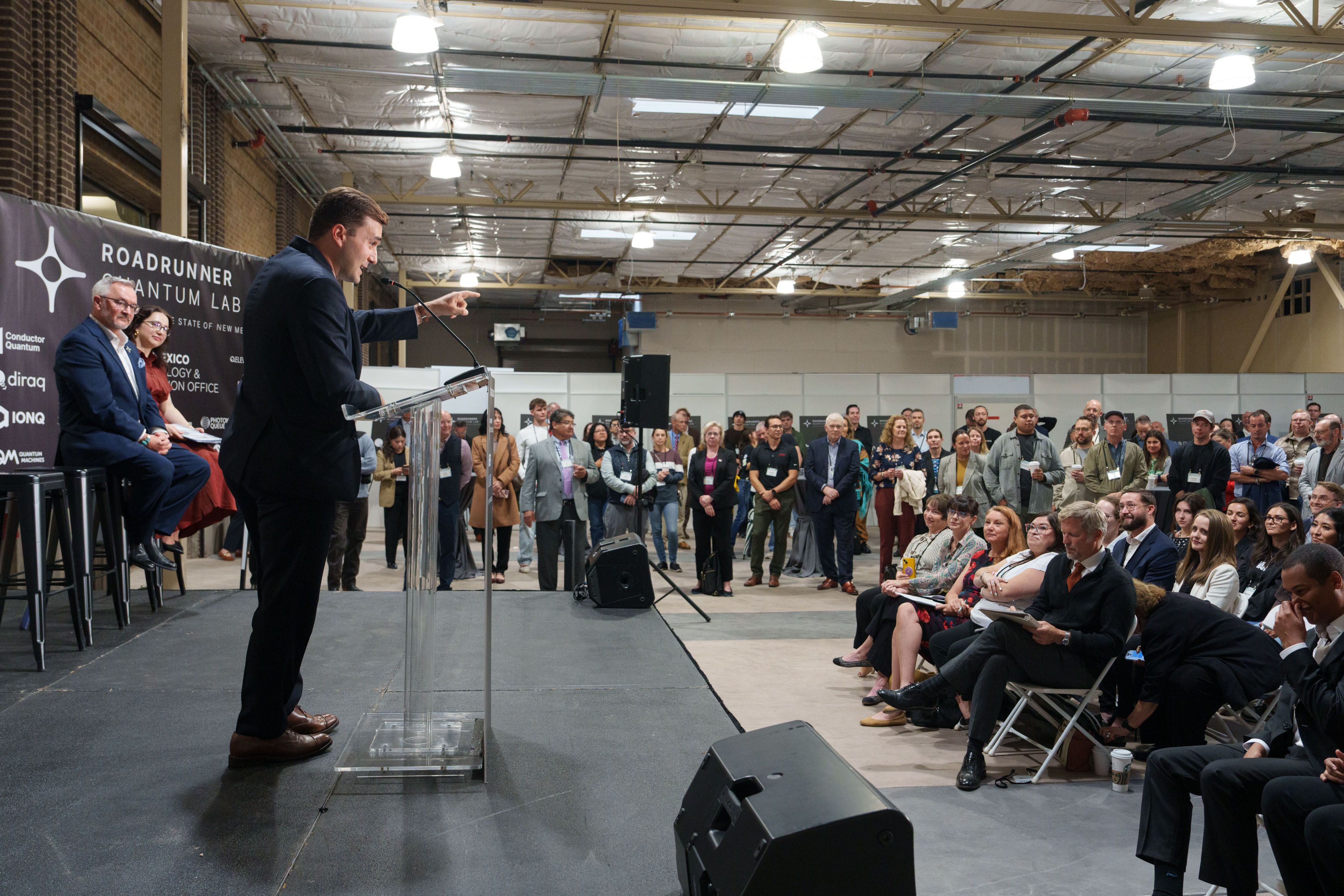
A quantum laboratory needs very cold refrigerators. Adam Hammer also wants it to have neighbors. On September 29, 2026, Roadrunner Venture Studios and New Mexico’s Technology and Innovation Office opened a shared facility in Albuquerque where researchers, startup teams and equipment providers could work within reach of one another. The ambition was large. The practical proposition was wonderfully ordinary: give people somewhere to do the work.
Hammer, Roadrunner’s co-founder and CEO, has spent his career moving among institutions that approach the future from different directions. An investment bank asks what a business is worth. A research laboratory asks what is possible. A young company asks whether it can survive long enough to make the answer useful. His current job involves getting those questions into the same conversation.
The Roadrunner Quantum Lab offers a physical answer. Its 35,000 square feet in the city’s Innovation District give an idea that might otherwise travel between distant facilities an address. For Hammer, the building is another step in a project that began with a conviction about overlooked research and grew into the less glamorous, more demanding business of helping scientists become founders.
A childhood with frequent introductions
Hammer was born in Houston. His father came from a small Illinois town; his mother immigrated from Damascus. He and his sister grew up across countries including Libya, Syria, Indonesia and Singapore. He has described those moves as an education in making a community again, meeting unfamiliar ideas and working with people whose experiences differed from his own.
He spent fifteen years abroad, with Saudi Arabia, the United Arab Emirates and China also among the places he lived. It is a useful background for a career that now requires passage between finance, science and government. Each has its own language, customs and occasionally baffling paperwork. Familiarity with one does not automatically confer fluency in the others.
Seen across his career, those experiences suggest a recurring interest in bringing people from different settings together. Albuquerque gives that interest a physical setting: a studio, a laboratory and the people working inside them.
Before the studio, a salon
At Yale, Hammer and fellow graduate student Nat McLaughlin began the Jackson Salon in fall 2018. They wanted conversations about current events that could extend beyond the boundaries of the curriculum. The early group met in the student lounge at Horchow Hall; within six weeks, it had initial funding and a regular place to gather.
As the salon developed, its organizers distributed responsibility. Team members selected reading, recruited informed participants and moderated individual meetings. Hammer and McLaughlin described the quality of the discussions improving when that ownership spread. The mechanism was modest: find a room, give people a reason to enter it, and let them help shape what happens there.
A student discussion group and a quantum laboratory operate on rather different budgets. Still, the resemblance is hard to miss. Both projects make deliberate space for people who might otherwise remain in separate conversations. At Yale, the product was a better discussion. In New Mexico, Hammer wants those encounters to produce companies.
Three jobs, three sets of questions
Hammer graduated from Wake Forest University and Yale’s global affairs program. His early career at Goldman Sachs involved advising energy and industrial businesses on acquisitions and transactions linked to assets. It was a training in evaluating companies and understanding how capital moves. Those skills would matter later, when the assets under discussion were younger, stranger and harder to price.
At Schmidt Futures, the initiative founded by former Google CEO Eric Schmidt, Hammer became managing director and head of strategy. He worked on portfolio evaluation and development and directed the International Strategy Forum, which supports emerging national security leaders and ideas. Technology and geopolitics were already sharing space in his working life.
Then came Qrypt, where he served as chief operating officer. The company worked on post-quantum encryption and quantum hardware; Hammer led product and commercial strategy. That experience put him inside the process of turning technical work into something an organization could sell. A spreadsheet can value a business. It cannot, by itself, produce the business being valued.
His work still crosses into national security. He serves as an intelligence officer in the US Navy Reserves and as an industry commissioner on the Atlantic Council’s Defense Innovation Adoption Commission. The institutional variety helps explain why his account of company formation includes public agencies and research organizations alongside investors and customers.
The difficult distance from a lab bench
Roadrunner publicly launched in Albuquerque on December 5, 2023, with backing from America’s Frontier Fund and the New Mexico State Investment Council. Its early promise was unusually specific: founders would leave with a company, investment, a customer and a team. The studio would enter early, when a venture might still be a sketch or a scientific insight.
The offer included product development, recruitment and commercialization. Early company support extended to customer discovery, engineering, legal work, fundraising and laboratory space. Payroll might appear a comically small concern beside frontier science, until somebody has to run it. The studio model gives those everyday obligations a home alongside the technical ones.
Hammer’s collaborators included America’s Frontier Fund leaders Gilman Louie, Jordan Blashek and Steve Weinstein. His account of Roadrunner’s beginnings credits that group with the original studio concept. It is a revealing choice of emphasis for someone whose name now sits at the top of the organization: he presents company creation as work with several authors.
In a fundraising conversation, Hammer described technically sophisticated founders as poorly understood by conventional venture capital. The danger is that an investor recognizes familiar business patterns more readily than unfamiliar science. His response is to build beside the founder and help make the commercial case intelligible, rather than expect a research background to arrive packaged as a ready-made business.
“Capital should be the least valuable thing we provide.”
Adam Hammer
That is a demanding standard for an investor to set. Hammer’s pitch asks founders to examine an investor’s technical understanding and patience, while also making customer urgency clear. The science has to matter to somebody. A promising invention earns its way toward a market through the particular problem it solves, and through the people prepared to use it.
Bring the investors to the science
In 2025, Hammer introduced the Roadrunner Venture Consortium. Its members included Airbus Ventures, At One, Crosslink Capital, Khosla Ventures, Lux Capital and Playground Global, working with Roadrunner and partners UP and Antler. The arrangement was designed to involve investors in technology reviews and direct engagement with scientists.
By the time of that announcement, Roadrunner said it had reviewed more than 2,000 emerging technologies over two years. That figure is a record of examination, not a tally of successful businesses. Its significance lies in the amount of translation involved: determining which scientific possibilities can support a product, a team and a convincing route to customers.
For researchers in New Mexico, the consortium offered a way to connect with national investors while remaining near the institutions where their discoveries began. Hammer’s argument gives geography a practical role. Relationships with local laboratories are valuable assets; moving away can impose costs that a map of familiar venture hubs fails to show.
Roadrunner’s reported total over the two years preceding its consortium announcement. Research reviewed, not companies launched.
A refrigerator is part of the business plan
In August 2025, New Mexico selected Roadrunner and its coalition partners to lead a quantum initiative backed by $25 million in state support. The plan combined a Founder-in-Residence program, recruitment of quantum companies and a dedicated investment network. Infrastructure was one component of a broader effort to make company formation possible.
The equipment commitments made that strategy tangible. In July 2026, Maybell Quantum announced New Mexico operations and four dilution refrigerators for the Roadrunner Quantum Lab. Its announcement also described QuEra’s $4 million computing testbed commitment and Qunnect’s quantum network. Different kinds of quantum work require different tools; gathering them gives founders more routes to testing their ideas.
At the September opening, the lab’s participants included Diraq, IonQ, Quantum Machines, Photon Queue and others. Sandia and Los Alamos were research partners in a Quantum Demonstration Facility intended to help early companies prototype and evaluate devices. Technical expertise, equipment and company teams would occupy the same working ecosystem.
Hammer has pointed to Taiwan’s semiconductor development as part of the inspiration. In his account, shared facilities and patient government capital helped companies build close together. The analogy is an aspiration for how a place can support an industry. Albuquerque’s future results will depend on what its teams do with the facilities now available.
The room after the ribbon
The following day, September 30, Roadrunner convened its fourth annual Technology Forum, with more than 400 registered leaders from science, industry, government and venture capital. The program included Pat Gelsinger, now at Playground Global, and discussions about investing, quantum partnerships and New Mexico’s State Investment Council.
There was an earlier version of this gathering in September 2024 at the Historic Wool Warehouse. Its announced speakers included Hammer, Gilman Louie, Trae Stephens and Navy technology leader Justin Fanelli. More than 400 people registered that year, too. The continuing point of the gathering is the mix of people, rather than a competition over the headcount.
Hammer’s September 2026 description of the forum looked back to the first gathering and forward from the new lab. The sequence captures the work’s changing scale: introductions lead to relationships, relationships support projects, and eventually a building has to accommodate the projects. A ribbon can be cut in an afternoon. Creating useful neighbors takes longer.
For Hammer, the next chapter will be written by the founders using that space: the tests they run, the people they hire and the customers they find. He has helped assemble a setting in which those things can happen near the science that prompted them. The refrigerators are installed. Now comes the work that gives the room its purpose.
Continue the conversation
- Roadrunner Venture Studios
- Adam Hammer on LinkedIn
- Adam Hammer at the Atlantic Council
- The Jackson Salon at Yale
- Watch: Fun Raising with Adam Hammer
- Listen: Arsenal of Democracy
- Read: Hammer on the Roadrunner Venture Consortium
- News: The Roadrunner Quantum Lab opening
- Interview: Hammer on building startups