A rubbish bin is a surprisingly good place to begin a story about technology. It has an ordinary job. It fills up. Somebody empties it. Attach sensors, a radio link and a cloud connection, however, and it becomes a different kind of object: one that can report its condition. At Kumasi Hive, a smart-bin project used Waziup technology to send information about waste levels, location and battery charging through a gateway. The interesting question arrives after the electronics work. Who will use it, maintain it and pay for it?
- Shared tools meet technical mentoring and business support.
- Hardware founders, students and small businesses share the mix.
- Training connects to prototypes, incubation and internships.
Kumasi Hive occupies that space between a clever object and a useful enterprise. Its hardware incubator helps selected founders develop prototypes and prepare products for market. A separate accelerator supports other early-stage ventures. There are rooms to work, meet and train, alongside programs in digital skills and biotechnology. The company’s offering makes sense if you picture a founder carrying several problems through the same door.
The machine is only the beginning
Consider the early projects. In May 2016, reporting on the newly opened Hive described Dext’s lab-in-a-box science set, KLAKS 3D’s printers made from electronic waste, and Faith Tech Ghana’s locally manufactured drip-irrigation system. Each addressed something tangible: equipment for teaching, machinery for making, water for growing. This was entrepreneurship with components, tolerances and things that could break.
That gives the Hive a particular place in the market. A founder who needs help making a physical device has requirements beyond a desk and Wi-Fi. Technical advice and access to equipment matter before a polished pitch becomes useful. Kumasi’s hapaSpace also offers startup support, skills development and co-working. The Hive’s hardware incubation and fabrication work make it especially relevant to people whose ideas must survive contact with a workbench.
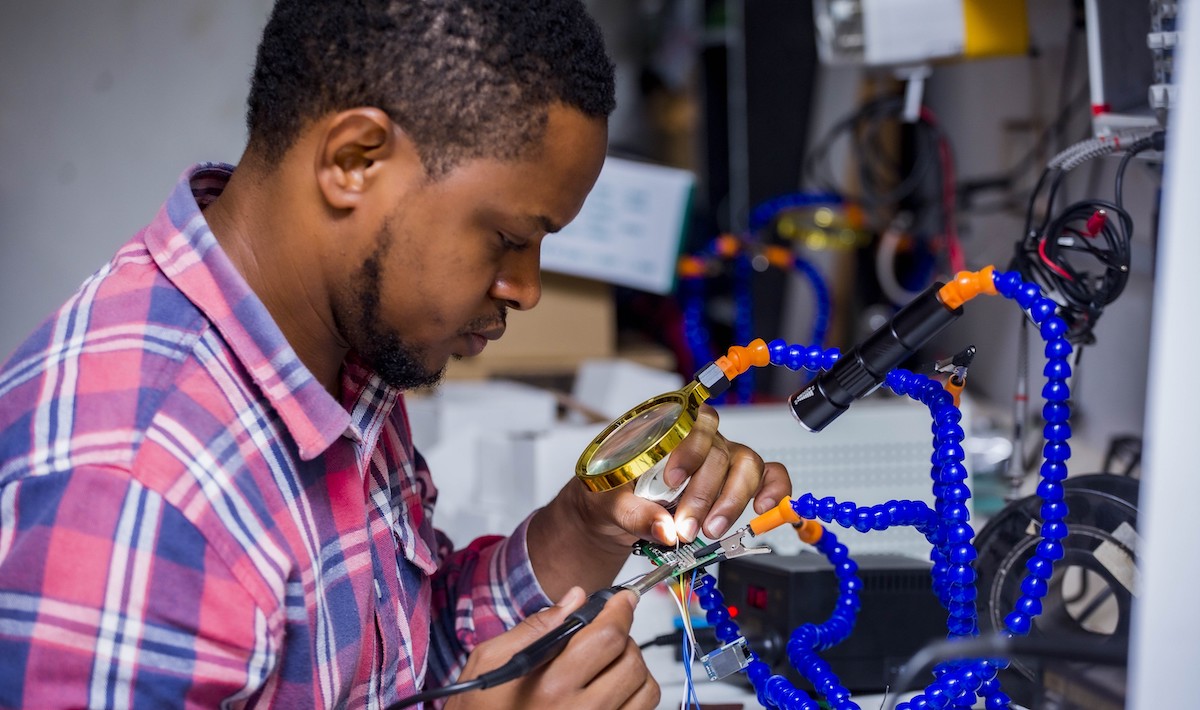
The expertise is practical: prototyping, electronics, 3D fabrication, software and the business work around them. Customers and users include makers, early-stage companies, students and small businesses; development organizations also partner on programs. Those groups arrive with different needs. One wants a prototype. Another wants job skills. A sponsor wants a program delivered. Keeping their needs connected is part of the operating challenge.
First, leave the workshop
At a Wazihub bootcamp held at the Hive in July 2018, more than 40 participants worked through an unusually useful sequence. They met stakeholders, identified problems and proposed solutions before moving through sensor-node prototyping, cloud visualization and application development. The field trip belonged inside the engineering process.
- 01Meet people
- 02Define the problem
- 03Build a prototype
- 04Connect the data
Someone building a similar program can copy that order. Put a prospective user into the process while the design is still cheap to change. Then teach the tools against a problem participants have actually heard described. A sensor reading is easier to interpret when somebody can explain what decision it should change.
Give the course somewhere to go
Bridge the Gap applied a related idea to women entering technology. Participants could move into incubation, with business coaching and mentoring, or internships with industrial partners. The course had a destination beyond its final session. In 2019, the initiative won the Leadership in SMEs category at the EQUALS in Tech Awards.
Its February 2019 summit offers a more concrete picture than an awards photograph. Sixty young women had received support over four months. Teams presented a machine intended to process plastic waste into 3D-printer filament, printed collectibles based on Ghanaian cultural symbols, and science teaching kits. ENAQ Innovations received GHS 2,000 in seed funding. Those were proposed businesses with objects to inspect, rather than a roomful of certificates.
The same preference for practical access appears in Hive Biolab. Biotechnology adds another kind of equipment and another set of skills to the hub’s reach. A molecular-biology masterclass advertised for April and May 2024 cost GHS 1,200. For 2026, the Hive advertised a Girls in Biotech wet-lab fellowship covering microbiology, molecular biology, mentorship and professional development. Practical science has become part of the company’s program mix.
The workshop has bills, too
The founding story contains a useful warning about overhead. The company dates its founding to 2015; contemporary reporting places the physical opening in January 2016. Co-founder Prince Boadu later recalled that the founders spent their savings renting space and lived at the Hive for a period. Crowdfunding brought in more than £13,000. That figure describes an early lifeline.
“We started Kumasi Hive with our own funding.”Prince Boadu · 2021 interview
The pandemic exposed a different financial weakness. Projects were suspended while budget commitments remained. Boadu described the scramble to manage cash and staff volunteering salary cuts. The immediate pressure was the timing of money. A funded project can look reassuring until the work stops and the organization still has people to pay.
Business-model discussions continued. At a July 2022 AfriConEU workshop, later documented by the project, a Hive representative spoke about improving financial viability. Another described an interest in the builder model, which aims to generate revenue through creating businesses. That was a stated direction, rather than proof that the transition had happened.
Today’s visible model combines paid training, space rental, services and partner-backed programs. The Internet of Production Foundation also lists Kumasi Hive among nine makerspaces awarded $19,000 each to participate in its Innovative Manufacturing in Africa project. Such support pays for particular work; it should be read separately from customer revenue.
What a second city can copy
The transferable idea is to connect capabilities people otherwise have to assemble separately. A workshop needs mentors. Training needs somewhere to lead. A prototype needs a prospective customer. Putting those relationships close together can reduce the distance between learning something and using it.
There are conditions. Equipment needs upkeep, practical work needs competent supervision, and access alone cannot create demand for a product. Sponsor-backed courses also require money to arrive when costs do. Kumasi Hive’s history makes those constraints visible. Its useful proposition is the patient work of helping an unfinished idea meet the people, tools and business decisions required for its next step.