Before a startup has an investor, it has smaller problems. Where will the team work? Who can check the financial projections? How does a promising programmer learn to sell? Innovation Centre Kosovo has built much of its purpose around these unglamorous questions. In Prishtina, its offer puts business advice, skills training and other founders within reach of people trying to turn an idea into work.
That combination makes ICK an interesting institution to examine closely. Its website reports supporting 500 startups and small and medium-sized businesses, alongside 11,000 training participants. Those are cumulative activity figures, not a count of surviving companies. Still, they describe a substantial meeting point between Kosovo’s ambitions for a digital economy and the everyday work of acquiring useful skills.
Today, the organization is also pursuing social-enterprise development and green-skills projects. The question running through its story is practical: how much can a nonprofit do to help businesses stand on their own, and how does it pay to keep doing it?
A startup address, assembled by institutions
ICK began in June 2012 as an initiative of Norway’s Athene Prosjektledelse and the Kosovo Association of Information and Communication Technology, STIKK. Crimson Capital was the main cooperating partner, while the Norwegian Ministry of Foreign Affairs financed the establishment. Its origins belong to a partnership, rather than the familiar tale of one founder with a laptop.
The centre’s stated mission connects job creation with ICT and green energy. Its practical remit includes both new businesses and existing companies with growth potential. In a 2022 interview with OBCT, then executive director Uranik Begu explained the employment logic: participants might enter an employer’s workforce, become freelancers or establish companies. Entrepreneurship was one route through the building.
There were identifiable businesses in that early community. STIKK’s account of KosICT 2013 records ZAG Apps and Solaborate presenting as companies from ICK, discussing their development and work with clients in Kosovo, Europe and the United States. International customers were already part of the conversation. The ambition was to connect a local starting point with a much wider market.
The offer begins before the pitch
The published incubation criteria are concrete. Applicants should have an ICT business idea, or an innovative product or service in a business operating for less than two years. They need a team with business and technical capabilities and a commitment to developing the startup full-time. Selection considers the idea, team, market potential and prospects for growth.
The Founder’s Pack combines a five-day bootcamp with consulting, workspace, mentoring and international exposure. Financial projections sit beside marketing, sales and human resources. That matters because a product demo can conceal a surprising number of unanswered business questions. ICK advertises access to more than 50 mentors and a 30 percent training discount for incubated startups.
- 01Apply with an idea
- 02Committee review
- 03Refine the business
- 04Pitch for admission
The network has also brought established operators into the room. In March 2023, ICK hosted a Startup Grind discussion with KODE Labs co-founder Edi Demaj. The published session covered company origins, international growth, team culture and product development. For an early founder, that is a useful kind of proximity: someone who has faced a larger version of a problem can explain the decisions behind it.
Bring your own laptop
ICK’s education business has a similarly direct pitch. Its Skills & Development program serves incubator tenants, businesspeople, ICT professionals, public administration and civil society. The trainer roster spans cybersecurity, Python, DevOps, design and other disciplines. ICK says its instructors are commercially active in their fields. The catalogue is broad enough that its 2026 listings included chess alongside web development and motion design.
Consider one specific offer: the front-end course scheduled from May 9 to June 21, 2026. It advertised 54 hours for €350, with weekend sessions and a requirement to bring a laptop. The curriculum included HTML5, CSS3, JavaScript, responsive design, Git and building a basic web application. That is a purchase a prospective student can evaluate against time, budget and the work they want to do.
“we focus on quick fix industry led solutions”
Uranik Begu, speaking to OBCT in 2022
Scholarships offer a different entry point. DevelopHer’s six-month cybersecurity offer, with an application deadline in January 2025, used an exam to select scholarship recipients. Its curriculum moved from operating systems and networking to offensive and defensive security, practical exercises and a final capstone. Completion required attendance at at least 80 percent of classes and an exam score above 80 percent. The standards give the promise of access some substance: participants still have to do the work.
Three different meanings of money
Money appears throughout ICK’s story, but the numbers describe different transactions. A student paying tuition, a company receiving a grant and a donor financing the centre are not interchangeable. ICK’s reported €7.5 million in financial and technical support is a cumulative support measure. It is not a venture funding round, revenue figure or valuation.
The historical Innovation Fund offers a more specific example. The OECD’s 2021 Kosovo assessment describes donor-backed co-financing of up to €50,000, with more than €500,000 awarded to 13 SMEs across calls in 2018 and 2019. That arrangement helped existing businesses undertake innovation. It also shows why describing ICK simply as a place for first-time founders misses part of its work.
Fee paid by a participant
SME co-financing
Financial + technical support
International partners have supplied another layer of expertise. The 2021 Tech Boost offer combined a 10-week pre-acceleration program powered by Startup Wise Guys with an acceleration route involving Spring Activator. Supported through the EFSE Entrepreneurship Academy and the EU, it advertised the chance to win €15,000 and pitch to investors. These were opportunities attached to a particular program, rather than an automatic entitlement for every incubated company.
A documented 2023 EBRD Star Venture call focused on product discovery, market fit, competition and investment readiness. It sought young companies with technology capable of supporting growth. Across these offers, ICK’s role is often to organize access: find the entrepreneur, connect the adviser and make the next business decision less lonely.
The community has a floor plan
ICK also sells something easier to picture than investment readiness: somewhere to sit. Its workspace page lists offices for four, six or ten people, coworking with round-the-clock access, meeting facilities and shared equipment. For a small team, office administration can be a distraction. Putting those services together leaves fewer arrangements to make separately.
The social logic predates the current catalogue. A 2016 report on ICK’s coworking launch described 36 workstations situated among incubated companies. Freelancers, students and international visitors could work near designers and programmers building businesses. The arrangement deliberately mixed people who might otherwise occupy separate circles.
There are alternatives now. VentureUP has a university-based incubation role in Prishtina; STIKK has promoted startup space at TechPark Prishtina; ITP Prizren combines technology, education and community activities. Its May 2026 Digital Skills Festival advertised hackathons and workshops. ICK’s distinction is the combination of services and relationships it has assembled. A prospective user should compare the actual program, its location and its eligibility rules with the problem at hand.
Solar skills, justice problems and a fuller room
The LuxDev-funded TechEco Pathways project illustrates ICK’s wider direction. Its 24-month design includes hands-on training for 75 young graduates and paid internships for 35 selected participants. These are program targets. The offer links ICT with renewable energy, including AI fundamentals, solar-energy systems and battery storage. It also incorporates women’s technology training and innovation challenges.
JusTech took the same organizing skills into another field. Working with USAID Justice Activity, ICK advertised a justice innovation competition, a five-day development camp and grants of up to US$50,000. The call invited legal professionals, developers, students and others to address access to justice. Its criteria included value for money, feasibility and sustainability. A useful prototype would need to survive contact with real institutions and their users.
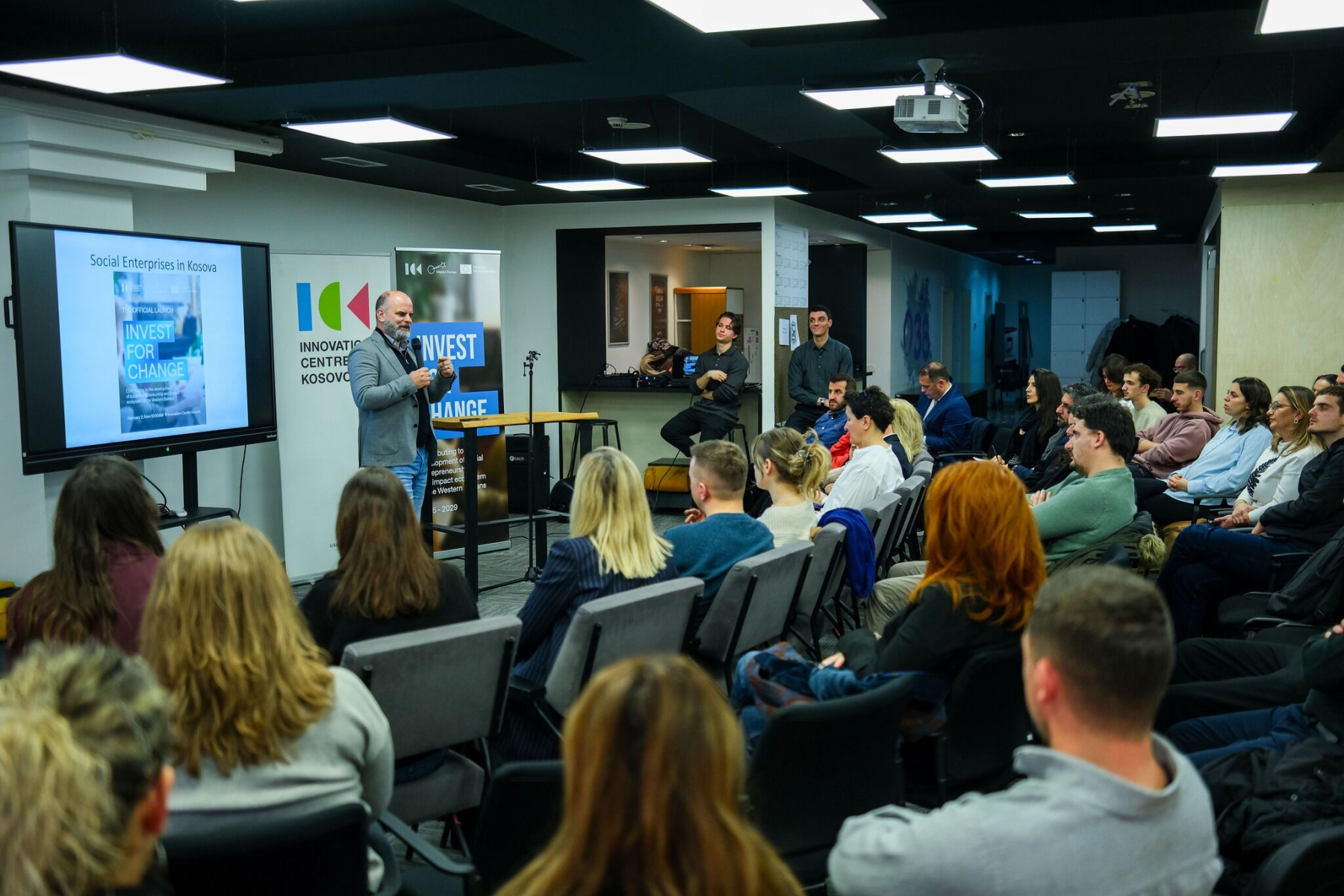
In February 2026, ICK hosted the Prishtina launch of Invest for Change, an EU-funded regional initiative led by Impact Europe. Its announced support includes grants, mentoring, training and cross-border connections for social entrepreneurs. In March, ICK sought an expert to develop a Social Entrepreneurship Academy manual, including the curriculum and selection framework. That procurement notice is a modest but concrete sign of work moving from an announcement toward a program.
The rent still comes due
An independent evaluation published by Sida in February 2026 supplies the harder part of the story. It examined SEK 21.6 million in core support during 2019-2024, crediting continuity of services while identifying declining incubation quality, weak follow-up, costly premises and governance constraints. Core support covered up to 80 percent of operating costs. The report recommended a broader approach to supporting Kosovo’s innovation system and reforms at ICK.
Those findings make the copyable lesson more demanding than “open a hub.” Our reading: combine practical teaching with business advice, connect participants to experienced people, and plan how to track what happens afterwards. A course attendance total cannot answer whether someone kept a job. An introduction cannot guarantee an investment. A room full of founders needs a financial plan of its own.
For people considering ICK, the useful first move is specific: examine a course, ask about an incubation call or explore a workspace. For organizations hoping to borrow the model, the conditions matter just as much. Mentors must have time, training must meet employer needs, and recurring services need dependable income. ICK’s contribution is visible in the opportunities it has assembled. The test ahead is whether those opportunities keep turning into work.