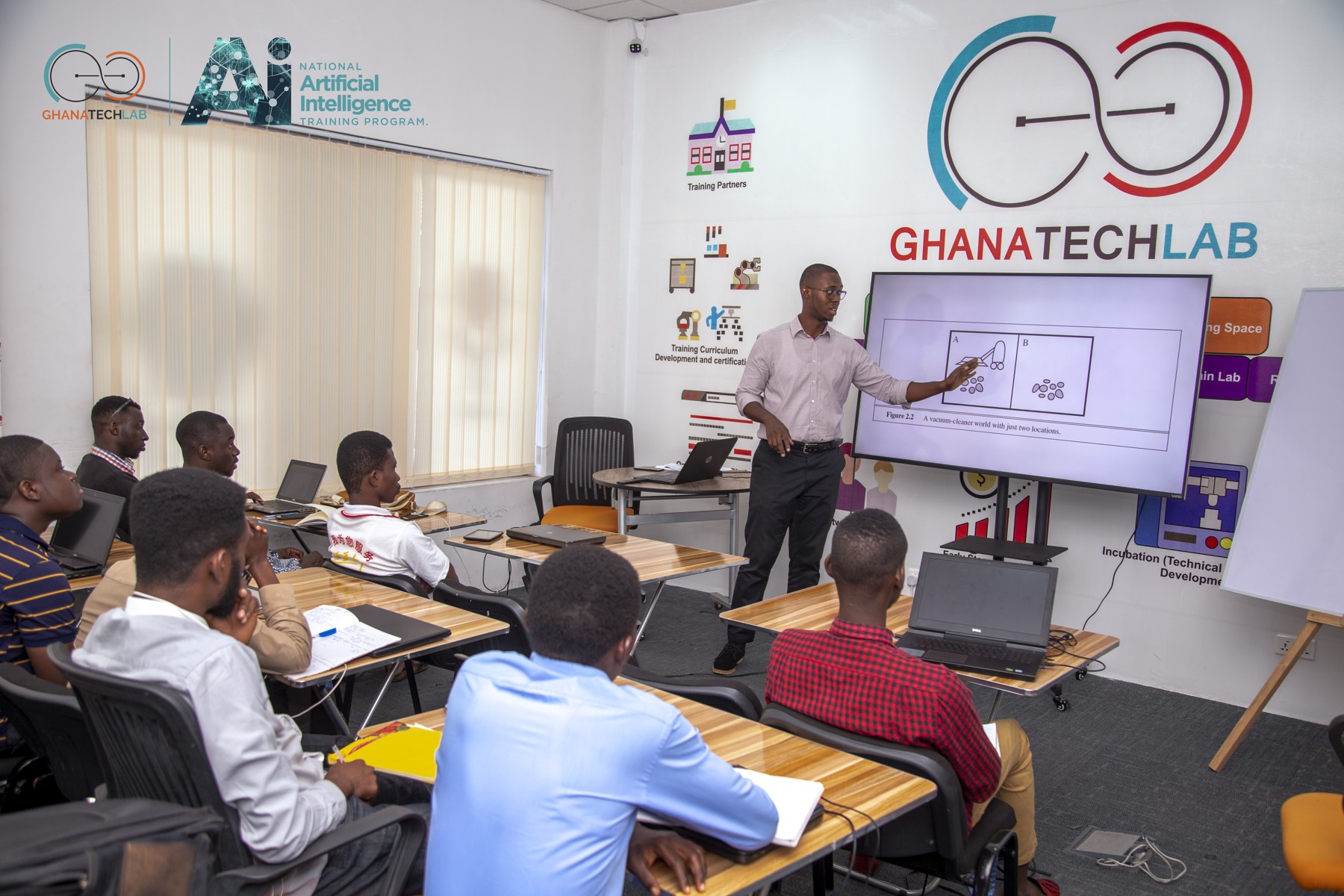
Diana Adikie Ayitevie went to Ghana Tech Lab to study artificial intelligence. During the incubation programme that followed, she met Adjoa Kakra Kuwornu. The two became co-founders of FondoTech, a platform connecting startups and small businesses with investors, with particular attention to women entrepreneurs. The useful thing she took away from the classroom was another person.
Ayitevie’s account, published by the Sababa Development Center, describes six weeks of AI training, then ten weeks of incubation. The pair finished as second runners-up at a national startup investment pitch summit. It is a modest, specific story about what a tech hub can do: bring people into the same room, give them something difficult to work on, and help a new partnership survive its first business questions.
That sequence explains Ghana Tech Lab better than the long list of technologies attached to its name. Based at the Accra Digital Centre, it works across digital education, entrepreneurship and employment. Its public offer includes training, prototyping space, mentors and selective startup support. The intended destination might be a business. It might also be a job.

The next step is built into the course
Founded in 2018, the lab emerged from Ghana’s eTransform initiative, implemented by Kumasi Hive and Innohub with government and World Bank support. Jorge Appiah, also a co-founder of Kumasi Hive, is identified as a GTL founder in his Global Innovation Gathering biography. His background includes electrical and electronic engineering, business administration and renewable energy. The combination fits an organisation concerned with both making things and making them viable.
On the lab’s homepage, the flagship Base Program is described as one month of digital training followed by two months of intensive incubation for selected trainees. Individual cohorts have used different schedules. The important feature is the selection point: finishing a course does not automatically turn somebody into a funded founder.
Archived web-development training for people aged 18 to 35 covered full-stack development, user experience and interface design, backend work, and an introduction to mobile development using React Native. These are skills someone can use to build an interface, connect it to a working service and begin testing a product. They also have uses inside an existing employer.
Programme design, not a guarantee of admission, funding or a job.
In a 2019 interview, co-founder Price Sarfo described startup funding, coaching and industry exposure for incubated teams, alongside internships for other trainees. That second route deserves attention. A training provider can become so enthusiastic about entrepreneurship that everybody is encouraged to pitch a company. GTL’s design leaves room for someone who would prefer to become a capable employee.
A classroom does not have to be in Accra
By October 2019, GTL was working with 11 partner hubs in nine Ghanaian regions. Sarfo described conversations with industry and local stakeholders to establish which skills were missing, then design programmes around those gaps. The curriculum began with a question asked outside the classroom.
Regional partner Node Eight’s project history makes that arrangement tangible. It records GTL collaborations in AI training, web development, mobile applications, digital media and incubation. Its account of the incubation work includes empathy, ideation, prototypes and business models, followed by presentations at the Ghana Startup Summit. The practical rhythm runs from understanding a problem to showing something that might solve it.
The range also resists the assumption that every digital career requires the same coding course. A 2022 manufacturing-training announcement included 3D modelling, fabrication, welding, woodwork, laser cutting and electronics. There is something refreshing about a technology curriculum with room for a saw. A product may need a physical enclosure, a working circuit or a fabricated part before it needs a launch announcement.
For a learner, the regional model can bring instruction closer to home. For another organisation trying to copy it, the lesson is concrete: find credible local delivery partners and give them a defined role. An impressive central facility cannot, on its own, make attendance convenient for someone living hundreds of kilometres away.
Free tuition still has a bill
The lab promotes free digital skills training. Applicants should nevertheless read the terms of their particular cohort: its Cohort 7 application form specifies a GH¢50 registration payment after the interview and selection stage. That is a registration charge attached to that form, not a published price for every GTL programme.
Behind the tuition offer sits institutional money. An October 2019 report put the lab’s initial World Bank financing at US$1.2 million. That figure describes support for establishing the initiative. A historical investment guide separately listed typical startup grants of GH¢10,000 to GH¢15,000. The budget for running the lab and the money a young business receives are different pots.
Reported in 2019
Investment guide published in 2020
Listed on the application form
The business model is therefore best understood as supported programme delivery. Public and development partners help pay for training and enterprise support; learners and founders receive the service. Those beneficiaries are not necessarily the people financing it. For prospective partners, the attraction is an existing route to young people and early-stage businesses, rather than the need to build a new delivery organisation.
The World Bank’s December 2024 completion report makes the financial tension plain. Its assessment of the supported hubs says modest coworking charges would not cover effective operation, while many intended trainees could not afford the full cost of instruction. Keeping access affordable requires somebody to keep paying for trainers, equipment and the space itself.
The lab coat comes with a business plan
GTL’s specialist programmes move beyond beginner instruction. In 2020, it launched the Africa AI Accelerator with GIZ and IBM. Eleven startups from Ghana, South Africa, Rwanda and Uganda were selected for the first cohort. The programme combined technical mentoring with business-development help and virtual and physical participation.
The accelerator’s own description sought teams beyond the idea stage, with market relevance and early traction. Its planned outputs included a business-model report and a strategic growth plan, with check-ins involving technical mentors and business consultants. That is a useful distinction for applicants: an accelerator expects something to accelerate. A promising concept and a functioning young business need different kinds of help.
A joint health-tech call with Villgro Africa applied a more specific filter: women-led businesses in healthcare with a minimum viable product. The original offer targeted five startups and a combined US$50,000 funding pool, alongside incubation, investment readiness and mentorship. GTL’s description added product development, operations, governance and regulatory affairs to the support. The cheque was one part of the package.
That breadth places the lab among Ghana’s overlapping training and startup-support organisations. MEST offers another route into technology entrepreneurship; Ghana Innovation Hub also supports business development. UNICEF StartUp Lab serves eligible social-impact ventures. GTL’s distinctive combination is its regional training network, practical facilities and several entry points, from a first technical course to specialist acceleration.
“Stories are our trademark.”
Ghana Tech Lab’s description of its work
The line captures its public culture: making a founder’s progress understandable is part of the programme. Alongside that storytelling, the Ghana Mentorship Network offers business guidance and startup performance support. A founder needs opportunities to explain the company, but also someone willing to examine the explanation.
The doors that remain hard to open
Access involves more than the tuition line. Research ICT Africa’s 2021 case study of the AI accelerator noted that eligibility requirements could favour people with education, resources and an existing venture. It also documented questions around transport costs, attendance commitments and regional availability in responses to GTL programmes. Free instruction can still be difficult to reach.
The same analysis found men accounted for roughly 68 percent of identified founding partners in the first AI accelerator cohort. Recruiting women and achieving equal participation are separate tasks. A programme designed for experienced teams cannot be assumed to serve a beginner with little equipment or time. The entry requirements help explain both who benefits and who remains outside.
Jobs attributed to Ghana Tech Lab in the eTransform completion report.
There is a substantial result on record: the World Bank’s 2024 completion report attributes 1,939 jobs to GTL, including 875 for women. Those are reported project outcomes. They do not turn a course application into a promise of employment.
A later procurement record adds a reason to distinguish planned spending from delivered support. A May 2025 World Bank revision lists a proposed US$2.6 million GTL digital-skills training activity as canceled, with zero in the actual-amount column. The entry concerns that procurement activity; it does not establish that the lab itself stopped operating.
Build the handoff, then build the business
The part worth borrowing is the connection between stages. Ask local employers and communities what they need. Teach a relevant skill. Give promising teams room to test a product and its business model. Keep an employment route available. Bring mentors into the period when an idea becomes a set of decisions about customers, costs and delivery.
That design depends on dependable funding, competent partners and participants who can actually attend. It also needs customers or employers at the far end. A demonstration can show that something works; only use in the world can show that it is useful. Ayitevie’s account gives the process a human scale: a course led to a meeting, a partnership and a company. The next business may begin with the person at the neighbouring laptop.
Find your next classroom
Explore programmes and ask about the next intake.