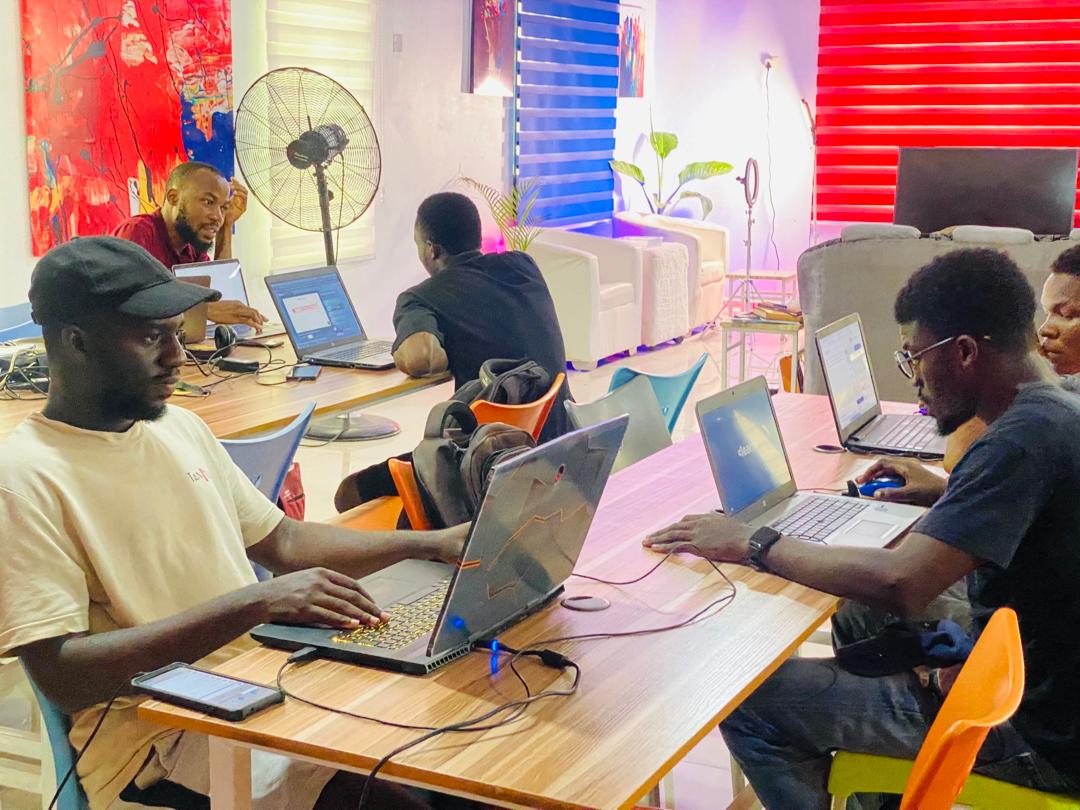
The laptops are open, the extension leads are busy and the chairs refuse to match. In a photograph of The Growth Hub’s Akure workspace, orange and blue seats gather around long wooden tables. Red blinds compete with a bright mural. It looks like somewhere people have come to get things done. That is the company’s first sale: a usable place to work. The more ambitious sale is what might happen while you are there.
The Growth Hub combines coworking with digital skills training, creative studios, events and support for small businesses. A freelancer can rent a desk. A beginner can study web development or design. A founder can find a business program. These are different purchases, but they share a practical concern: getting from an intention to something another person can use, hire or pay for.
That concern runs through the business’s history. Founder Victor Adeoluwa Olatunde also founded SalesPlat, whose work includes sales talent and training. The Growth Hub emerged from plans to give that work a physical base. By July 2026, it was announcing an iHatch startup residency in Alagbaka, another part of Akure. What began as an operational need had become a broader local service.
A remote business wanted a room
In a 2023 LinkedIn account shared by the hub, Olatunde described preparing a space for SalesPlat’s content production and revenue-talent training. The requirements grew as he considered who would use it: employees, media crews, content specialists and facilitators. Those demands pushed him to expand the idea into a shared hub.
The proposed facilities were specific: offices, a small conference room, external coworking, a video and audio studio, a training hall and a lounge. Solar power was part of the plan. This was a physical extension of a business that had been operating remotely, with facilities useful to people beyond its own team.
The company’s competition page describes The Growth Hub as self-funded. Olatunde later dated the first hub’s opening to September 2023. The origin helps explain the mix of services. Training needs somewhere to teach; content production needs somewhere to record; businesses need somewhere to meet. Opening those facilities to outsiders gave the project more than one kind of customer.
“drew us into making the space a hub”
Victor Adeoluwa Olatunde, on expanding the SalesPlat workspace plan
There is a useful idea here for other operators. Start by understanding a recurring need in your own work. Then ask which parts of the solution other people could use. In this case, the shared resource was a building and its facilities. Whether that approach pays depends on local demand and delivery, but the starting point is refreshingly concrete.
The workday has a price tag
The published coworking menu makes the first transaction easy to understand. General space is listed at ₦3,000 a day; private space at ₦5,000. Both advertise power and internet, with privacy added to the latter. A conference space is offered by the hour. Customers can also buy weekly or monthly access.
The choice is partly about how someone works. A freelancer may want company around them. A person handling calls may care more about separation. An occasional team meeting needs a different booking again. Selling these separately lets customers choose the part of the facility that matches their immediate task.
The business model has similarly distinct parts: paid space, paid teaching and creative facilities, alongside sponsored business-support activity. Its financial logic is easy to see. Someone who arrives for one reason may discover another service worth using. That is an opportunity for the operator, provided the shared environment remains useful to people with different schedules and expectations.
The classroom is selling practice
The training offer stretches across web development, data analytics, graphic design, UI/UX, cybersecurity, artificial intelligence and machine learning. Several individual course pages list a ₦200,000 fee with payment in three installments. The intended audience includes beginners, graduates, university students and people changing careers.
Each subject offers a different entry point. The web-development pitch uses familiar customers such as schools and small businesses that need websites. Data analytics concerns turning information into decisions. Graphic design centers on visual communication and brand identities, while UI/UX deals with how people experience and navigate products. A prospective learner has reasons to choose among them beyond whichever job title sounds fashionable.
A more revealing teaching detail comes from UI/UX tutor Adaikem Ajufo. In a public account of summer training at the hub, Ajufo described starting with user experience before moving to interface design: understanding people, identifying problems, researching needs and applying those ideas. Software tools came later in that sequence.
That order matters. A polished screen can still be confusing to use. Learning to ask what someone needs gives a student a way to judge their own design. For readers comparing courses, this is a useful question to copy: what will I learn to notice before I learn which button to press?
The hub also advertises a two-month, fully online Virtual Assistant & Freelancing Program at ₦100,000, with live classes, replays and payment plans. Its topics include inboxes, calendars, projects and freelance-platform profiles. This expands the audience to people interested in administrative and client-service work, while allowing a learner to participate without renting a desk in Akure.
A studio belongs in this picture
Creative facilities were part of the original plan, and the studio offer still targets photographers, videographers, podcasters and other content creators. The connection to training is straightforward: a lesson may need recording, a business may need promotional material, and a creator may need a setting that differs from their ordinary workspace.
Placing those activities within the same business creates useful possibilities. A designer and a photographer can serve the same client in different ways. A trainer may also make educational content. Those are potential relationships, rather than automatic results of sharing an address. The facility earns its place when it helps people complete the work they came to do.

Grants brought the business owners in
The Growth Accelerator Grant Competition gave the business-support offer a defined shape in 2024. Aimed at businesses in Ondo State, it advertised cash grants from ₦125,000 to ₦2 million for 10 winners. A larger group was to receive training and support, with investor-pitch access offered to selected participants. Its finale was scheduled for August 10 at FUTA’s 2,500-seat auditorium.
That structure addressed more than a cash shortage. Applicants needed a viable business plan and growth potential. Learning resources, registration assistance and access to digital tools featured in the wider advertised package. The proposed process asked entrepreneurs to prepare their businesses as well as enter a competition.
The awards were competitive, and the 2024 application page is closed. Its advertised benefits describe the program’s offer; a reader should treat them as such. They are useful for understanding how the hub approaches business support: combine practical preparation with access to people who may be able to finance the next step.
The company displays Sterling Bank, UAC Foods, Spurt, Tradeflow Africa and other organizations in a combined clients-and-partners list. Olatunde’s own biography also describes work with businesses on sales, growth and fundraising. Together, those connections explain the commercial emphasis running through a company that can otherwise look, at first glance, like a place to plug in a laptop.
The community shows up on a calendar
A community is easier to assess when it has appointments. The hub’s first Fun Tech and Biz Akure event was scheduled for November 11, 2023, with subjects including funding, branding, data analytics and opportunities for women in technology. Games were part of the invitation. The agenda made room for both serious business and reasons to stay after the talking stopped.
Other organizers have used the venue. Flutter Akure lists a November 18, 2023 gathering at The Growth Hub with 32 attendees. BOB’s Hybrid & Chill series named it for a June 2025 Akure meetup. A Team1 developer workshop listing describes practical Avalanche sessions, including creating an L1 and an NFT collection. These are different technical communities choosing a common meeting place.
That gives the hub a role within an existing local market. Akure Tech Hub is another coworking and innovation option in the city. Online courses, home offices and standalone studios offer alternatives for individual needs. The Growth Hub’s proposition is the combination, especially its link between learning, workspace and business development. The right choice depends on which of those a customer will actually use.
Alagbaka opens another chapter
In April 2026, reporting on iHatch Cohort 5 named The Growth Hub as the selected hub for Ondo State. The national program’s structure placed a hub in each state and the Federal Capital Territory. In July, the company announced a physical residency at its Alagbaka location, focused on business models, mentoring and investment readiness.
The move gives its local activity a connection to a wider incubation effort. Current company promotions name both Akad and Alagbaka and include children’s summer and weekend technology programs. The customer base the hub is trying to reach now spans first lessons, working professionals and founders preparing a business.
Making those groups share a business requires care. Quiet work, teaching, recording and events have different needs. Learners also need time to practice and money to cover tuition; founders must do the work that a program asks of them. The appealing part of The Growth Hub is that it puts practical resources within reach of those ambitions. Its everyday test is whether the next person through the door can use them.
Find your way into the hub
Explore the facilities, current programs and community channels.