The assignment was unusually concrete for a startup program: make agricultural training easier to understand. By May 2024, five young companies had emerged from Qesbeqes, an initiative executed by xHub Addis with Ethiopian agriculture institutions and GIZ. Their materials used animation, games and visual explanations. Their intended audience included agricultural development agents, the people who help farmers put technical knowledge to work.
There was homework outside the classroom, too. Project manager Rebecca Mulugeta described field trips that helped the teams understand their audience and adapt their content. That detail does more to explain xHub than a wall of startup slogans could. A lesson can look splendid on a laptop and still miss the person it is supposed to help.
The five platforms were Enkoy, I Learn Ethiopia, Ebrana, Be’and and Senq. GIZ reported that the six-month effort equipped 25 young professionals with business skills and produced more than 20 digital training modules. Qesbeqes means “slowly” in Amharic. For an incubation project, it is a rather refreshing name: permission to learn before declaring victory.
A leadership school’s startup experiment
xHub grew out of the Center for African Leadership Studies, or CALS, founded by Tewodros Tadesse Araya in 2012. The hub followed in 2014. Its intellectual starting point was leadership education adapted to an African setting: how people make decisions, work together and take responsibility. Entrepreneurship gave that work a place to meet customers, costs and deadlines.
Early coverage was modest in a useful way. In November 2014, Disrupt Africa reported two registered entrepreneurs, with up to 60 people working from the space. One entrepreneur was developing a health service using SMS. Another was working on a subscription website for abstracts of economics and financial journals. Those were specific attempts to make information useful and accessible.
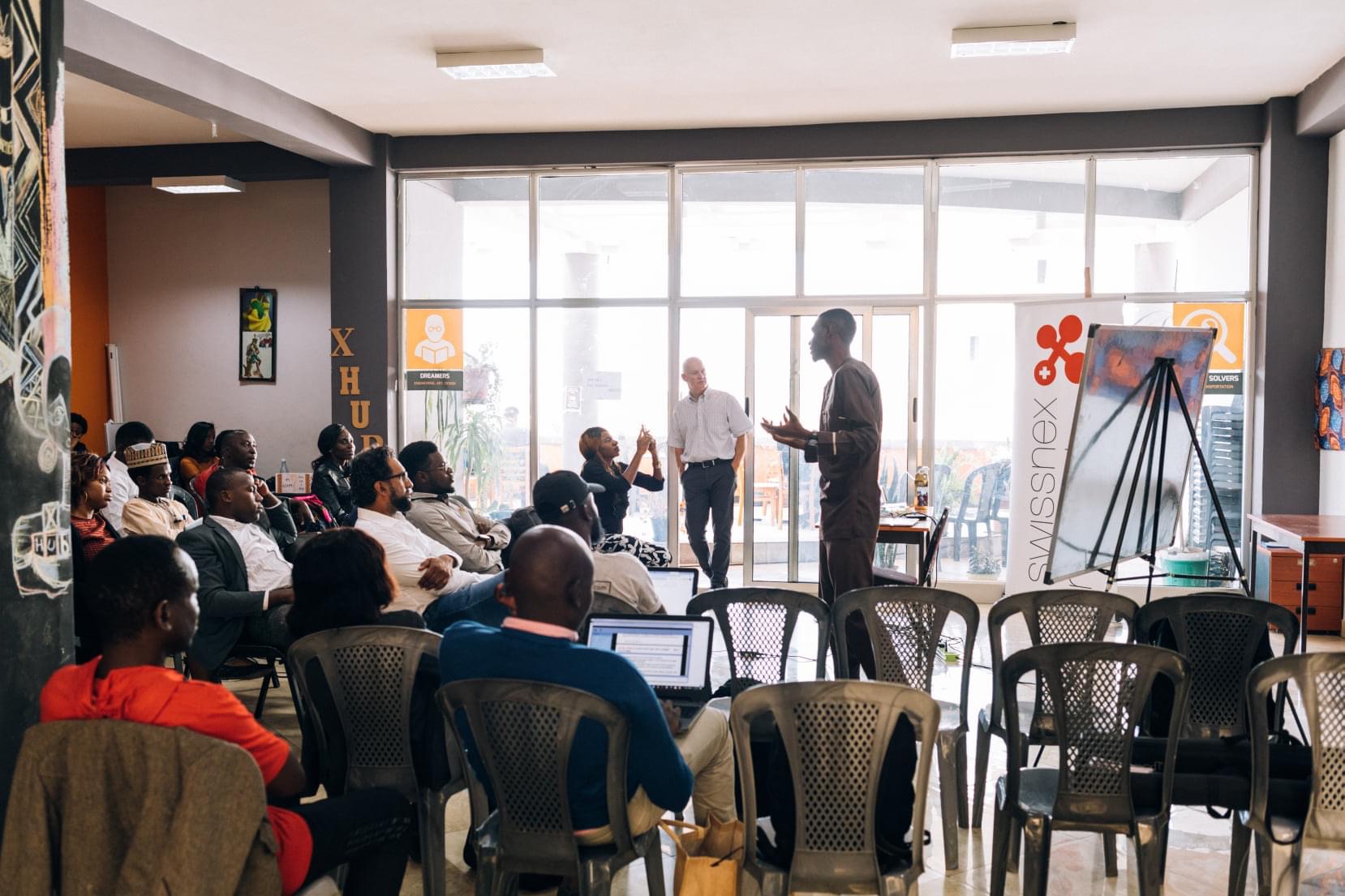
Today, xHub’s website describes more than 100 enterprises incubated and accelerated across several sectors. Its services include workspace, startup training, coaching, business and legal clinics, networking, and connections to investors and grants. The emphasis on leadership persists. Building a product requires a team capable of agreeing what to build, who needs it and how to pay for the work.
“The leaders Africa needs most are those already forged by difficulty.”
Tewodros Tadesse Araya · CALS founder
The organization’s explanation of its name adds a small joke about schoolwork. An x can mark a wrong answer. Here, it also stands for an unknown quantity and room for imagination. xHub uses it to express acceptance of failure during learning. That is a stated philosophy; the more revealing test is how a program lets people investigate an idea.
Seventeen places, four months, $5,000 apiece
AHUN offers a clear view of the mechanics. A campaign launched in April 2021 by Ethiopia’s Jobs Creation Commission and UNDP, working with CALS/xHub Addis, attracted 755 applications. Seventeen entrepreneurs entered four months of incubation. UNDP subsequently awarded each winner $5,000 in seed funding. That puts the documented awards at $85,000 in total.
About 2.3% selected. Historical cohort figures; selection is not a measure of business survival.
The package covered business models, leadership, finance, marketing, communication and legal services. Participants visited entrepreneurs in related sectors and practiced pitching. The structure put learning, exposure and money in sequence: preparation first, followed by seed support. For a founder, that can make a grant easier to deploy with a purpose.
The $85,000 was money awarded to participating businesses. It should be read separately from the expense of running the program. Coaching time, administration and facilities belong to a different calculation. This distinction matters when copying an accelerator: the cheque handed to a founder is only one component of the support that founder receives.
The selectivity also sets expectations. AHUN was a bounded cohort with a particular brief and limited places. Its figures describe that 2021 exercise. A prospective applicant needs to read the terms of the specific program available to them, including its schedule, eligibility and any financial support.
The curriculum follows the problem
Warka brought another brief: ventures addressing climate issues, among other areas in its published call. Developed with the British Embassy, it combined incubation and business development with coaching and opportunities to seek support. The embassy later highlighted ten startups trained for three months. xHub also described an investor-pitching event for Warka II at the embassy.
The attraction of that structure is easy to see. A climate founder needs people who understand the problem as well as the presentation. An investor event can expose a business proposition to questions about its customers and practicality. The public record documents opportunities to pitch; a founder still has to persuade someone to commit.
Lemat, xHub’s agricultural business program, makes another useful distinction. Published calls separated a Starter track for 20 early-stage startups from a Catalyzer track for ten micro, small and medium enterprises. The advertised training commitments were five days and twelve days respectively. Those are training durations, rather than a universal timetable for building a company.
20 idea-stage startups
5 days of training
10 MSMEs
12 days of training
Separating stages is worth copying. Someone investigating an idea and someone managing an existing enterprise face different decisions. Combining them indiscriminately risks making the same lesson too abstract for one and too basic for the other. Lemat’s published design acknowledges that difference before the training begins.
Qesbeqes takes the sector logic further by attaching an actual production task. The output was digital agricultural learning material. The teams had a defined audience to investigate and content to deliver. On that evidence, xHub’s distinctive contribution is its ability to connect entrepreneurship instruction with an institution’s practical assignment.
Who is buying, and who is learning?
xHub serves several groups whose roles can overlap. Entrepreneurs use its incubation and coaching. Professionals and prospective mentors use training. Development organizations and public institutions collaborate on programs aimed at employment, innovation or service delivery. A participant can benefit from a program paid for or supported by an institutional partner.
This makes xHub understandable as a service business and program operator. Its offer includes people’s time, structured learning, access to a workplace and introductions. The public training menu covers marketing, finance, management, digital skills and business law. These are recognizable operating needs, including for founders whose businesses have little to do with writing software.
There are paid events, too. One historical announcement for an Entrepreneurship Mindset Session on mental health and entrepreneurship advertised admission at 500 Ethiopian birr. That is a price for that particular event. It illustrates a direct transaction alongside the partner-backed work, without turning one ticket into a general price list.

Within Ethiopia’s support market, founders can also encounter iceaddis, Orbit Innovation Hub, GrowthAfrica and Reach for Change. JICA’s ecosystem mapping places such organizations in a wider field of incubators and accelerators. xHub’s CALS connection and documented sector programs give applicants specific reasons to consider it. The sensible comparison is the fit between a founder’s needs and a program’s actual offer.
That comparison should begin with the work a founder needs to do next. A first customer interview, a more credible financial plan and an introduction to a sector partner require different kinds of help. Naming that need makes a conversation with a mentor considerably more productive.
The mentors have homework, too
One of xHub’s more interesting reported numbers concerns the advisers. Its account of the May 2021 Young Africa Works graduation lists 137 business mentors alongside 20 startup enterprises. Developing a pool of people able to coach businesses was part of the project. That is a useful complement to training the people who receive the advice.
The community events widen the circle. xHub describes its Entrepreneurship Mindset Sessions as recurring conversations involving students, business owners, professionals and government officials. Its event page says sessions moved to Sheraton Addis from late 2021 to accommodate a wider audience. The format gives founders a way to encounter experience outside their own company.
The calendar has also included broader professional opportunities. In September 2025, the official channel advertised a Chevening scholarship information session at xHub. It had previously promoted a December 2024 entrepreneurship conversation featuring Tewodros. These announcements show a community role extending beyond the start and finish dates of a single incubation cohort.
Take the field trip seriously
For someone considering xHub, the next step is practical. Its published FAQ distinguishes individual incubation enquiries from group programs recruited through calls. Individual applicants are directed to contact the hub for an application form. Group applicants need to follow announcements and meet that cohort’s criteria. Choosing a program begins with understanding its assignment.
The lesson other founders can borrow is visible in Qesbeqes: put the audience close to the work. Meet the people expected to use a product, learn where they struggle and adapt the material accordingly. A field trip earns its place in a startup budget when it changes a design decision. Attendance by itself is a weak substitute.
That approach depends on access to users and a team willing to revise its assumptions. Coaching and introductions can help, but a business still needs a workable route to customers and income. For an education product, producing a module is an intermediate achievement; getting someone to understand and use it is the next test.
The five Qesbeqes startups leave xHub’s proposition unusually easy to picture. Young teams worked on agricultural lessons, learned business skills and went out to understand their audience. The useful question to carry away is simple enough for any founder’s notebook: who needs this, and what happened when they tried it?
Follow the work
Explore xHub Addis, its incubation programs and application guidance. Keep up with announcements on LinkedIn, X, Instagram, Facebook and Telegram.
Read the agricultural education story or UNDP’s AHUN update. Watch Asham TV’s xHub feature in Amharic ↗.