The blackboard behind Tewodros Tadesse Araya is having a busy day. There are drawings, a map of Africa, fragments of advice and several competing invitations to think differently. In a photograph taken at xHub Addis in May 2022, he stands second from the left among colleagues and visiting partners. Everyone has found room in the frame. The wall, apparently, has reached capacity.
It is a useful picture of his work. Tewodros, also known as Teddy, founded the Center for African Leadership Studies, or CALS, and the business incubator xHub Addis. Around those organisations, people arrive with different kinds of knowledge, authority and money. The practical question is what they can help someone else do. A group photograph is the easy part. Getting the group to be useful takes longer.
A family lesson, given a name
His early example was his mother. After Ethiopia’s Derg regime imprisoned his father in the 1980s, she raised six children through famine and war. A sermon he heard in 2000 helped him give that experience a name: leadership. CALS followed in 2012.
The sequence gives his institutional work a personal starting point. Responsibility existed before the vocabulary for it. The task became recognising that capacity and helping it develop.
At CALS, he has designed and facilitated training for government offices, nongovernmental organisations and private businesses. Servant leadership is central to his stated approach. The emphasis puts an obligation on the person with authority: other people’s ability to work matters. For a trainer, that is a demanding proposition. A persuasive talk may earn applause; whether a team makes better decisions is a more patient test.
“The leaders Africa needs most are those already forged by difficulty.”
Tewodros Tadesse Araya
A small beginning, with an x to solve
When xHub launched in 2014, its reported beginnings were modest: two registered entrepreneurs, with up to 60 people working from the space. One project concerned a subscription service for abstracts of economics and financial journals. Manager Kibrom Tadesse described a city with scattered software talent and a need to bring people together.
The x in the name referred to an unknown, a puzzle awaiting an answer. It is a sensible mascot for a new business. A founder can be remarkably certain about the solution while still negotiating with the question.
The early programme included sessions on leadership, marketing, business plans and presentation. The arrangement brought several kinds of learning under one roof. Someone might need help explaining a product, finding a collaborator or deciding what to charge. The hub’s stated role included connecting entrepreneurs and investors. Its usefulness would depend on what passed between the people who came through the door.
Desire needs a diary
In a January 2021 episode of The Entrepreneurs, Tewodros discussed three ingredients for entrepreneurship: desire, vision and habit. The episode also addressed his wish to create an environment that helps people pursue their dreams.
Habit is the wonderfully inconvenient item on that list. Desire can flourish during a conversation. Vision can look excellent on a slide. Habit requires another appointment with the work, including on days when the original excitement has left early.
There is a useful connection here with coaching. A person can understand an idea and still need a structure for acting on it. An environment supplies reminders, other people and occasions to try again. For an entrepreneur, the routine might involve listening more closely, checking a cost or returning to an unresolved question. The interest in Tewodros’s formulation is how ordinary its final ingredient sounds. Anyone can admire a vision. A habit asks for time on the calendar.
His own formal study continued alongside the institutional work. He completed a Master of Letters at Omega Graduate School in 2023, continuing his own education while building an organisation devoted to other people’s development. There is a pleasing fit between the educator and the student sharing a name. Running a place that helps other people learn leaves the founder with a question of his own: what will he keep learning? A qualification records one part of that process. The organisations he runs provide another, with colleagues, participants and partners continually bringing problems that will require a fresh answer.
The mentors had homework, too
A 2021 Young Africa Works graduation made the support around the entrepreneur visible. The programme, involving the Mastercard Foundation, Ethiopia’s Jobs Creation Commission and CALS/xHub, included 20 startups and 137 business mentors. The mentors completed a mentorship programme designed by xHub. The startups pitched to potential investors, partners and government officials, and received $3,000 each from the Mastercard Foundation.
The mentor figure is revealing because advice is work with consequences. Experience in one business does not automatically explain another person’s problem. A mentor has to listen, judge what applies and recognise where a question would help more than an instruction.
Training the advisers gives the model another direction of travel. The entrepreneur develops, and so does the person offering support. It also spreads attention beyond the founder of the institution. A hub can bring people together more often when useful knowledge belongs to a community rather than remaining in one person’s diary.
Four months before the cheque
AHUN, another 2021 programme, supplied a different view of the machinery. A campaign launched in April attracted 755 applications. Seventeen entrepreneurs were selected for four months of incubation at xHub. UNDP subsequently provided $5,000 in seed funding to each winner.
The preparation included business models, leadership, finance, marketing, branding, communication and legal services. Participants also visited entrepreneurs in similar sectors and took part in networking and pitch sessions.
That order matters. A cheque arrives with possibilities; preparation helps a founder decide which possibility deserves money first. Talking with someone who runs a related business can make an assumption considerably less comfortable. Pitching can expose a sentence that sounds clear only to its author.
For Tewodros’s wider project, AHUN offered a place where leadership learning and business preparation could meet. The documented result was a cohort completing a programme and receiving seed support. The next decisions would belong to the businesses themselves.
- 755applications
- 17selected
- 4months
- $5,000per winner
Historical programme figures. Awards were provided by UNDP.
A photograph full of connections
The May 2022 visit brought xHub staff together with representatives of BIC Africa, BIC Ethiopia and GrowthAfrica. The discussions concerned challenges facing entrepreneurs and how incubators could help. BIC Africa also described its role in building connections with European initiatives and markets.
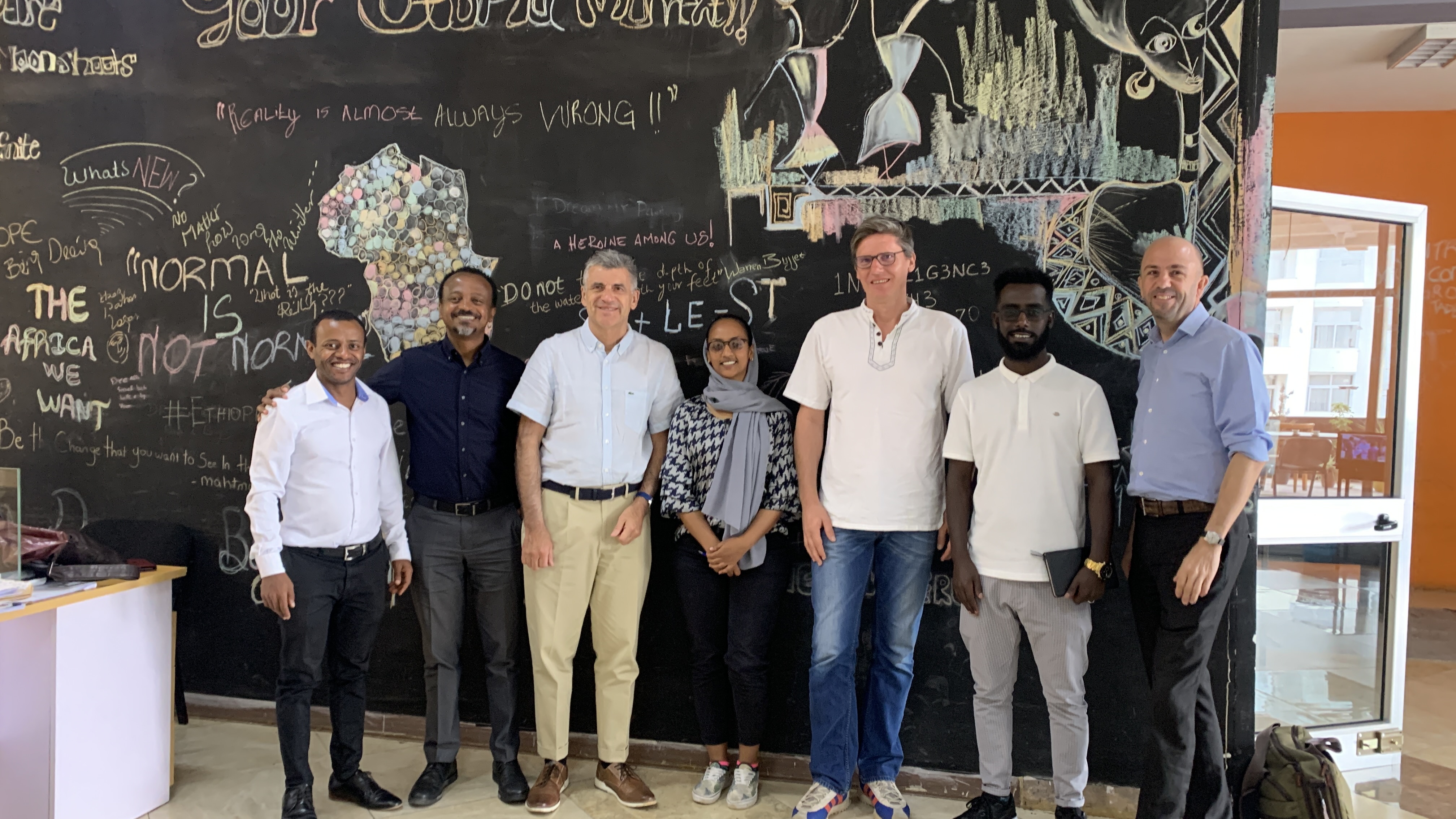
The photograph makes the word network unusually concrete. There are people from several organisations, standing in the same room. Each connection still needs a purpose. An introduction can lead to a conversation; a conversation needs someone to follow through. The labour between those steps rarely gets its own photograph.
Tewodros also makes room for public business conversations. In October 2022, he invited the xHub community to an Entrepreneurship Mindsets Session at Sheraton Addis on growth, expansion and diversification. The subject list sounds like a pleasant problem until a business has to choose among them. Growth creates its own questions, and a room of people with different experience can be a useful place to start asking.
When the assignment gets a customer
By May 2024, the QesBeQes programme offered a practical example of incubation meeting delivery. At its closing event, Tewodros said five startups had been incubated and two had secured contracts with GIZ to digitise agricultural training modules.
Project manager Rebecca Mulugeta described tailored training and field trips intended to help the startups understand their audience. Enkoy cofounder Eyob Teklay reported a 1.3 million-birr contract and work on five modules using animated videos and pictures.
Audience awareness becomes a real constraint when someone must learn from the result. A team needs to consider what a picture explains, where an animation helps and what the user already understands. The customer supplies another discipline: delivery. For a business incubator, a contract is a particularly useful change of subject. The team has moved from describing what it could do to being responsible for doing it.
His work also carries a stated commitment to who gets an opportunity. CALS signed the Women’s Empowerment Principles in April 2021. In its accompanying statement, Tewodros supported equal rights, chances and resources, extending the commitment beyond the workplace. For a leadership organisation, that raises a practical question about participation: who enters the room, whose experience is taken seriously and who has the opportunity to take responsibility?
Keeping a place for the next founder
Tewodros has been candid about the difficulties of providing that support. Discussing entrepreneur support systems across Ethiopia and neighbouring countries in 2023-2024, he identified a tension between serving startups and meeting funder requirements. He also described fragmentation, the need for shared information and the cost of finding the right people.
“Sustainability is always a challenge.”
Tewodros Tadesse Araya · on sustaining startup support
His priorities included sustaining the hub, equipping it with resources such as testing computers and a maker space, and securing skilled staff. These are everyday institutional needs. They determine whether advice, access and opportunities will still be available when the next entrepreneur arrives.
That is where the work becomes quietly demanding. Supporting someone else’s ambition requires an organisation with time, people and a way to pay for both. Tewodros’s story continues in those decisions: what to teach, whom to bring into the room, and how to keep a useful place available. The blackboard can hold another idea. Someone still has to make room for the work.