Monty Montoya joined the organization that became SightLife in 1997, when making payroll was a problem. Before there could be any grand conversation about changing the world, somebody had to make the organization work. It is an unglamorous beginning for a founder’s story, which is part of its appeal. The first obstacle was familiar to anyone who has ever opened a small business’s accounts and wished, briefly, that arithmetic were negotiable.
He would eventually lead SightLife, help establish its commercial offshoot, CorneaGen, and go on to found, run and advise other companies. But the useful starting point is that early financial difficulty. It put a practical question underneath the ambitions: how do you build an organization capable of paying for the work it wants to do?
Montoya’s career offers several answers. Hire people with skills you need. Give them a process that works. Find partners. Be willing to change the structure. These sound ordinary until an organization has to do them, when each acquires a surprising number of opponents, meetings and budget implications.
A mission still has to make payroll
The organization had been founded by regional Lions Clubs in 1969. For years it depended on charitable funding and volunteers. Montoya arrived almost three decades later, with the institution struggling financially. His task involved the machinery of running it: improving protocols, employing trained technicians and developing contracts with hospitals.
“We realized that if we didn’t start operating like a business, we were going to go out of business,” he said. There is little romance in that sentence. Its virtue is that it leaves everyone in the room with the same problem to solve.
The work took more than a decade. By 2011, SightLife had 96 employees and annual revenue above $14 million. Montoya had recruited former Starbucks executive Tim Schottman to lead an overseas program. There were partnerships in India, Nepal and Paraguay. The organization that had worried about payroll was learning to transfer its operating knowledge across borders.
The interesting achievement here is organizational. An institution built around local charitable effort developed a professional operation and international relationships. Those changes required people, contracts and repeatable ways of working. A mission statement could explain why the effort mattered; it could hardly negotiate every agreement itself.
Back to school, with a real problem
Montoya had a bachelor’s degree from Arizona State University. At Duke’s Fuqua School of Business, where he earned his MBA in 2003, he brought a decade of technical experience and a clear sense of the skills he still needed. Leadership, business and marketing would help him expand the organization.
That is a particularly practical way to arrive at business school. The case study is already waiting at work. Every discussion about growth has a possible destination outside the classroom, and every elegant theory must eventually meet a budget.
His relationship with Duke’s Center for the Advancement of Social Entrepreneurship continued after graduation. He participated in its programs as an alumnus and credited the center with helping him develop the knowledge and ambition to grow SightLife’s annual budget from $1 million to $45 million. Those figures describe an annual budget, a different measure from the revenue reported in 2011.
Business education also became part of his influence on others. Brian Wright, later an MBA student at the University of Washington’s Foster School of Business, named Montoya as the person who most influenced his decision to study business. Wright had associated MBAs with maximizing corporate profit. Watching Montoya use those skills in a nonprofit widened his understanding of what the degree could be for.
That is a quieter kind of professional legacy: another person notices how you work, then changes what they think is possible for themselves.
“It’s allowed me the inspiration and knowledge to grow SightLife’s annual budget from $1 million to $45 million.”
Monty Montoya · on his connection with CASE at Duke
The Post-it stage of ambition
In April 2015, SightLife brought its core team and representatives from two partner organizations to Duke’s Change Academy. Dan Heath led the program. The group used Post-it notes to map a complicated workflow and identify places it could improve.
There is something reassuring about that scene. An international organization with substantial ambitions was still putting pieces of paper on a wall. Sometimes the sophisticated thing is to make the sequence visible enough that people can disagree about the same step.
The workshop asked the team to settle on a measurable goal and a concrete plan. It makes a useful companion to Montoya’s financial turnaround: both episodes concern the distance between wanting something to happen and arranging the work so that it can.
It also gives a different picture of leadership from the founder alone at a lectern. Here the work belonged to a group, including outside partners. The task was shared, the process could be examined, and improvement depended on more than the executive’s conviction.
work visible
clear measure
the next steps
Changing the company’s shape
In 2016, SightLife created a commercial subsidiary, initially called SightLife Surgical and later known as CorneaGen. Flying L Partners provided capital. Montoya moved into a business that would pursue investment and commercial growth alongside the continuing nonprofit organization.
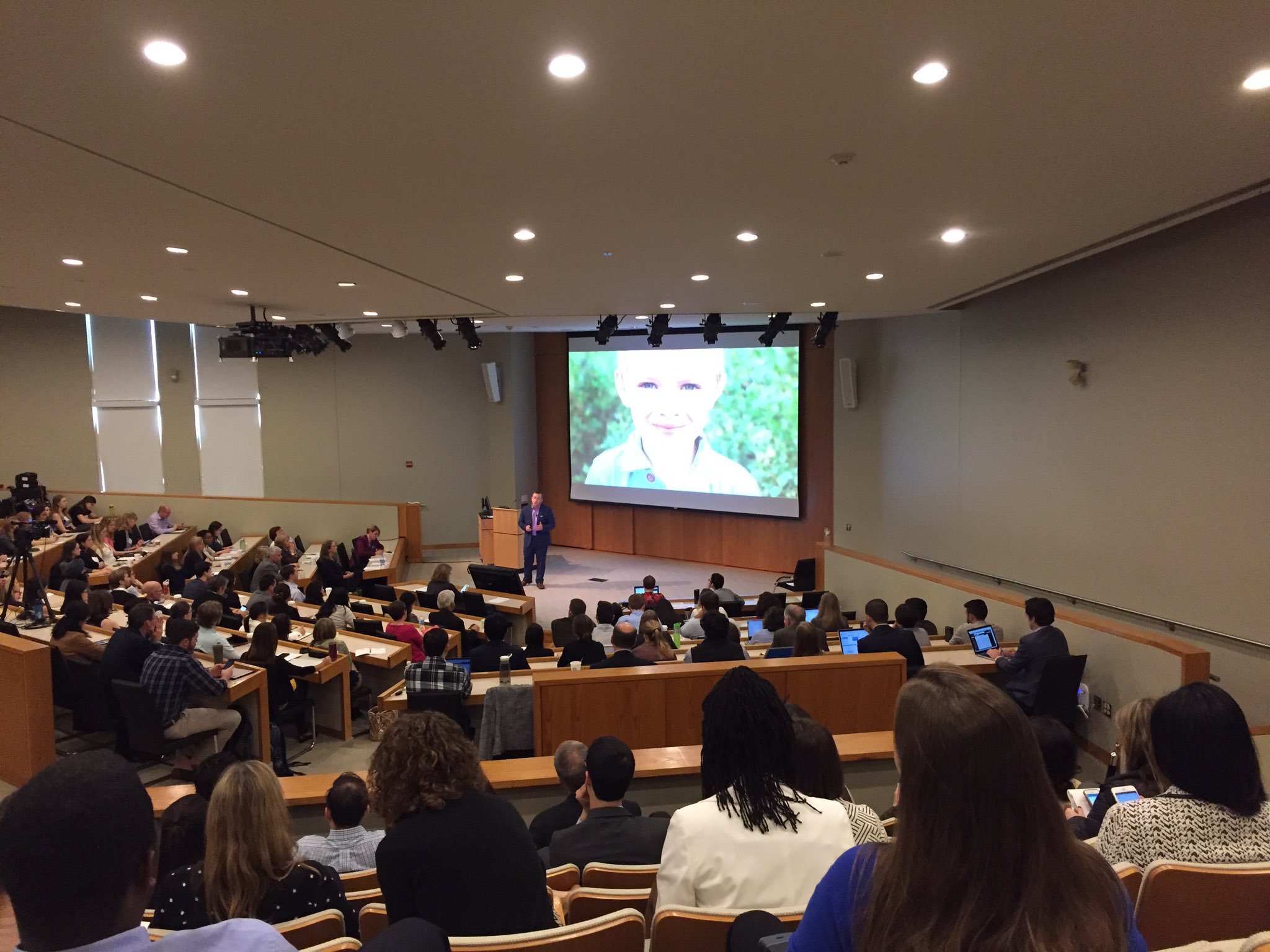
At Duke’s 2017 Sustainable Business and Social Impact Conference, he discussed the reasoning behind the hybrid structure. The subject was organizational design: what could a company do with access to investment, and how could that structure support the purpose that had brought its people together?
For someone who had spent years strengthening an existing institution, this was another kind of change. Improving the operation had been one answer. Creating a separate enterprise opened a different set of relationships with investors and business partners.
There was also a leadership handoff. In 2017, Claire Bonilla became SightLife’s CEO while Montoya focused on leading the commercial subsidiary. Bonilla had joined SightLife in 2015 after a long career at Microsoft. The board’s decision gave the two organizations separate chief executives and distinct responsibilities.
That detail matters to the story. Founding another enterprise can be described as expansion, but it also requires deciding who will lead the work already under way. In this case, the structure included another CEO with her own experience and remit.
Another table, another set of questions
CorneaGen raised $37 million in a Series B round in 2019. Montoya had led the company since its separation from SightLife. The financing placed a venture investment milestone alongside a career that had begun with a struggling nonprofit’s operating problems.
The titles changed again. He was a founder of Aurion Biotech. In July 2021, TherOptix appointed him CEO. By then, the announcement described three decades of experience and a history that included leadership of SightLife and CorneaGen.
Viewed together, these roles suggest a career built around institutions at different stages: an established organization needing a turnaround, a new commercial subsidiary, another founding role and an appointment to lead an early company. Each brings a different question about people, money and execution.
The recognition came from several directions, too. He received EY’s Pacific Northwest Entrepreneur of the Year award in the Life Sciences category in 2014. In 2019, he received OWL’s Visionary Award, which recognizes leadership advancing diversity. OWL also listed him among its mentors that year. The mentor role sits comfortably beside the more public awards: experience becomes useful when someone else can draw on it.
Permission to be unavailable
One of Montoya’s more memorable management proposals concerned vacation. In January 2022, he published his approach to “No Access Time Off”: remove work access during leave, arrange alternative contacts and return without a waiting backlog of vacation email.
He said he had followed the practice as a CEO for ten years. He also described requiring a sales employee to disconnect for a two-week honeymoon. The proposal was deliberately concrete. It depended on an actual change in access and on colleagues handling responsibilities while someone was away.
For an executive whose career involved building larger organizations, the idea raises an apt question: can the team operate when the leader is absent? An out-of-office message is easy to write. Giving other people the authority to deal with what arrives takes more preparation.
The work now travels through other people
Montoya’s public professional profile now centers on Monty4Sight in Kirkland, Washington, and lists executive coaching, team building, strategic planning and leadership development among his services. The emphasis extends the pattern of his earlier work: helping people organize themselves around something they intend to accomplish.
His professional life also includes board and advisory responsibilities. The Holland Foundation lists him on its board of directors. A 2026 conference appearance found him involved with SCOPE, Stableyz and Sofia Biologics, with responsibilities spanning non-executive, chief executive and operating roles.
There is a recognizable progression from the payroll problem to this collection of roles. Early on, he helped an organization become more capable. Later, he helped change its structure and led a separate company. Now, coaching and advisory work offer ways to put that experience into other teams’ decisions.
The story’s appeal lies in its practical details: a contract, a classroom, a wall of notes, a separate CEO, a colleague trusted to answer a question. Montoya’s career gives those details weight. Organizations are built through choices like these, long before their histories can be compressed into a founder’s biography.